Lakeside Roasted Red Pepper Hummus Wraps with Crunchy Chickpeas
Roasted pepper hummus, vegetables, and crunchy chickpeas make a sturdy vegetarian wrap for lakeside lunches and travel days.
Tools
Sheet pan, parchment, clean towels, food processor, silicone spatula, skillet or microwave, knife, cutting board, parchment wraps, foil, leakproof containers, cooler, ice packs
Ingredients · swaps in parentheses
Chickpeas, olive oil, cumin, smoked paprika, roasted red pepper, tahini, lemon, garlic, salt, black pepper, tortillas, spinach, carrots, cucumber, optional red cabbage
Magic
Dry chickpeas completely keep hummus thick use spinach as a barrier avoid overfilling roll tightly add crunch late.
Before you begin
Dry and roast chickpeas, make thick hummus, wash and dry spinach, cut vegetables into dry matchsticks, warm tortillas, and pre-chill cooler.
The parts that change whether this works tonight.
These fields come from the published recipe itself. If a recipe has not separately declared an operating fact, the gap stays visible instead of being filled with a guess.
- Servings
- 4 large wraps
- Timing
- About 1 hour 15 minutes
- Equipment
- Not separately declared
- Make-ahead
- Up to four days ahead: Make the hummus and refrigerate it. · Up to three days ahead: Roast chickpeas and store airtight only after they are completely cool.…
- Holding
- Not separately declared
- Leftovers
- Refrigerate hummus for up to four days and finished wraps for up to one day. Carry assembled wraps at 40°F or colder because they contain prepared hummus and…
- Dietary notes
- Not separately declared
- Method map
- 21 ingredient lines · 10 method steps
A good travel wrap needs contrast and structural integrity. This one gets both from thick roasted-red-pepper hummus, crisp vegetables, and chickpeas roasted until crunchy. The moisture barrier matters: spinach sits against the tortilla, hummus stays in the center, and the crunchy chickpeas remain separate until the last useful moment.
Use it for a lake day, roadside stop, or easy cabin lunch. For the outdoor side of the plan, visit Hook the Horizon.
Yield and timing
- Yield: 4 large wraps
- Prep: 25 minutes
- Roast: 25 to 30 minutes
- Cool: 20 minutes
- Total: About 1 hour 15 minutes
- Best service window: Within 4 hours of assembly
Ingredients
For the crunchy chickpeas
- 1 can chickpeas, 15 ounces, drained, rinsed, and dried thoroughly
- 1 tablespoon olive oil
- 1/2 teaspoon ground cumin
- 1/2 teaspoon smoked paprika
- 1/2 teaspoon kosher salt
- Black pepper
For the roasted-pepper hummus
- 1 can chickpeas, 15 ounces, drained and rinsed
- 1 large jarred roasted red pepper, drained and patted dry
- 2 tablespoons tahini
- 2 tablespoons fresh lemon juice
- 1 small garlic clove
- 2 tablespoons olive oil
- 1/2 teaspoon ground cumin
- 1/2 teaspoon kosher salt
- 2 to 4 tablespoons cold water
For assembly
- 4 large sturdy flour tortillas or wraps
- 2 cups baby spinach, washed and thoroughly dried
- 1 cup shredded carrots
- 1 cup cucumber cut into dry matchsticks
- 1/2 cup thinly sliced red cabbage, optional
- Freshly ground black pepper
Method
- Heat the oven: Set the oven to 425°F and line a sheet pan with parchment.
- Dry the chickpeas: Spread the first can of chickpeas on a clean towel and rub gently to remove surface moisture and loose skins.
- Roast: Toss with olive oil, cumin, smoked paprika, salt, and black pepper. Roast for 25 to 30 minutes, shaking the pan twice, until crisp outside and dry at the center.
- Cool completely: Leave the chickpeas uncovered on the pan. They crisp further as they cool.
- Make the hummus: Blend the second can of chickpeas, roasted pepper, tahini, lemon juice, garlic, olive oil, cumin, salt, and 2 tablespoons water. Add more water only until thick and spreadable.
- Warm the tortillas: Heat briefly in a dry skillet or microwave under a damp towel so they roll without cracking. Cool slightly before filling.
- Build the moisture barrier: Arrange spinach across the center of each tortilla, leaving a 2-inch border. Spread about 1/3 cup hummus over the spinach rather than directly against the tortilla.
- Add the vegetables: Divide carrots, cucumber, and optional cabbage among the wraps. Add black pepper.
- Add crunch: For immediate service, add crunchy chickpeas. For packed wraps, keep them separate and add when eating.
- Roll tightly: Fold the sides inward, pull the lower edge over the filling, and roll firmly. Wrap in parchment, then foil if additional structure is needed.
Slicing and plating
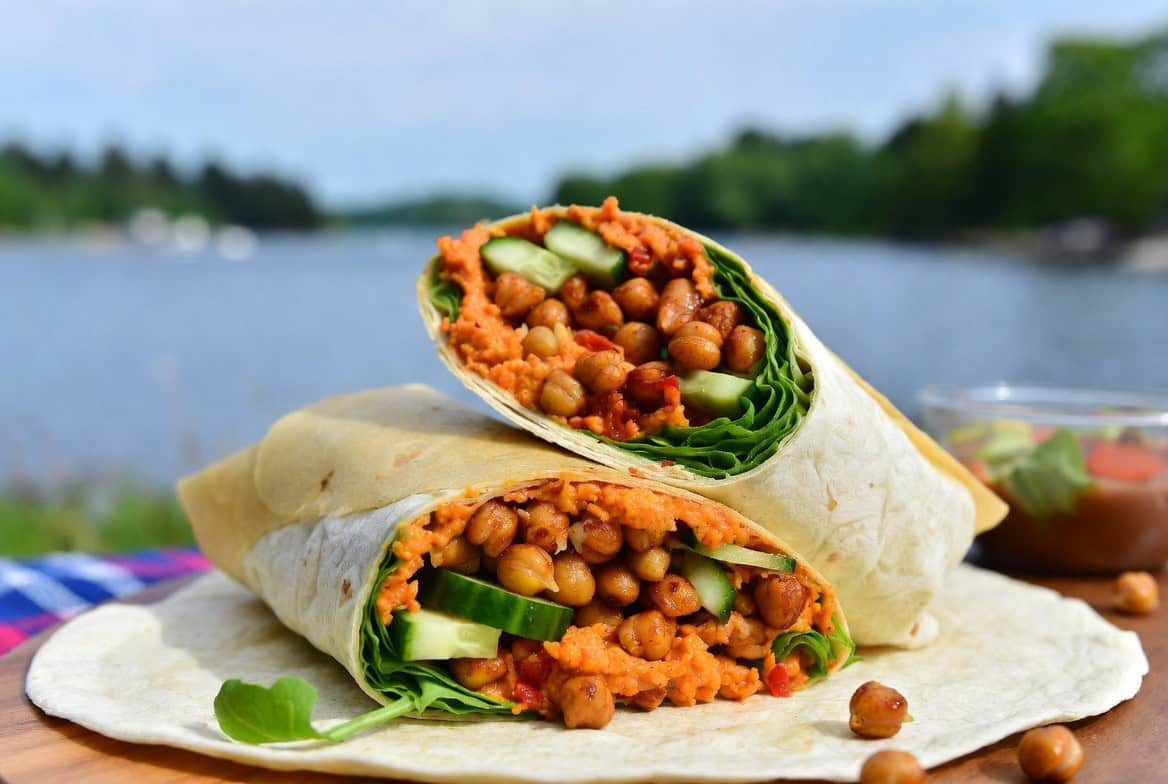
Cut one wrap diagonally to show the red-pepper hummus, spinach, carrot, cucumber, and chickpeas. The filling should look layered and crisp rather than compressed into paste. If you want chickpeas visible inside the wrap, use only half inside and scatter the remainder beside the cut wrap so the promise remains plausible without sacrificing all crunch.
Make-ahead and packing plan
Up to four days ahead: Make the hummus and refrigerate it.
Up to three days ahead: Roast chickpeas and store airtight only after they are completely cool.
One day ahead: Wash and dry spinach, shred carrots, and cut cucumber. Store each separately with dry paper towel.
Morning of service: Assemble wraps, omitting crunchy chickpeas until eating whenever possible. Keep at 40°F or colder.
Substitutions that work
- White-bean spread: Replace hummus with blended cannellini beans, lemon, garlic, and olive oil.
- Bell-pepper strips: Replace cucumber for less moisture.
- Romaine: Replaces spinach and provides a stronger moisture barrier.
- Gluten-free wraps: Warm thoroughly before rolling and choose a brand known to remain flexible.
- Feta: Add 1/2 cup crumbled feta when dairy is desired.
- Sunflower seeds: Replace crunchy chickpeas for a faster crisp element.
Likely failure points
The chickpeas remain soft: They were not dried, the pan was crowded, or they were sealed while warm. Dry thoroughly and cool uncovered.
The hummus is watery: The roasted pepper was not drained or too much water was added. Blend in more chickpeas or tahini.
The tortilla tears: It was cold, overfilled, or rolled without folding the sides first. Warm it and reduce the filling.
The wrap becomes soggy: Wet cucumber or hummus touched the tortilla directly. Dry vegetables and use spinach as a barrier.
The filling falls out: Vegetables were cut too large or the roll was loose. Use matchsticks and compress gently as you roll.
The wrap tastes flat: Add lemon, black pepper, or salt to the hummus before adding more filling.
Storage and food-safety limits
Refrigerate hummus for up to four days and finished wraps for up to one day. Carry assembled wraps at 40°F or colder because they contain prepared hummus and cut vegetables. Discard wraps left above 40°F for more than two hours, or one hour in temperatures above 90°F.
Kitchen Kit
Goods: Chickpeas, olive oil, cumin, smoked paprika, roasted red pepper, tahini, lemon, garlic, salt, black pepper, tortillas, spinach, carrots, cucumber, and optional red cabbage.
Gear: Sheet pan, parchment, clean towels, food processor, silicone spatula, skillet or microwave, knife, cutting board, parchment wraps, foil, leakproof containers, cooler, and ice packs.
Before: Dry and roast chickpeas, make thick hummus, wash and dry spinach, cut vegetables into dry matchsticks, warm tortillas, and pre-chill the cooler.
Magic: Dry chickpeas completely, keep hummus thick, use spinach as a moisture barrier, avoid overfilling, roll tightly, and add crunch at the last useful moment.
The final wrap should be creamy, crisp, bright, and structurally competent enough to reach lunch without becoming a hummus-related incident.
Part of Recipes & Technique.
Recipe provenance: Salty & Clever editorial formulation, built from established culinary technique and the traditions identified in the article. No chef, restaurant, family, or firsthand cultural provenance is claimed unless it is explicitly named and sourced. How we write and check recipes


