Tempeh and Plum Kale Salad with Buckwheat and Tamari Ginger
Tempeh roasted until the edges go dark, plums that slump but hold, and kale worked by hand until it stops fighting. Buckwheat gives it enough body to eat cold the next day.
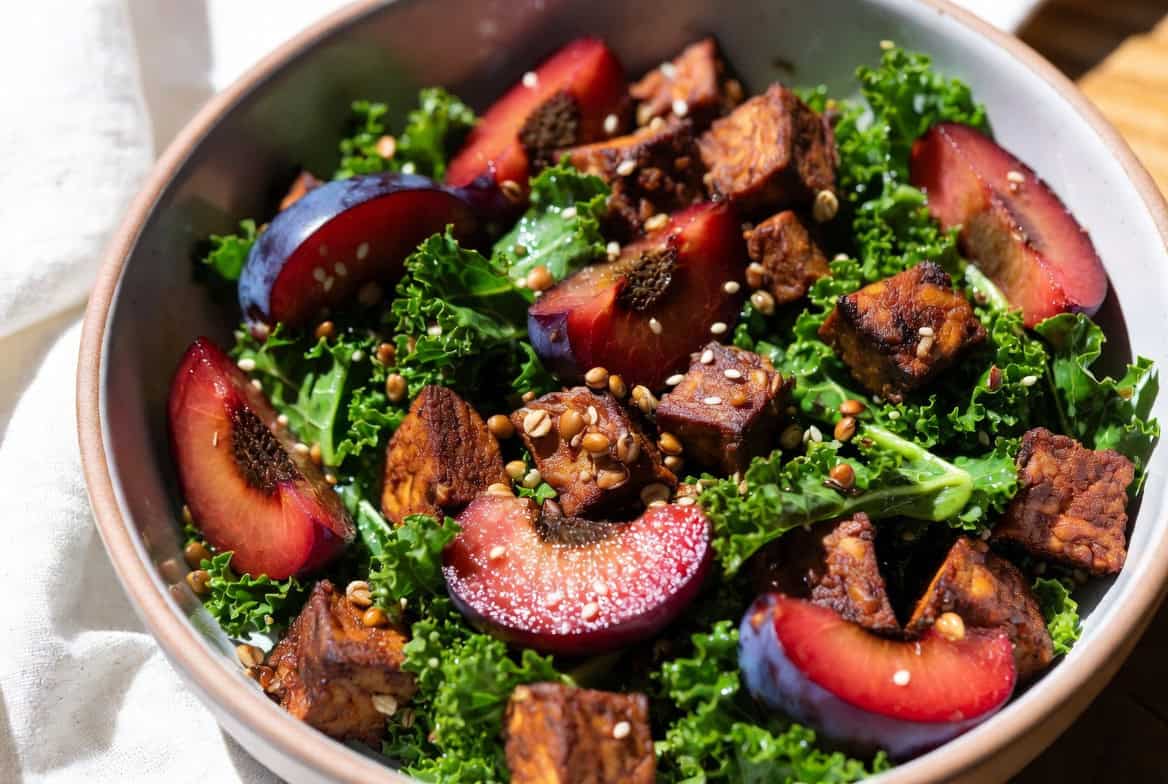
The parts that change whether this works tonight.
- Serves
- 4
- Time
- 40 minutes
- Equipment
- Two sheet pans, because the tempeh and the plums want different heat and different air, plus a rasp grater for the ginger and a…
- Holding
- This is the rare salad that improves in the refrigerator for a few hours
- Dietary
- Vegetarian
- The method
- 12 ingredients · 6 steps
From this recipe’s own yield and timing lines, Kitchen Kit, holding, packing, and the second day section and tags. Nothing here is a guess.
Pairing
Wine — A chilled Gamay, or a light Pinot Noir. Plums and tamari make this darker and more savory than a kale salad has any right to be, and a low-tannin red served cool meets it head on. Mixed drink — A whisky and soda with a wedge of lime. Tempeh and buckwheat are both nutty and dense, and the drink's only assignment is to be sharp and carbonated. Teetotaler — Green tea over ice, unsweetened, with a squeeze of lemon. Kale is bitter and tamari is salty, and tea is the one drink that treats both as perfectly normal.
Tools
Two sheet pans, because the tempeh and the plums want different heat and different air, plus a rasp grater for the ginger and a peeler for shaving carrots
Ingredients · swaps in parentheses
Tempeh (firm tofu, pressed), tamari, toasted sesame oil, plums (pluots, apricots), curly kale (lacinato), buckwheat groats (farro, brown rice), carrots, sunflower seeds (pepitas), rice vinegar, lime, fresh ginger, maple syrup
Magic
Start the dressing on the plum pan. Twelve minutes at 425 leaves that sheet coated in plum sugar cooked down to something between caramel and jam, and the recipe currently sends the whole lot to the sink. Pour the rice vinegar onto the pan while it is still hot and scrape: it lifts in about ten seconds and comes away dark red and syrupy, and it is worth more than everything else in the dressing bowl combined. Whisk the rest into that. The kale is then massaged in roasted plum rather than in sharp vinegar with fruit sitting politely alongside, which is a different salad by the time it reaches the table. Not feeling brave? Deglaze with half the vinegar and add the other half cold.
Gotcha
Buckwheat groats go from toothsome to porridge in about ninety seconds. Start tasting at 10 minutes, drain them the moment they have a faint chew left, and spread them on a plate to cool. Mushy buckwheat takes the crunch out of a salad named for it.
Tempeh is not a tofu variant and it stops being disappointing the moment you stop treating it like one. It is whole soybeans bound by a culture into a firm cake, which means it has structure, a nutty bitterness, and a surface that browns instead of just drying out. Cube it, roast it hot, and it holds up in a dressed salad for hours. Tofu in the same bowl would have surrendered by the second serving.
Serves: 4 Time: 40 minutes
Ingredients
- 8 ounces tempeh, cut into 3/4-inch cubes
- 1 tablespoon tamari
- 1 teaspoon sesame oil
- 4 plums, quartered
- 5 cups chopped kale, stems stripped
- 2 cups cooked buckwheat groats
- 2 carrots, shaved into ribbons
- 1/3 cup sunflower seeds, toasted
- 2 tablespoons rice vinegar
- 1 tablespoon lime juice
- 1 teaspoon grated ginger
- 1 teaspoon maple syrup
Method
Where the time goes
- Toss the tempeh425°F
- 20 minRoast it hard
- 12 minRoast the plums separately
- Whisk the dressing
- Massage the kale
- Build it
- Toss the tempeh. Combine the cubes with the tamari and sesame oil and let them sit five minutes while the oven comes to 425°F. Tempeh drinks quickly, so there is no reason to marinate longer.
- Roast it hard. Spread the tempeh on a sheet pan with space around each cube and roast 20 minutes, shaking the pan once. You want browned edges and a slightly leathery surface, not uniform tan.
- Roast the plums separately. Quarters cut-side up on a second pan, 12 minutes. They should slump and darken at the edges while still holding their shape. On the same pan as the tempeh they would steam it, which is the whole reason for two pans. For the magic version, lift the plums off and pour the rice vinegar onto the hot pan here, scraping up everything the fruit left behind.
- Whisk the dressing. Rice vinegar, lime juice, grated ginger, maple syrup, and a pinch of salt. It will be aggressive on a spoon. It needs to be, because kale absorbs a startling amount of acid and gives back very little.
- Massage the kale. Put the kale in the biggest bowl you own with half the dressing and work it with your hands for a full minute, until the volume drops by about a third and the leaves go glossy and dark. This is texture management, not a wellness ritual.
- Build it. Add the buckwheat, carrot ribbons, tempeh, plums, and sunflower seeds. Toss with the remaining dressing. Taste, and add lime rather than salt if it reads flat.
The stem question, and buckwheat that stays intact
Strip the kale stems. People say to slice them thin and include them, and you can, but they stay woody through a massage and they are the reason so many kale salads have one unpleasant bite in every four. Save them for stock or a stir-fry where they get real heat.
For the groats, use a wide pot and a lot of water, treat them like pasta, and drain them into a sieve rather than trying to cook the water off. Toasting the raw groats in a dry pan for two minutes before boiling helps them hold their shape and adds a bready, almost roasted note. Kasha, which is buckwheat sold pre-toasted, cooks even faster and needs closer watching. Spread the drained groats on a sheet pan to cool. Left in a pot they keep steaming and the bottom layer goes gluey.
Why the plums are not optional decoration
Roasted stone fruit in a savory salad is doing acid work as much as sweet work. A plum concentrates as it roasts and its skin turns properly tart, which is what keeps the maple and the sweetness of the roasted carrot from pooling into one flat note. Underripe plums are actually better here than perfectly ripe ones. Ripe fruit collapses into jam in twelve minutes and you lose the distinct pieces.
If plums are out of season, pluots behave nearly identically and apricots need only eight minutes. Skip pears and apples; they lack the acid and turn the salad soft in more ways than one.
Holding, packing, and the second day
This is the rare salad that improves in the refrigerator for a few hours. Massaged kale does not wilt further, buckwheat absorbs the dressing without going soggy, and the tempeh stays firm. Dress it fully, cover it, and eat it up to a day later with no repair work required.
Keep the sunflower seeds separate if you are packing lunches and add them at the last second, since they are the only component that goes soft. Past twenty-four hours the plums start bleeding color into the buckwheat and everything turns a uniform pink-brown. It still tastes fine. It just looks like something that has been in a cooler, because it has.
Part of Recipes & Technique.
Recipe provenance: Salty & Clever editorial formulation, built from established culinary technique and the traditions identified in the article. No chef, restaurant, family, or firsthand cultural provenance is claimed unless it is explicitly named and sourced. How we write and check recipes
Where this goes next

