Restaurant Hours Wrong Online? What to Trust When the Website, Google, and Instagram Disagree
Restaurant hours, menus, reservation rules, and seasonal closures often disagree online. Here is how to rank the evidence, preserve unknowns, and verify the fact that could ruin the night.
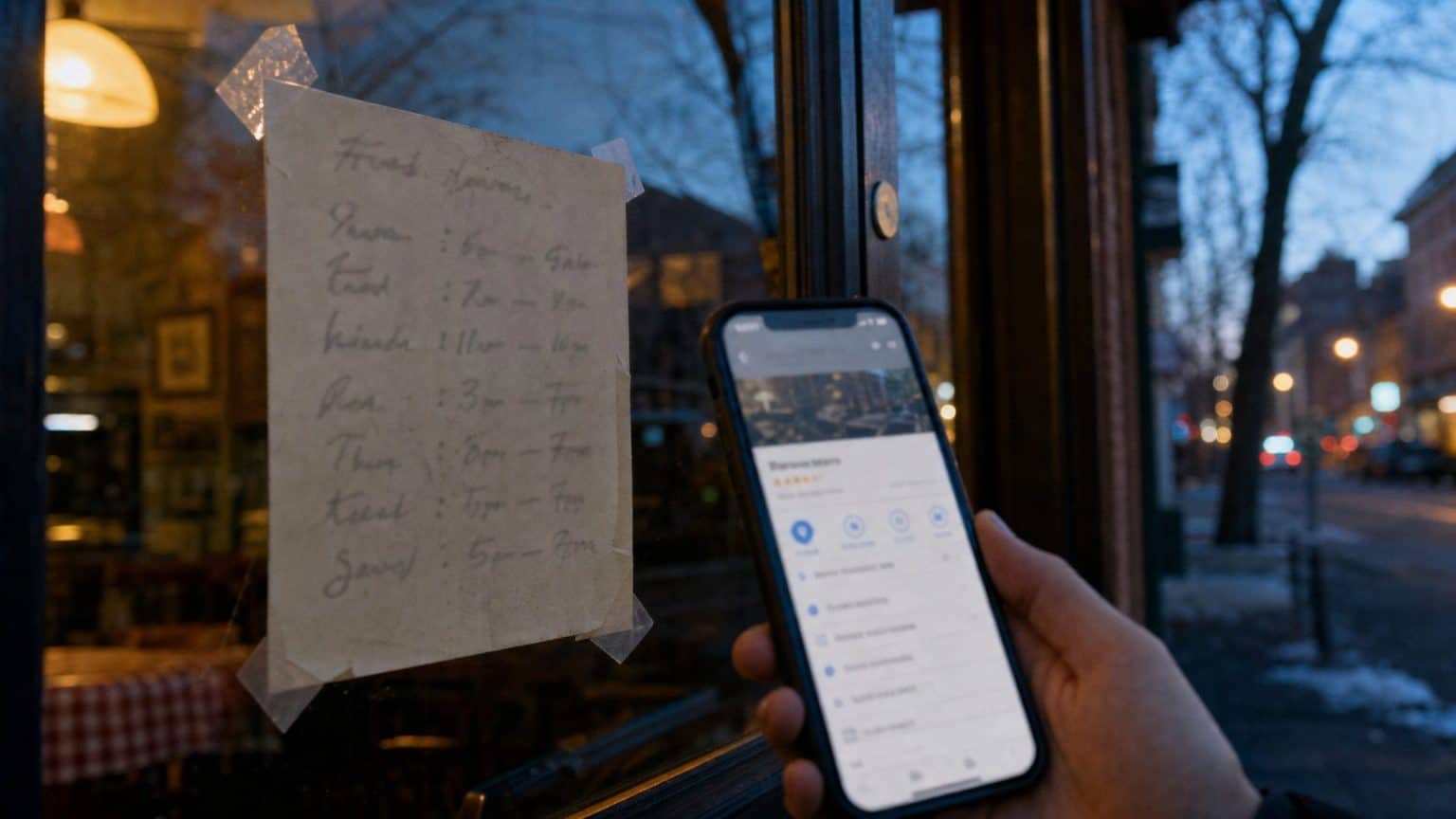
When restaurant information conflicts online, do not average the answers. Rank the evidence by how current, direct, and consequential it is—and verify the one fact that can actually ruin the night.
A restaurant can have three different closing times on three different screens and still be a perfectly competent restaurant. The problem is not necessarily the restaurant. The problem is that restaurant information has a half-life, and the internet is very good at preserving every version.
The map listing says 9:00. The website says 8:30. A social post from six weeks ago says the kitchen is now open until 10:00 on Fridays. A review from last winter says they stopped seating at 7:45. None of those facts can simply be stirred together until a trustworthy answer appears.
A small-market restaurant guide has an advantage on exactly this. In a city with four thousand choices, people can shrug and pick something else. In a town with nine plausible dinner rooms, the wrong hour, an old menu, or a seasonal closure can erase a meaningful fraction of the evening.
The useful job is not to pretend the conflict does not exist. It is to show which source currently carries the most weight, what is still unknown, and what deserves a direct confirmation.
First, decide which fact actually matters
Not every discrepancy deserves a phone call.
If one source says the restaurant opens at 4:00 and another says 4:30, but you are planning dinner at 7:00, that difference may be irrelevant. If one source says the kitchen closes at 8:00 and another says 9:00, and you will arrive at 8:15 after a long drive, that is the entire decision.
Start by naming the fact that can break the plan: kitchen closing time, seasonal operating dates, whether dinner is served on Sunday, whether a reservation is required, whether the patio is the only dining area, whether a group menu applies, whether the restaurant can handle a dietary restriction, or whether a private room actually exists on the date you need it.
Then verify that fact with more care than the decorative details around it.
This sounds simple. It is also the difference between research and scrolling.
A source hierarchy is better than a pile of links
For operating facts, I start with the restaurant itself.
A current page on the restaurant’s own website generally carries more weight than an old review describing last year’s schedule. A dated announcement from the restaurant may outrank an undated footer. A current reservation platform showing bookable tables can be useful evidence about service, although it still may not tell you when the kitchen stops accepting orders. A social post written by the restaurant can be especially valuable in a seasonal market where temporary closures, mud season, staffing changes, or holiday hours move faster than the formal website.
Third-party directories and map listings are useful discovery tools. They are not automatically the final authority for a fact that can cost someone a drive.
Reviews belong even lower in the hierarchy for current operating details. A diner can accurately report what happened on the night they visited and still be completely wrong about what will happen six months later. The review is evidence of a past experience, not ownership of the current schedule.
The point is not to worship first-party information. Restaurants forget to update things too. The point is that direct, current evidence should start with more weight than inherited information copied from somewhere else.
Look for the date before you look for confidence
An old statement written with certainty is still old.
This matters because restaurant pages often contain durable-looking language: “Dinner Wednesday through Sunday,” “Happy hour daily,” “Reservations recommended,” “Closed Tuesdays.” If the page has no visible update date, the statement may be current. It may also be a fossil with excellent typography.
Dated material is easier to judge. A post from yesterday announcing September hours gives you a time anchor. A PDF menu labeled Spring 2025 does the opposite. Both are useful because both tell you what they are.
Deep Dish should prefer a dated truth over an undated certainty whenever the distinction matters. “Restaurant published these hours August 28” is stronger than “Hours: 4–9” with no provenance at all.
Dates do not make information infallible. They make the evidence legible.
Do not confuse dining-room hours with kitchen hours
This is one of the most expensive little misunderstandings in restaurant planning.
A restaurant may remain open while the kitchen stops taking full dinner orders earlier. A bar may continue serving after the dining room closes. A hotel restaurant may technically be open while the menu narrows late in the evening. A cafe may list building hours that include a transition between breakfast and lunch service.
“Open until 10” answers the wrong question if the kitchen takes its final dinner order at 8:45.
When timing is tight, the useful fact is the service window for the meal you intend to eat. If the website does not distinguish it, that is an unknown—not an invitation to assume the more generous interpretation.
For a traveler arriving after a flight, a family driving ninety minutes, or anyone attaching dinner to a performance, game, hospital visit, or other fixed event, that distinction deserves direct confirmation.
A menu photograph is not a current menu
Menus are particularly good at surviving beyond their useful life.
A customer uploads a photograph. A tourism page links an old PDF. A search engine preserves a menu tab. A blogger writes about a dish that disappeared two chefs ago. Then somebody builds tonight’s dinner around it.
If a particular dish is the reason for going, find the restaurant’s current menu or ask. If a dietary route matters, verify the current structure rather than relying on an old plate someone once photographed. If price matters, use the newest attributable menu you can find.
Restaurant Intelligence should distinguish “currently published menu” from “menu found online.” Those are not synonyms.
The difference becomes even more important in small and seasonal restaurants because menus may change with staffing, weather, supply, tourism cycles, hunting season, ski season, patio season, or simply the practical limits of a small kitchen. Change is not the failure. Hidden change is the problem.
Social media can be better evidence than the polished website
This is one of the places where a tidy source hierarchy needs a little judgment.
A restaurant’s website may be the formal home, but the restaurant’s own social feed may be where it actually publishes temporary changes. “Closed tonight because the pass is terrible.” “Back Thursday.” “Kitchen opening at five this week.” “Last weekend before seasonal break.” In a small operation, that may be the most current first-party evidence available.
Use it. Just keep the date attached.
A restaurant’s own current social post outranks an old directory entry because the source is closer to the operating reality and the evidence is newer. That does not mean every social caption is a permanent policy. It means the time-sensitive statement is useful for the time period it actually describes.
Currentness and scope both matter.
Reservation availability is evidence, not proof of the whole evening
If the booking system offers a 7:30 table on Saturday, that is meaningful. It suggests the restaurant expects to seat guests then.
It does not necessarily prove that the complete menu is available, that the dining room you want is open, that the kitchen can accommodate a particular restriction, or that a twelve-person group can book under the same rules as a table for two.
Reservation systems answer the questions they were built to answer.
Use them as one layer of evidence. Do not make them carry the entire decision.
Reviews are good for patterns and terrible for clocks
I read reviews. A lot of them. I also do not want a four-year-old complaint about Sunday hours deciding what is true tonight.
Reviews can reveal patterns that official copy will never explain well: the room gets loud, the portions are enormous, parking becomes strange during events, service slows when the patio fills, the bar is more fun than the dining room, the famous dish routinely sells out, or a supposedly casual restaurant behaves more like a special-occasion room.
That is valuable.
But a review saying “they close at eight” tells you what one diner encountered on one date unless the restaurant’s current information confirms it. Reviews are experiential evidence. They are not a live operating feed.
This distinction lets us use reviews without asking them to do a job they cannot reliably do.
When two first-party sources disagree, preserve the disagreement
Weak guides get very confident at exactly this moment.
The website says Tuesday through Saturday. The restaurant’s social bio says Wednesday through Sunday. The reservation calendar has no tables Tuesday. Which one wins?
Maybe none of them yet.
If the answer changes whether somebody should drive there, mark it unresolved and contact the restaurant. Do not silently select whichever source fits the desired conclusion. Do not print both sets of hours without explaining the conflict. Do not convert “probably” into a clean data field because the empty field looks unfinished.
An honest unknown is usable information.
It tells the reader exactly what still needs to happen before the decision becomes safe to act on.
The call should be short because the research already did its job
A direct call is not a substitute for doing any homework. It is the last-mile check for the unresolved thing that matters.
“Hi, I am seeing two different closing times online. Are you serving the full dinner menu until 9:00 this Friday?”
That is a much easier question for a busy restaurant to answer than “Can you tell me everything about dinner?”
The same applies to a seasonal reopening, a private-room policy, a dietary accommodation, or a holiday schedule. Bring the narrow question. Let the restaurant answer the thing only it can currently own.
Then date the answer.
Restaurant facts age. A confirmation is strongest when the reader can see when it was confirmed and what, precisely, was asked.
Build the file around confirmed, inferred, and unknown
This is the part I want Deep Dish to make visible.
Confirmed means the current restaurant source or direct confirmation supports the fact.
Inferred means the available evidence strongly suggests something but does not establish it completely. The booking calendar may imply Friday service. Menu structure may suggest a vegan route. Room photographs may suggest a certain kind of seating. Useful, but not final.
Unknown means the evidence does not currently answer the question.
Unknown should not be treated as a defect in the file. It is a state.
If the unknown is trivial, move on. If the unknown is decisive, confirm it before booking. That is the entire point of holding it open.
The source hierarchy, strongest first
- Name the fact that can break the plan
- Kitchen closing time, seasonal dates, group policy
- Then verify that one with more care than the decorative details around it
- The restaurant's own current page
- Strongest, when it carries a date
- A PDF labelled Spring 2025 does the opposite of reassuring
- The restaurant's own dated post
- A post from yesterday announcing September hours is a time anchor
- "Closed tonight because the pass is terrible" outranks any directory entry
- Reservation platforms
- Evidence the restaurant expects to seat guests then
- Not proof the complete menu is available when you arrive
- Directories and map listings
- Useful discovery tools
- Not automatically the final authority on anything
- Reviews
- Good for patterns: the room gets loud, parking is strange during events
- "They close at eight" is what one diner met, on one date
- When two first-party sources disagree
- Preserve the disagreement and mark it unresolved
- Do not quietly pick whichever one fits the conclusion you wanted
The more limited the market, the more valuable the uncertainty becomes
In a giant city, bad information is irritating. In a small town, it can erase dinner.
The restaurant that turns out to be closed may have been one of only three places serving after eight. The one current menu may be the only realistic route for a vegan diner. The private room may be the only space in town where twelve people can actually hear each other. The Sunday kitchen may be the only meal between a wedding and a long drive home.
This is why small-market Restaurant Intelligence should not aspire to look more complete by hiding uncertainty.
It should become more useful by showing exactly where certainty ends.
Trust the evidence that can survive the decision
The best source is not always the prettiest source, the highest-ranking source, or the one with the most reviews.
It is the source close enough to the restaurant’s current operation to support the specific decision you need to make.
Start with current first-party information. Keep the date. Use reviews for lived patterns rather than current clocks. Let booking systems answer booking questions. Preserve contradictions. Call when the unresolved fact can wreck the plan.
And if the answer is still unknown, print unknown.
That is not thin coverage. That is the part most restaurant guides are afraid to admit they do not know.
Read Small-Market Restaurant Intelligence, Seasonal Towns and Stale Listings, and use Restaurant Intelligence for the current decision file.
Restaurant hours, menus, policies, reservation availability, and operating dates change. Confirm any detail that materially affects travel, access, health, cost, or whether the meal can happen.
Part of Restaurant Records.
Where this goes next
