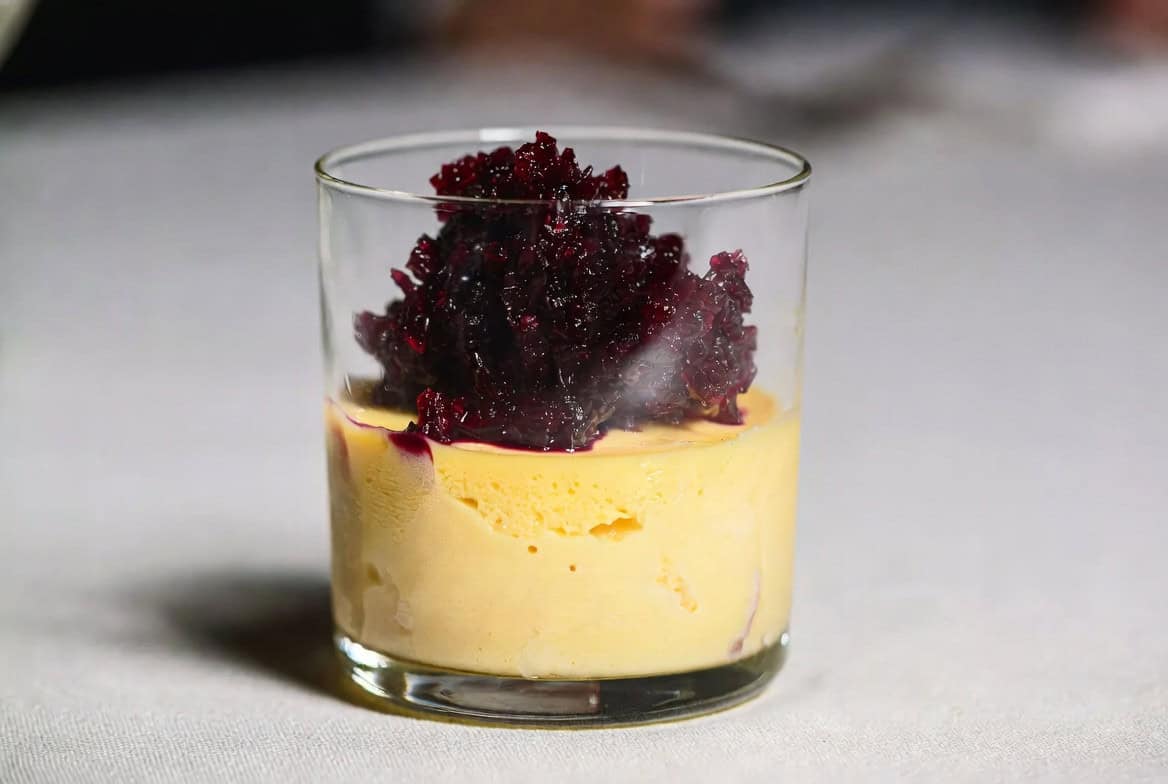
Sneaky Corn Panna Cotta with Blueberry–Balsamic Granita
Corn simmered with its own cobs, set just barely, under a sharp blueberry ice with enough vinegar to keep everything honest. The cobs are the ingredient here, not the kernels.
The parts that change whether this works tonight.
These fields come from the published recipe itself. If a recipe has not separately declared an operating fact, the gap stays visible instead of being filled with a guess.
- Servings
- 6
- Timing
- 35 minutes, plus chilling and freezing
- Equipment
- Not separately declared
- Make-ahead
- Not separately declared
- Holding
- Not separately declared
- Leftovers
- Not separately declared
- Dietary notes
- Not separately declared
- Method map
- 10 ingredient lines · 7 method steps
Pairing
Wine — A demi-sec Vouvray, or a Moscato d'Asti. Sweet corn is subtle to the point of shyness, and anything with tannin or oak erases it before the blueberry has even arrived. Mixed drink — A gin and tonic with a strip of lemon peel. Bitterness is the missing element here — the panna cotta is soft and sweet, the granita is soft and sour, and nothing on the plate is sharp. Teetotaler — Blueberry shrub over sparkling water. It repeats the balsamic idea in the glass, and vinegar is what makes corn taste like corn instead of like sugar.
Tools
A saucepan tall enough to hold two snapped cobs, a fine sieve, a liquid measure you trust, six glasses, and a shallow metal pan for the granita.
Ingredients · swaps in parentheses
Sweet corn, heavy cream, whole milk, sugar, kosher salt, powdered gelatin, blueberries, balsamic vinegar, lemon juice.
Magic
Never turn the burner on. Put the kernels, the snapped cobs, the cream, the milk, the sugar and the salt into the pot cold, cover it, and leave it in the fridge overnight, then strain, top up and warm it only as far as the gelatin demands. Heat is fast and it is also destructive: twelve minutes at a bubble drives off the volatile green compounds that make raw corn smell like a field and leaves the cooked, sweeter ones behind. Twelve hours cold takes all of it and burns none of it, and the panna cotta arrives tasting like the smell of husking corn rather than like creamed corn. Not feeling brave? Simmer for 5 minutes only, then cover it and steep it in the fridge for 4 hours.
Gotcha
Twelve minutes of simmering plus a covered steep evaporates more than you expect, and the cobs drink some too. Measure the strained liquid and top it back up to 2 1/2 cups with milk before the gelatin goes in. Skip that and you are setting a smaller volume with the same gelatin, which is how a panna cotta ends up bouncing.
The cobs matter more than the kernels. Once you have cut the corn off, what is left in your hand is a stick coated in milky starch and packed with the aromatic compounds that make raw corn smell like summer, and most recipes throw it in the compost. Snap them in half and simmer them. That is where the flavor of this dessert actually comes from — the kernels are almost a garnish by comparison.
Serves: 6
Time: 35 minutes, plus chilling and freezing
Ingredients
- 2 ears sweet corn
- 2 cups heavy cream
- 1/2 cup whole milk, plus more for topping up
- 1/3 cup sugar
- 1/2 teaspoon kosher salt
- 2 teaspoons powdered gelatin
- 1 cup blueberries
- 2 tablespoons sugar
- 1 tablespoon balsamic vinegar
- 1 tablespoon lemon juice
Method
Where the time goes
- 12 minStrip and simmer
- 20 minSteep off the heat
- Bloom and measure
- Warm and dissolve
- 4 hrSet
- 30 minGranita
- Assemble at the last second
- Strip and simmer. Cut the kernels from the cobs, then snap the cobs in half. Simmer kernels and cobs with the cream, 1/2 cup milk, sugar, and salt for 12 minutes at a bare bubble. For the magic version, leave the heat off: combine all of it cold in the pot, cover, refrigerate overnight, and go straight to step 3 in the morning.
- Steep off the heat. Cover and leave it 20 minutes. This is where most of the corn flavor arrives; the simmer just gets things started.
- Bloom and measure. Sprinkle the gelatin over 2 tablespoons cold water and leave it to swell. Strain the corn cream, pressing the solids, then measure it and add milk to bring it back to 2 1/2 cups.
- Warm and dissolve. Rewarm the cream until it steams — not a boil — and whisk in the bloomed gelatin until you cannot see a single grain. Rub a drop between your fingers to check.
- Set. Divide among six glasses and chill until firm, at least 4 hours.
- Granita. Blend the blueberries, 2 tablespoons sugar, balsamic, lemon juice, and 1/4 cup water. Pour into a shallow metal pan and freeze, scraping with a fork every 30 minutes until crystalline.
- Assemble at the last second. Spoon the granita over the set panna cotta immediately before serving.
Gelatin is a number, not a feeling
Two teaspoons of powdered gelatin is roughly 6 grams, and against 2 1/2 cups of dairy that gives you the set that trembles — firm enough to hold its shape in the glass, soft enough that a spoon goes through without resistance. It is a narrow target. A quarter teaspoon either way is the difference between panna cotta and either soup or a rubber puck, and there is no rescue after the fact. This is the part of dessert cooking that refuses to be casual, and pretending otherwise just means you find out four hours later.
Bloom in cold water first, always. Powdered gelatin dumped into warm liquid seizes into little beads with dry centers that never dissolve, and you get a panna cotta with grit in it. And keep the rewarmed cream below a boil: prolonged high heat starts breaking the collagen chains down, and a weakened gel is a set that never quite arrives.
The granita is doing acid work, not decoration
Corn cream is fat, sugar, and starch. On its own it coats the mouth and stays there. Balsamic and lemon in the blueberry ice give you two different acids — one dark and slightly sweet, one sharp and immediate — that cut through the fat between spoonfuls and reset your palate so the corn keeps registering. A dessert that only tastes sweet has failed, and this is the piece of the plate keeping that from happening.
Use the ordinary supermarket balsamic, not the syrupy aged bottle. You want the acetic bite, not the sweetness.
Getting ahead, and what holds
The panna cotta is friendly to planning. Set in the glasses, covered with plastic, it holds three days in the fridge without weeping or toughening, and the corn flavor is arguably better on day two. Any longer than that and the surface begins to develop a slightly leathery skin where it meets the air.
The granita is less patient. It stays properly fluffy for about a day, then the crystals coarsen; two or three days out it is still good but closer to shaved ice. You can re-fork a stiff pan straight from the freezer and get most of the texture back.
What you cannot do is combine them early. Granita spooned onto panna cotta starts melting on contact and within ten minutes you have a purple puddle sitting on a set cream, which tastes fine and looks like an accident. Plate the glasses, then walk the pan of ice to the table and spoon it there.
Part of Recipes & Technique.
Recipe provenance: Salty & Clever editorial formulation, built from established culinary technique and the traditions identified in the article. No chef, restaurant, family, or firsthand cultural provenance is claimed unless it is explicitly named and sourced. How we write and check recipes


