Bulgur with Roasted Peppers, Apricots, and Preserved Lemon
Bulgur steeped rather than boiled, then tossed with roasted peppers, apricots, and preserved lemon and left alone for fifteen minutes to finish seasoning itself.
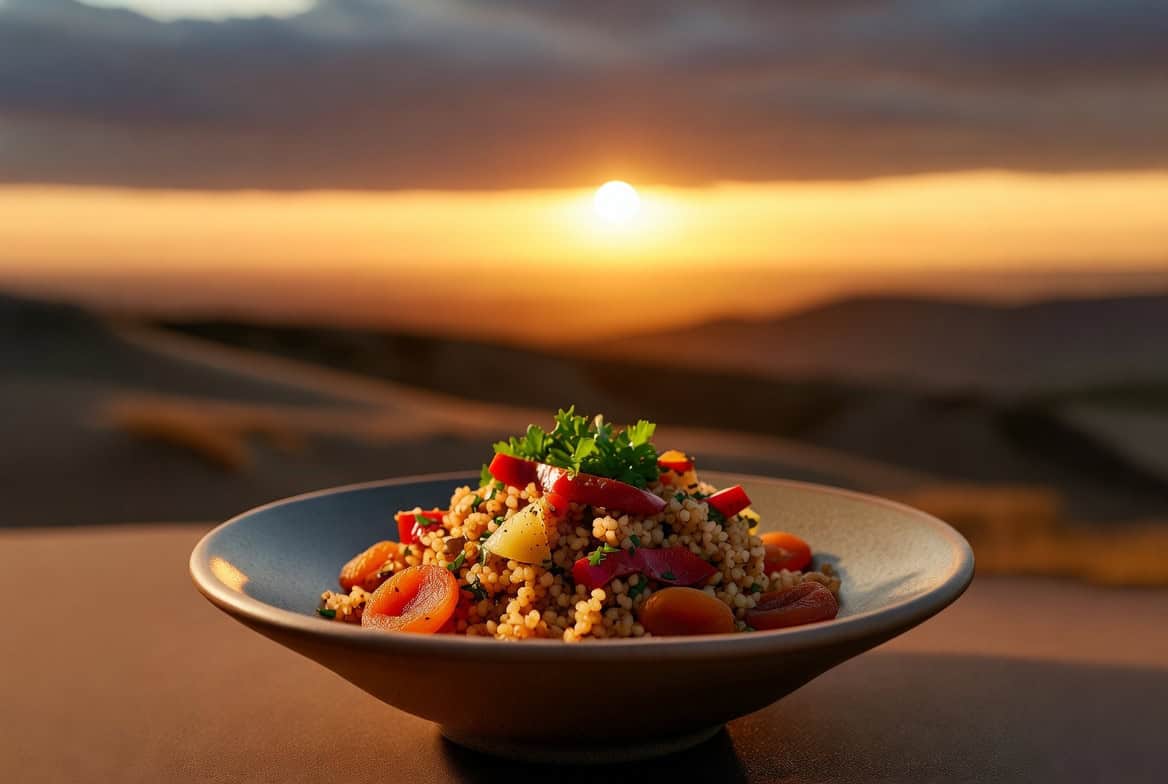
The parts that change whether this works tonight.
These fields come from the published recipe itself. If a recipe has not separately declared an operating fact, the gap stays visible instead of being filled with a guess.
- Servings
- 6
- Timing
- 35 minutes
- Equipment
- Not separately declared
- Make-ahead
- Not separately declared
- Holding
- Not separately declared
- Leftovers
- Not separately declared
- Dietary notes
- Not separately declared
- Method map
- 9 ingredient lines · 4 method steps
Pairing
Wine — A dry rosé from the Rhône, or an Assyrtiko if you want more edge. Preserved lemon is salt and acid arriving together, and it needs a wine with real acid of its own or the whole bowl tastes flat. Mixed drink — Ouzo or arak with cold water and one cube. Anise beside coriander and apricot is a regional pairing that has been under test for several hundred years. Teetotaler — Ayran, or plain salted yogurt thinned with cold water. It is the standing answer to preserved lemon everywhere preserved lemon is used, and it beats anything sweet by a wide margin.
Tools
A bowl with a lid or a plate that fits it, a kettle, and a fork. Not a spoon for the fluffing — a spoon compacts bulgur and a fork separates it.
Ingredients · swaps in parentheses
Bulgur (coarse or medium; couscous if you must, though the texture goes soft), roasted red peppers, dried apricots, preserved lemon rind, parsley and mint, pistachios (almonds), olive oil, lemon juice, ground coriander, black pepper
Magic
Toast the bulgur dry before any water gets near it. Three or four minutes in a hot dry pan, shaking it, until it smells like a bakery and has gone a shade darker, then tip it into the bowl and pour the boiling water over as usual. The standing complaint about grain salads is that the grain is a vehicle; toasting is how the vehicle acquires a flavor of its own, and it costs nothing but a pan and four minutes. It firms the outside of each piece slightly too, so the grains stay separate under the dressing instead of clumping. Not feeling brave? Toast half, hydrate it all together, and see whether you can pick the toasted grains out by taste.
Gotcha
Bulgur keeps absorbing after it looks finished. If it seems slightly wet when you first uncover it, that is correct; add liquid at that point and you will have a paste twenty minutes later, once the dressing has gone in too.
Bulgur is parboiled, dried, and cracked wheat, which means it is already cooked and only needs to be rehydrated. That single fact is why it belongs in a salad and why so many bowls of it come out disappointing. Treated like rice, boiled in a pot and stirred, it turns to porridge. Treated as what it is — a dried grain waiting for hot liquid and then left alone under a lid — it comes out separate, chewy, and capable of holding a dressing without dissolving into it. The grain has been a staple across the eastern Mediterranean and the Levant for a very long time, and the technique there has always been steeping rather than boiling.
Serves: 6
Time: 35 minutes
Ingredients
- 1 1/2 cups bulgur
- 2 roasted red peppers, chopped
- 1/2 cup dried apricots, chopped
- 1 tablespoon minced preserved lemon rind
- 1 cup parsley and mint
- 1/2 cup pistachios
- 3 tablespoons olive oil
- 2 tablespoons lemon juice
- 1/2 teaspoon ground coriander
Method
- Hydrate the grain. Prepare the bulgur according to package directions and cool slightly. Cover the bowl and do not stir it while it sits. For the magic version, toast the dry bulgur in a hot dry pan here, before the water goes on.
- Whisk the dressing. Whisk the olive oil, lemon juice, preserved lemon, coriander, and black pepper. Taste it on its own; it should be sharper than seems reasonable.
- Toss. Fluff the bulgur with a fork, then toss with the peppers, apricots, herbs, pistachios, and dressing.
- Stand. Let stand 15 minutes before serving.
Preserved lemon is not lemon
Fresh lemon juice is acid and a little perfume. Preserved lemon rind is something else entirely: months in salt break down the pith’s bitterness and ferment the peel into something savory, floral, and intensely salty, with almost none of the sourness left. That is why both are in the dressing. The juice brings the sharpness, the rind brings depth and a slow bloom of citrus oil that arrives after you have swallowed.
Mince it properly, to something close to a paste. Larger pieces are a shock rather than a seasoning, and one person gets a salt bomb while everyone else gets plain bulgur. If your jar has soft rinds, scrape away the remaining pulp first; the pulp is mostly salt and water and it will throw the seasoning off.
Sweetness that has to earn its place
Half a cup of dried apricots across six servings is not a small amount, and it is the ingredient most likely to make this cloying if you get careless. Chop them small, roughly the size of the pistachio pieces, so they distribute rather than arriving in chewy slabs. Dried apricots are also quite firm; they will soften slightly in the dressing during the fifteen-minute stand, which is another reason that stand is not optional.
Look for the dark brown ones if you can find them, unsulfured, which taste more of concentrated fruit and less of candy. The bright orange ones are treated with sulfur dioxide to keep the color, and they are sweeter and one-dimensional. Either works. The dark ones make the salad better.
The peppers do the work you think the grain is doing
Roasted red peppers bring three things at once: sweetness, moisture, and a smoky note from the char, and they are the reason this reads as a substantial salad rather than a bowl of seasoned grain. Chop them rather than slicing them into strips so they mix in properly instead of sitting in ribbons on the surface.
Drain them well. Jarred peppers carry a lot of brine, and that brine is both salty and acidic in a way that will quietly redirect the whole dressing if a few tablespoons of it come along for the ride. Pat them on a towel. If you are roasting your own, char the skins black under a broiler, steam them in a covered bowl for ten minutes, and slip the skins off; the ten minutes of steaming is what makes them peel easily rather than in frustrating fragments.
Assembly and the fifteen minutes at the end
Add the herbs and pistachios shortly before serving. Both degrade in contact with an acidic dressing, the herbs by going dark and limp and the pistachios by going soft, and both are contributing texture and color that the rest of the salad cannot supply.
That final fifteen-minute stand is doing real work. The bulgur is still slightly thirsty when it comes out of the bowl, and during those minutes it takes up the olive oil and lemon and finishes seasoning itself from the inside. Serve it immediately after tossing and the dressing is still sitting on the surface; the grain will taste bland underneath a sharp exterior. Give it a quarter of an hour and the whole thing evens out.
It works as a side, as lunch, or as a base under grilled chicken or fish, where the juices from the meat become part of the dressing. Made a day ahead, it needs a fresh squeeze of lemon and a new handful of herbs before it goes out, because the first ones will have given up by then.
Part of Recipes & Technique.
Recipe provenance: Salty & Clever editorial formulation, built from established culinary technique and the traditions identified in the article. No chef, restaurant, family, or firsthand cultural provenance is claimed unless it is explicitly named and sourced. How we write and check recipes


