Apricot–Rosemary Cobbler with Salted Cornmeal Dumplings
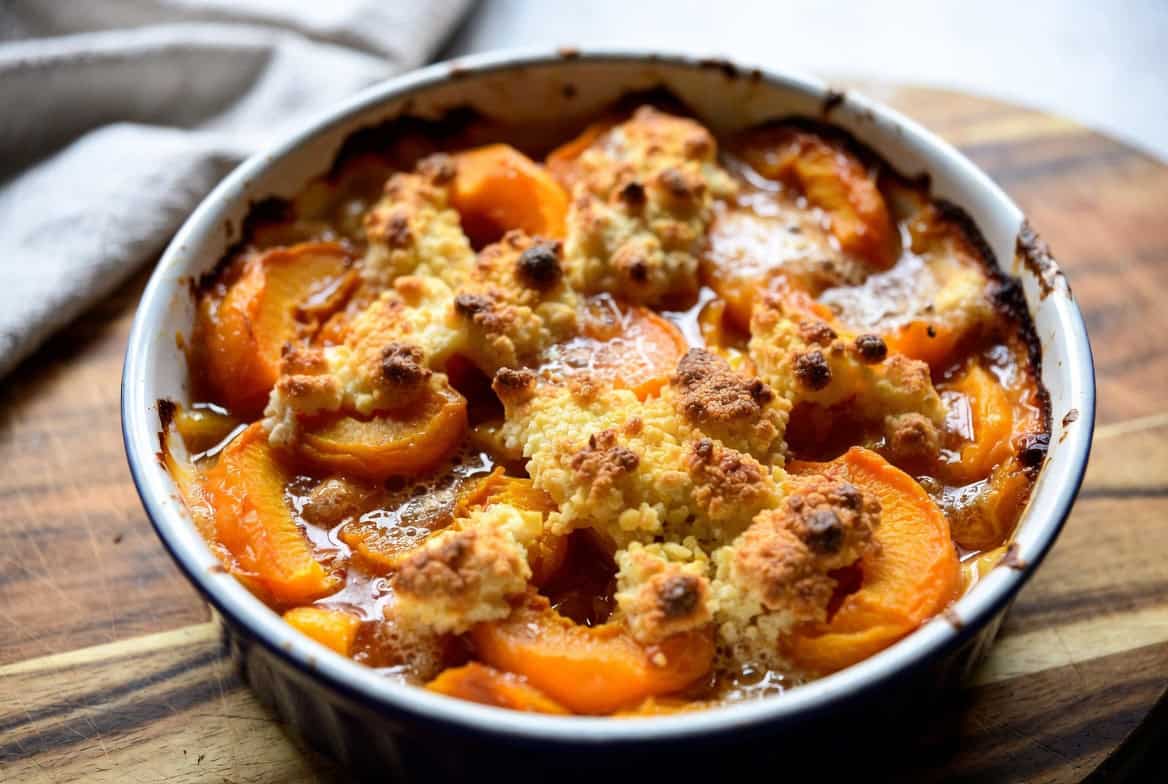
Apricots cooked until they turn floral, with cracked pepper keeping them from getting sentimental, under craggy cornmeal dumplings salted the second they leave the oven. Serve it twenty minutes out, not hot.
The parts that change whether this works tonight.
- Serves
- 8
- Time
- 1 hour
- Equipment
- A 2-quart baking dish, a pastry cutter or two knives, a sheet pan to sit underneath and catch the boil-over, and a mortar for…
- The method
- 14 ingredients · 5 steps
From this recipe’s own yield and timing lines and Kitchen Kit. Nothing here is a guess.
Pairing
Wine — Muscat de Beaumes-de-Venise, or a late-harvest Viognier. Apricot is what both of them taste of, and the rosemary needs a wine with some perfume of its own or it stands there looking awkward. Mixed drink — A rosemary gin fizz, short on syrup. The herb repeats and the acid handles the buttered cornmeal, which is heavier than a cobbler crust ever looks. Teetotaler — A strong rosemary tisane with lemon, hot. The cobbler is already sweet and buttery, so the glass should be herbal and sharp — a much shorter list of options than it sounds.
Tools
A 2-quart baking dish, a pastry cutter or two knives, a sheet pan to sit underneath and catch the boil-over, and a mortar for cracking pepper. Nothing here needs a mixer.
Ingredients · swaps in parentheses
Apricots, sugar, cornstarch, lemon juice, rosemary, flour, fine cornmeal, baking powder, kosher salt, cold butter, buttermilk, flaky salt (whole black peppercorns for the magic version).
Magic
Crack 3/4 teaspoon of black peppercorns coarsely in a mortar and toss them through the apricots with the sugar. Cooked stone fruit turns floral and slightly perfumed, and pepper is the thing that stops that from tipping into cloying — the piperine reads as warmth rather than heat and it makes the apricot taste more like itself, the way pepper does on a strawberry. Not feeling brave? Use a scant 1/4 teaspoon and add a wide strip of lemon peel to the fruit alongside it.
Gotcha
Leave real gaps between the dumplings. Cover the fruit edge to edge and the steam has nowhere to go, so it condenses back into the dough and the undersides stay raw and pasty while the tops brown convincingly. You want to see bubbling fruit between the mounds.
Apricots are the one stone fruit that is reliably better cooked than raw. A peach eaten over the sink at the right moment in August cannot be improved on, but a raw apricot is usually mealy, faintly cottony, and less sweet than it looks. Heat fixes all of that: the flesh collapses, the acid concentrates, and the flavor goes from thin to genuinely floral. Buy them slightly firm and stop apologizing for them.
Serves: 8
Time: 1 hour
Ingredients
- 2 pounds apricots, pitted and quartered
- 1/2 cup sugar
- 1 tablespoon cornstarch
- 1 tablespoon lemon juice
- 1 teaspoon finely chopped rosemary
- 1 cup flour
- 1/2 cup fine cornmeal
- 2 tablespoons sugar
- 2 teaspoons baking powder
- 1/2 teaspoon kosher salt
- 6 tablespoons cold butter
- 3/4 cup buttermilk
- Flaky salt
- 3/4 teaspoon black peppercorns, for the magic version
Method
- Dress the fruit. Heat the oven to 375°F. Toss the apricots with the 1/2 cup sugar, cornstarch, lemon juice, and rosemary directly in a 2-quart baking dish. For the magic version, crack 3/4 teaspoon black peppercorns coarsely and toss them in here.
- Cut the dough. Whisk the flour, cornmeal, 2 tablespoons sugar, baking powder, and kosher salt. Cut in the cold butter until the largest pieces are the size of peas, then stir in the buttermilk just until it comes together in a shaggy, sticky mass. Stop early.
- Drop it rough. Spoon eight or nine ragged mounds over the fruit, leaving clear gaps between them. Do not smooth them; the craggy edges are what get crisp.
- Bake. Bake 35 to 42 minutes, until the fruit is bubbling hard at the edges and the dumplings are golden and firm. Set the dish on a sheet pan first unless you enjoy cleaning ovens.
- Salt while hot. Scatter a restrained pinch of flaky salt over the dumplings the moment it comes out, while the surface is still steaming enough to hold it.
Cornmeal makes a dumpling, not a biscuit
Cornmeal has no gluten, so half a cup of it against a cup of flour dilutes the structure and gives you something tender and slightly crumbly rather than layered and flaky. That is the right call on top of wet fruit — a proper laminated biscuit sitting in apricot juice goes soggy in its lower half and the layers become a liability. A cornmeal dumpling absorbs juice and stays pleasant.
Use fine cornmeal, not coarse polenta grind. Coarse cornmeal needs longer hydration than a 40-minute bake gives it and you end up with a gritty topping that people politely do not mention.
The butter still needs to be cold and still needs to stay in visible pieces. Those pieces melt in the oven and leave steam pockets, which is the only leavening working alongside the baking powder. Warm butter smears into the flour and you get something dense and scone-like.
Rosemary belongs with the fruit
Rosemary is aggressive and resinous, and baked into a dough it has nowhere to go but up your nose — the aroma concentrates in the dry crumb and reads as pine cleaner. Tossed through wet fruit, it steeps rather than roasts. The juice extracts the aromatic oils and disperses them, and what you taste is a background of something green and slightly medicinal in a good way, sitting under the apricot rather than sitting on top of it.
Chop it finely, and a full teaspoon is enough for two pounds of fruit. Rosemary needles that stay whole are unpleasant to bite.
The juice is a variable you cannot fully control
One tablespoon of cornstarch against two pounds of apricots is calibrated for fruit that is properly ripe but not collapsing. Firmer apricots release less liquid and the cobbler comes out on the dry side, which is easily fixed with cream at the table. Very ripe ones release considerably more and you get a looser, more sauce-like base — still good, just less tidy on a plate.
What you cannot do is add more cornstarch as insurance. Too much and the juice goes cloudy and slightly gluey, with that dulled, coated quality that thickened pie filling gets when someone panicked. Under-thickened fruit is a much better failure than over-thickened fruit.
When to actually serve it
Twenty to thirty minutes out of the oven is the window. Straight from the oven the juice is thin and molten, because cornstarch does most of its setting as it cools, and it will run everywhere and scald anybody who commits too early. Fully cold, the dumplings have gone dense and the aromatics have shut down.
It holds at room temperature for a few hours and reheats decently — 15 minutes at 350°F, uncovered, which re-crisps the tops. Beyond a day the dumplings have absorbed enough juice that they are more like a moist pudding. Some people prefer this. They are not wrong, they are just eating a different dish, and it should be eaten cold with cream rather than reheated.
Part of Recipes & Technique.
Recipe provenance: Salty & Clever editorial formulation, built from established culinary technique and the traditions identified in the article. No chef, restaurant, family, or firsthand cultural provenance is claimed unless it is explicitly named and sourced. How we write and check recipes
Where this goes next

