A Brought Dish Needs an Answer in Five Seconds
A dish you did not plan for arrives at the door, and it needs one of four answers before you turn to take a coat.
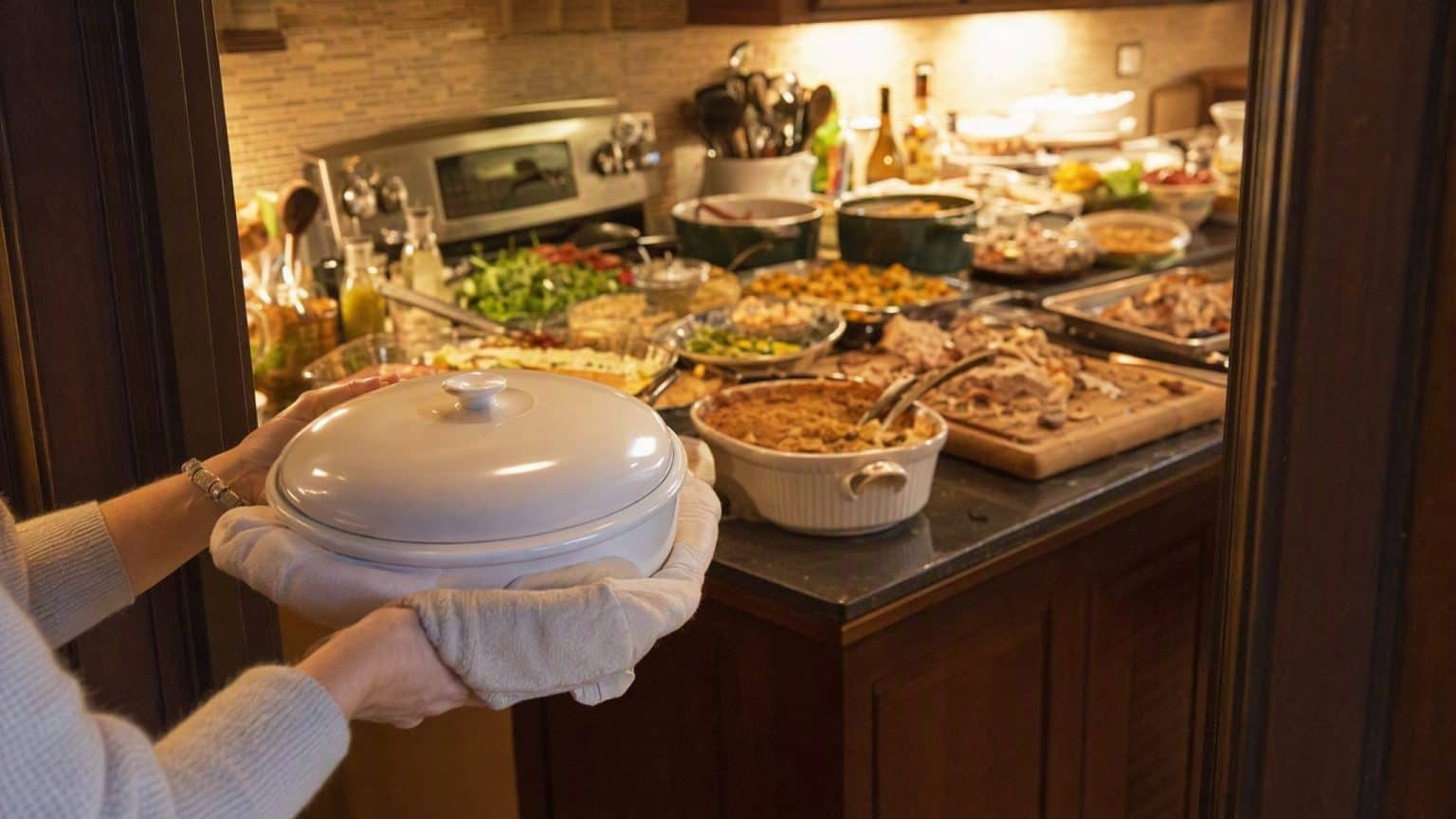
A foil tray still sitting on the counter at nine o’clock is not evidence of a generous guest. It is the record of a decision the host declined to make at 6:52.
Someone arrives eight minutes early holding a 9×13 dish under plastic wrap. It is warm on the bottom and cool at the corners. They are pleased with it, they want somewhere to set it down, and there are four more people coming up the walk behind them. You have about five seconds of attention to spend before you turn and take a coat, and in those five seconds the dish gets an answer or it gets the counter.
Four answers, and “later” is not one of them
A brought dish has exactly four destinations. The work is picking one and saying it out loud:
- Out now, as it is. It goes to the table or the sideboard at the temperature it arrived, because that temperature is fine and the meal can absorb it.
- Out later, with a resource attached. It needs an oven rack or a refrigerator shelf between now and service, and you name which one before you set the dish down.
- Tomorrow’s. It goes into the refrigerator covered and unopened, and you thank the person for lunch instead of for dinner.
- The side table. It is served, but outside the sequence: near the drinks, on its own plate, with its own spoon, not folded into the courses.
The fifth outcome is the foil tray, and the foil tray is not a decision. It is the visible form of a host who has not made one, which everyone in the room can read by the second glass.
The oven and the cold shelf were spoken for at four o’clock
The variable that moves here is not goodwill. It is committed capacity. A menu built on a single oven has no spare rack at seven, because the rack schedule is what made the menu possible in the first place. A refrigerator staged for a dinner has no shelf, because staging is exactly the act of filling it.
Reheating a brought casserole is not a small ask, and the arithmetic is worth having in your head before the doorbell. A 2-inch-deep casserole taken from a refrigerator at 40°F needs roughly 30 to 45 minutes covered at 350°F to reach 165°F in the center. The same dish arriving at room temperature needs something closer to 20 to 30. Both of those are ranges because they depend on the dish itself — glass and stoneware take longer to come up than thin metal — on how dense the filling is, and on your oven, which is the part you cannot look up. A heavy, well-insulated range gives back the 25 to 50 degrees it loses when the door opens in two or three minutes. A light one can take five to eight, and if you are opening it every few minutes to baste or to check, it may never fully recover.
Then there is the temperature conflict, which is the part people skip. If you are running 425°F for potatoes and the casserole wants 350°F, you do not get both. Run it hot and the top browns hard before the center gets anywhere near 165°F. Cover it tightly with foil and you can usually get away with the higher temperature, at the cost of the crust the person who made it was expecting. That trade is worth naming to yourself, because it is the difference between serving their dish and serving a scorched version of it.
Cold space has its own arithmetic and it is less forgiving. A 9×13 dish is about 15 by 10 inches on the shelf and wants 3 to 4 inches of clearance with its cover. Home refrigerator shelves run roughly 14 to 18 inches wide, so that dish is not sharing. It takes a shelf, and what it displaces is whatever you staged there this afternoon.
Menu coherence is a real cost and a small one
A brought dish often does not fit. A second starch next to the one you planned. A third rich thing on a plate that already had two. Something sweet landing where the sequence wanted acid. That cost is real: people take less of two starches than of one, the plate reads muddy, and the shape you spent an afternoon building goes slightly slack.
Weigh that honestly against the other cost. Someone made food, carried it across town, and watched it not get served in a room full of people. They will hold onto that longer than anyone will hold onto the fact that there were two potato dishes. The person wins, and a hosting piece that pretends otherwise is protecting the host’s design at the guest’s expense. The menu is a plan, not a promise.
What you can do is put the dish where it does the least structural damage. The side table exists for precisely this: served, visible, credited, and out of the plate’s argument with itself. Second-pass service works too — bring it out after the first plates are down, as its own thing rather than as a competitor.
Two cases that are not about manners
Some dishes do not get this treatment, and the reason is not preference.
If the table is managing an allergen, a dish whose ingredients you cannot verify does not go into shared service. Not because anyone acted in bad faith — because you cannot confirm what is in it, and a serving spoon moving between dishes finishes the job. It goes at the far end with its own utensil, or it goes in the refrigerator for tomorrow. That is a rule, not a judgment.
The second case is temperature history you do not have. Cold food belongs at or below 40°F and hot food at or above 140°F, and cooked food gets no more than two hours total in the range between them — one hour if it has been above 90°F. A dish that left a kitchen at 5:15, rode in a car, and reached your counter lukewarm at 6:52 has spent most of that budget already. If it is a cooked dish you can bring to 165°F all the way through, reheating resolves it. If it is something that cannot be reheated — a dressed salad bound with mayonnaise, a cream pie, a cold seafood dish — the honest answer is that it does not go out.
Own that in your own voice: “I’m going to hold this one for tomorrow.” Do not ask the guest whether it is still fine. That hands them a call they have no information to make and quietly transfers the responsibility for the answer to the person who brought the food.
The fix is upstream of the doorbell
There are two coherent positions and both have to be taken before the invitation goes out.
If you do not want dishes, ask for something that is not a dish. Ice. Bread. A bottle. Flowers. A specific ask is far easier to say yes to than “nothing,” because “nothing” reads as politeness most people will override, and they override it with a casserole. The cost is giving up the posture that you needed no help at all.
If you are glad to receive dishes, build for them. Hold one deliberate gap in the menu — a vegetable, a starch, a salad you have not designed — and clear one refrigerator shelf, and know which oven rack is free and for which twenty-five minutes. Then the arriving dish has somewhere to go and nothing has to be displaced to make room. The cost is a slightly less designed menu: you are holding a slot for food you cannot plan around, so the meal is a little less yours than it could have been. That is a fair price, and it is cheaper than rearranging a full oven while eleven people are standing in your kitchen.
The tell
Stand in the kitchen at four and ask yourself which rack, which shelf, which table a covered casserole would get if it walked in at 6:50. If you cannot answer without pausing, you have no plan, and with no plan you will do nothing with it — it will go on the counter and stay there. The check takes ninety seconds: open the refrigerator and find an actual shelf, then look at the last two hours before service and find twenty-five uncommitted minutes of oven. If neither exists, your answer is the side table or tomorrow, and knowing that now is worth more than improvising it at the door.
The figures here are reasoned from how service actually behaves rather than measured at a single party, so treat them as a starting count to adjust against your own room; Salty & Clever’s standing note on how we write and check recipes applies. The number most likely to be wrong in your house is oven recovery after the door opens — a heavy older range and a light modern one differ enough to move a 30-minute reheat window by ten minutes in either direction, so time your own oven once and trust that over anything here.
Part of Hosting & Service.
Where this goes next

