The Sideboard Is a Service Tool, Not a Furniture Prop
A sideboard has one job, and it is not looking good. Give it a single task, walk the route with the chairs pulled out, and never let clean service meet the dirty plates.
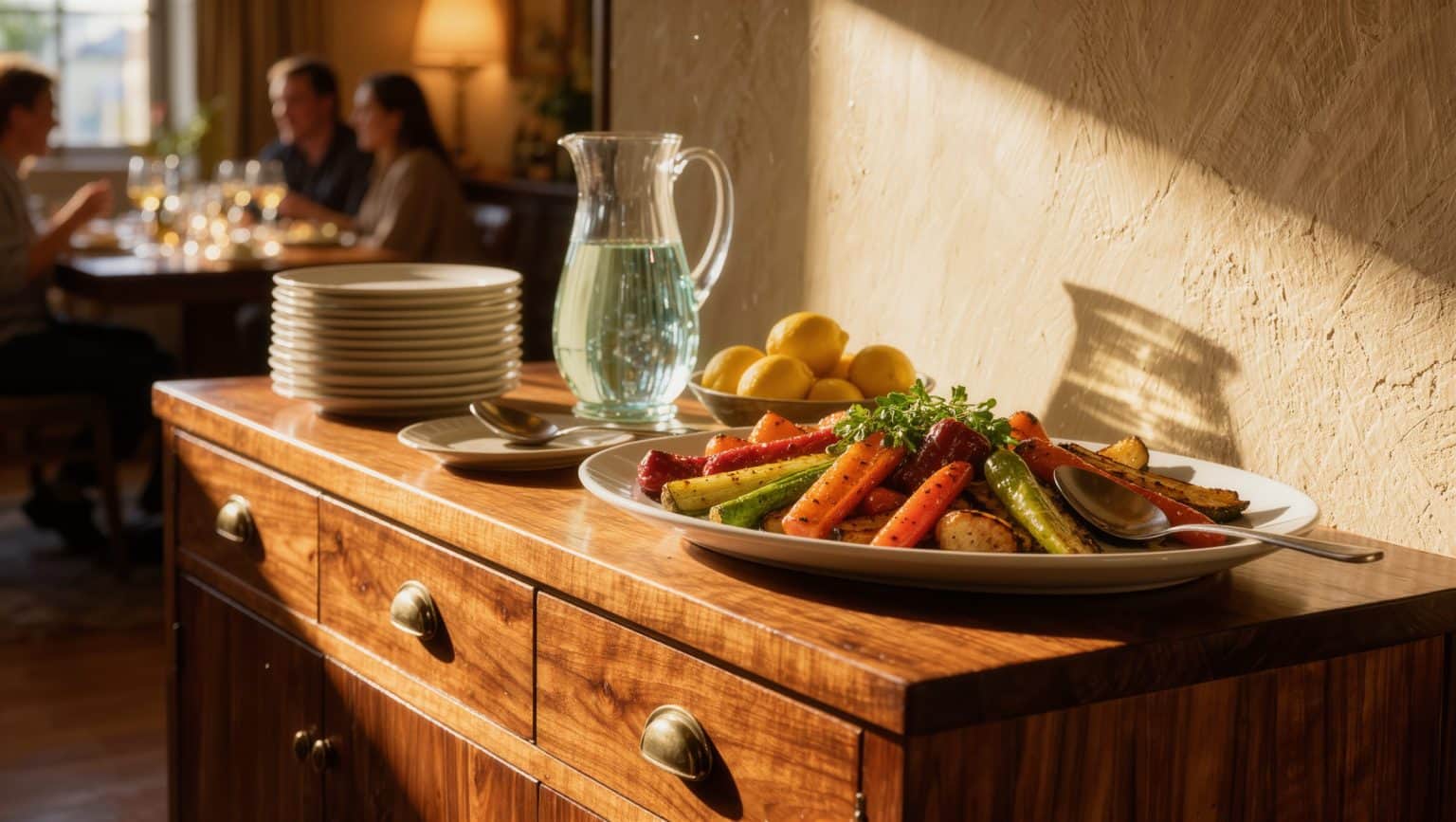
Your sideboard has one job, and it is not looking good. Its job is to take pressure off the table.
Everything else — the linens, the lamp, the bare wall it justifies — is a bonus you collect once the job is handled. Most sideboards never get that far. They are bought as furniture and then used as a shelf, and by eight o’clock they are holding candles, unopened mail, and the serving bowl nobody can reach.
Name the pressure
I spend my working life looking at systems where the visible problem is not the actual problem, and a dinner table is no different. A crowded table is almost never a table problem. It is a staging problem with nowhere to go.
There are five pressures worth relieving, and they do not all want the same answer:
- The table is too crowded. Refills, bottles, backup bread and stationary sauces come off the dining surface entirely.
- The kitchen is too far. Stage the next useful thing where it will be needed, not where it was made.
- Hot dishes are hard to pass. Give them a fixed landing place and one person who serves from it.
- The host keeps standing up. Build a station that covers the first hour without a single trip.
- Used dishes have nowhere to go. Give them a destination that never touches the clean one.
A sideboard with no governing problem becomes decorative real estate. Decorative real estate has a remarkable ability to fill itself while solving nothing.
A sideboard doing one job properly
- Drinks stationGlasses, ice, the bottle, one opener. Nothing here should require a trip to the kitchen.
- LandingDeliberately empty. This is the space that makes everything else survive the evening.
- Refill stationBackup bread, the second sauce, the water nobody wants to ask for
- Dirty returnFar end, and never beside the clean side. That pairing is the one that ruins a sideboard.
One job, maybe two
Refill station, drinks station, landing place for hot dishes, dessert staging, dirty-plate return. Pick one. Allow a second only if the surface is long enough to keep them genuinely apart, and never pair clean service with dirty return — that is the combination that fails first and worst.
When a surface is holding active food, empty plates, drinks, flowers and tomorrow’s mail, it has not become multifunctional. It has become a witness.
Walk it with the chairs out
This is the step everyone skips and the one that decides whether any of the rest works. A sideboard can sit three feet from the table and be completely unreachable.
A pulled-out dining chair eats about two feet. Put a person in it and you want close to a yard of clear floor behind them before a route counts as a route. So pull the chairs out, imagine them occupied, open every door and drawer within reach, and walk four things:
- Kitchen to sideboard, carrying a full serving piece.
- Sideboard to table with one hand already occupied.
- Table back to sideboard with an empty or messy dish.
- Sideboard to kitchen while somebody else is using the room.
If two of those cross, the sideboard is not your problem. Traffic is. And it will show up at 8:20 as someone standing behind an occupied chair holding something hot, waiting for a stranger to notice them.
The zones
Divide the surface even if it is small. An arrival zone, clear and heat-protected, wide enough for the largest thing that will land on it. An active zone holding the dish being served, its utensil, and nothing else. A reserve zone for the second bowl, the backup bread, the batch that does not need an audience yet. A return zone only if the surface is genuinely long enough — otherwise send returns elsewhere and stop pretending.
Leave real gaps between them. Empty surface is not wasted surface. It is where the next thing lands without knocking a bottle into the gravy.
Within each zone, arrange in the order a person uses it: plate, dish, utensil, condiment, somewhere to set the utensil down. Service order beats symmetry. A perfectly balanced station can still be functionally absurd, and the guest working that out is doing it one-handed.
Heat
Stable trivets, a surface that can take it, handles turned in but still reachable, and a heat-safe place for the spoon to rest.
Anything very hot and very heavy does not move. Assign a person to serve from it or send guests up one at a time. Do not send a loaded Dutch oven on laps around the table.
Every active dish needs somewhere for its utensil to live — a small plate, a spoon rest, a folded napkin. Without one, a single spoon starts touring the dishes, which matters the moment anyone at the table is avoiding something. Make the right utensil obvious. Nobody should have to run a small forensic investigation before serving themselves.
The bar
Drinks generate bottles, glasses, ice, condensation, garnish, openers, spills and constant return traffic. If the sideboard is also holding food, one of them has to lose, because running both from one surface is how a wine bottle ends up in the bread.
Order matters more here than anywhere: glasses, ice, the drink, garnish, napkins, then a clear place to set a finished glass. A tray under the bottles. An opener that is visibly present rather than theoretically nearby. Ten pounds of ice for eight people, and more than you think for anything running past two hours.
I care about the next part more than is strictly reasonable. The nonalcoholic option gets its own proper glassware, its own garnish, and a position someone can reach without negotiating past the wine. A teetotaler drink hidden behind three bottles is not an equal option. It is an administrative afterthought wearing citrus.
Where the dirty plates go
Empty platters, drained bottles, used napkins and stray spoons accumulate faster than anyone plans for. Decide their destination before the first course, not during the third.
Small sideboard: keep it entirely clean and send returns to a kitchen counter or a cart. Long sideboard: give one end to returns and put a tray there, so the boundary is visible instead of theoretical. Either way, never let a used plate drift into the reserve zone. Nothing announces that an evening has entered its decline quite like fresh bread arranged beside a stack of scraped plates.
Five minutes before the door
With the room set the way it will actually be:
- Take everything purely decorative off the surface.
- Put down the largest thing that will sit there.
- Add its utensil and something for the utensil to rest on.
- Add the first likely refill. Only the first.
- Walk the route with the chairs out.
- Run one refill and one dirty-dish return.
- Reach for every item with one hand full.
- Remove whatever creates a reach, a spill, a burn or a line.
It should feel boring. That is the compliment. Service furniture is allowed to be competent before it is photogenic.
When it earns the space
Use a sideboard when it genuinely reduces passing, protects the table and gives you a predictable route. Skip it when the path is bad, the surface is unstable, or the room already has a better counter. A cart you can move beats a beautiful cabinet in the wrong corner, and I will take the cart every time.
The first thing I move is always the water. It is the highest-traffic object on any table and the least interesting to look at, and getting it onto another surface buys more room than an hour of careful arranging.
A sideboard does not have to look busy to prove dinner is generous. It has to keep the meal moving and the host sitting down often enough to remember why these people were invited.
Part of Hosting & Service.


