The Dishwashing Tax Nobody Budgets For
Every serving piece, cocktail tool, sheet pan, and tiny condiment bowl charges interest after dinner.
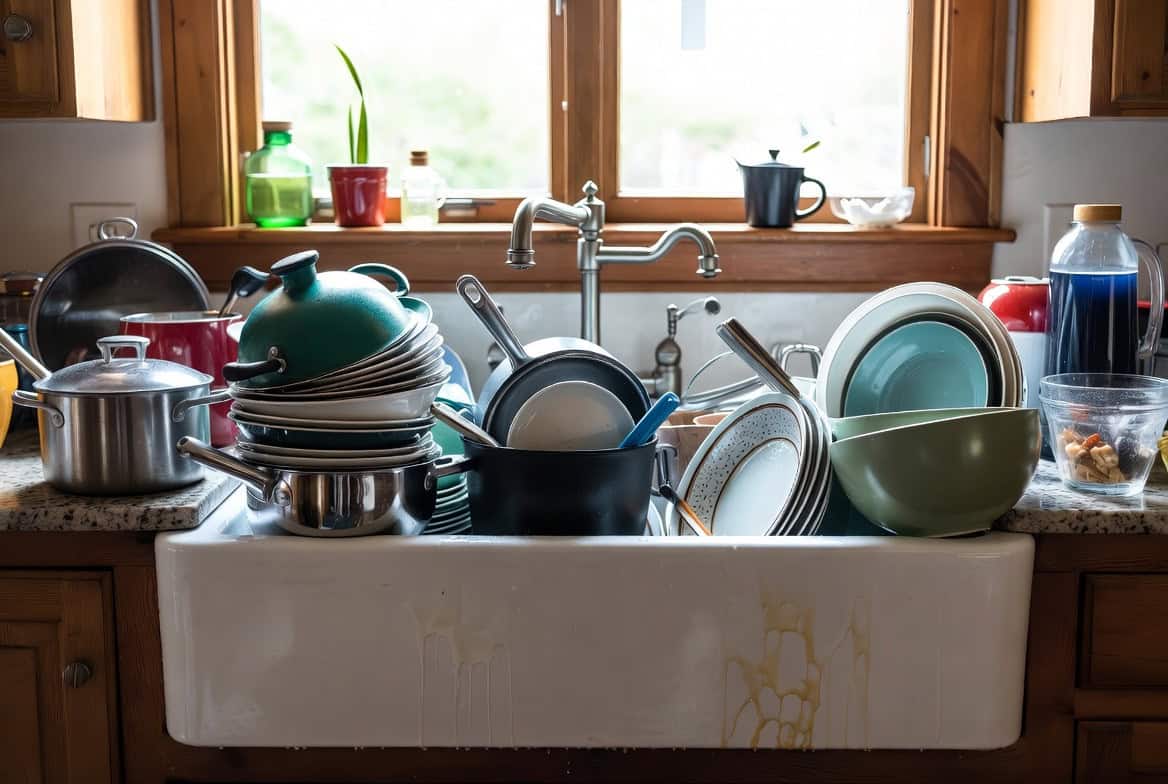
Nobody plans the cleanup, and then the cleanup plans your night. Every serving piece, cocktail shaker, sheet pan, and thimble-sized condiment bowl quietly charges interest, and the bill comes due at exactly the moment you would like to sit down with a drink and your guests.
We treat cleanup like the epilogue—the boring part after the story is over. It is not. Cleanup decides whether you have counter space mid-party, whether the sink is usable when you need it, whether leftovers get stored properly, and whether you spend the last hour of your own dinner as a short-order dishwasher.
A menu can be generous and beautiful without turning every component into its own load of dishes.
Count the vessels before you count the ingredients
Walk through the menu and write down what each dish touches on its way to the table.
A dip can use a mixing bowl, a baking dish, a storage container, a serving bowl, and a spoon. That is five pieces for one dip before anyone has eaten it. If the recipe can be mixed, baked, and served in one good oven-to-table vessel, three of those pieces disappear.
The same is true of salad. Do you need a prep bowl and a serving bowl? Maybe. Do you need three little bowls for toppings that could be staged in one tray? Probably not.
Dish count is not a reason to make boring food. It is a reason to stop laundering the same ingredient through four containers because each stage had a different aesthetic fantasy.
One dip, counted twice
| The dish | Vessels it touches | What that costs you at nine o'clock |
|---|---|---|
| Dip, staged the usual way | Mixing bowl, baking dish, storage container, serving bowl, spoon | Five pieces before anybody has eaten anything |
| Dip, one vessel | Mixed, baked and served in the same oven-to-table dish | Two, and the sink is still available when the main course needs it |
| Salad, staged the usual way | Prep bowl, serving bowl, three small topping bowls | Five, and three of them are decorative |
| Salad, one tray | Prep bowl, serving bowl, one staged tray | Three, and nobody at the table can tell |
Buy for double duty where it actually helps
A skillet, Dutch oven, shallow baking dish, sheet pan, platter, or mixing bowl that can move from prep to cooking to service is more valuable to a host than many single-use gadgets.
I am not arguing for one-pot everything. Some foods need separate vessels to get the texture right. Raw meat and ready-to-eat food need appropriate separation. A delicate sauce may need its own pan. The point is not austerity.
The point is noticing when the extra vessel changes nothing.
An oven-to-table baking dish can be set on a trivet and look completely intentional. A folded linen under a plain casserole dish has solved more hosting aesthetics than a surprising number of decorative serving pieces.
Make the sink part of the service plan
Protect one side of the sink if you can. The whole sink becoming a vertical storage unit is where the kitchen starts to lose function.
Decide what genuinely has to be washed during service: the knife needed again, the blender jar required for another course, the raw-meat board that should be cleaned and sanitized promptly, the pan needed for the next task.
Everything else can wait.
This is the part hosts fight because washing one more bowl feels productive. Sometimes it is. Sometimes you are spending ten minutes on a bowl that could soak while a side dish quietly overcooks.
Clean what restores function. Delay what merely creates visual tidiness.
Do not make the dishwasher a storage locker before dinner starts
If you have a dishwasher, start with it empty or nearly empty.
That gives dirty prep tools somewhere to go as the kitchen turns over. It also prevents the common 6:15 p.m. discovery that the dishwasher is full of clean breakfast dishes nobody unloaded because future-you was apparently expected to become more organized.
Run a load early enough that it can finish before the final prep phase if the event needs that capacity.
Do not count on a mid-party dishwasher cycle if the machine is loud, blocks access, or contains serving pieces you suddenly need. Appliances have service consequences too.
The cocktail program can quietly become a dishwashing program
Individually shaken cocktails are wonderful until ten people arrive at once and the bar produces a shaker, strainer, jigger, spoon, citrus tools, sticky cutting board, and a parade of glasses that all need attention.
If the drink is complicated, reduce complexity somewhere else. Batch what can be safely and appropriately batched. Offer one signature drink rather than five. Build the zero-proof option with the same level of thought but not necessarily a completely separate equipment ecosystem.
The bar should not consume the sink while dinner is trying to use it.
This is a good example of the dishwashing tax changing the menu itself. The drink may be excellent. The question is whether it earns the hardware during the busiest part of the night.
Tiny bowls are adorable until there are fourteen of them
Condiment bowls, garnish cups, sauce ramekins, nut dishes, olive bowls, salt cellars, pickle plates: small serving pieces multiply because each one feels inconsequential.
Together they become an archaeology layer across the counter and dishwasher.
Combine compatible garnishes. Serve sauces from one useful vessel. Put condiments on the table only if guests actually need choice. Do not give every ingredient its own apartment.
This also improves the table. Fewer small objects leave room for plates, glasses, serving platters, and human elbows.
Use parchment, foil, liners, and disposables selectively
Reducing cleanup can be worth using a liner when the liner solves a real stuck-on mess, protects a sheet pan, or makes a large batch easier to manage.
It does not mean covering every surface in disposable material by reflex. Sometimes the pan is going to need washing anyway, and now you also have trash.
Use the tool when it meaningfully reduces the cleanup burden without hurting browning, crispness, or the food. A sheet-pan vegetable that needs direct metal contact may be worse on a liner. A sticky glaze may justify one.
Again: what did the extra thing buy?
Stage the close before the doorbell
Put leftover containers somewhere accessible. Make sure trash and recycling have room. Set aside a soaking zone for the pans that can wait. Have dish towels and cleaning cloths where they normally belong instead of under a pile of party supplies.
If guests are likely to take food home, have containers for that too.
The last fifteen minutes of a party should not begin with finding lids.
Create a “done for tonight” line
This may be the most important part.
Decide what must happen before you go to bed and what can wait until morning.
Food gets stored safely. Perishables do not sit out. Raw-meat surfaces are cleaned. The sink remains functional. Fragile or expensive pieces are dealt with. Trash likely to smell or leak is handled.
The roasting pan can soak. The serving platter can wait. The wine glasses do not need to be polished at midnight unless that activity brings you personal joy.
Without a stopping point, cleanup expands until the kitchen is spotless and the host has missed the last third of the evening.
Do not outsource chaos to tomorrow completely
There is a difference between leaving nonurgent dishes and leaving a kitchen that will punish you at 7:00 a.m.
Scrape plates. Soak the pan that needs it. Consolidate glassware somewhere safe. Wipe up sticky spills. Put food away. Clear enough counter that coffee can happen.
This is not “cleaning the whole kitchen.” It is making tomorrow survivable.
Dishwashing burden should influence serving style
Family-style service often uses fewer pieces than individually plated multi-component food. A large platter can replace six plates of garnished starters. A sheet-pan side can go straight to the table in the right vessel. One good dessert can replace a tasting flight of tiny things that each require a utensil.
That does not mean family style is always easier. Large platters need space, and serving utensils matter. But the dish count belongs in the choice.
If the event already has a complicated bar and several courses, this may be exactly where to simplify.
The cleanup burden is part of the cost of a recipe
We talk about ingredient cost and cooking time, but a recipe that uses a blender, food processor, two pans, three bowls, sieve, mixer, and eight ramekins has another cost: the kitchen has to come back from it.
Sometimes the result is worth every piece. I am willing to make complicated food when the complication pays off.
But a twelve-step recipe with a barely perceptible improvement and a sink full of equipment should be judged accordingly.
Effort includes the return trip.
Function is what lets style survive the night
None of this is an argument for a bare table or a joyless menu.
It is an argument for deciding where the abundance belongs.
Let the food be extra. Let the table be beautiful. Use the good platter when it matters. Make the ridiculous dessert if the ridiculous dessert is the point.
Then let the dip stay in the baking dish. Let the bread sit in a basket. Let the sauce have one spoon. Let the skillet come to the table.
Function is not the enemy of a beautiful dinner. It is the thing that lets the beautiful part survive contact with real guests, real timing, and a real kitchen.
And when everyone is still sitting at the table instead of watching you wash ramekins, the dishwashing tax has finally been budgeted.
Count the cleanup before it becomes the last unplanned course of the evening. Occasion will put a number on it, and Hosting and Service has the rest of the room you are trying to stay in.
Part of Hosting & Service.
Where this goes next
The next thing you will need.

Pour alongside
 Drink