Family-Style Without the Table Traffic Jam
Family-style fails on circulation, not food. Service zones, vessels people can actually lift, hot dishes that stay put, and somewhere for every spoon to land.
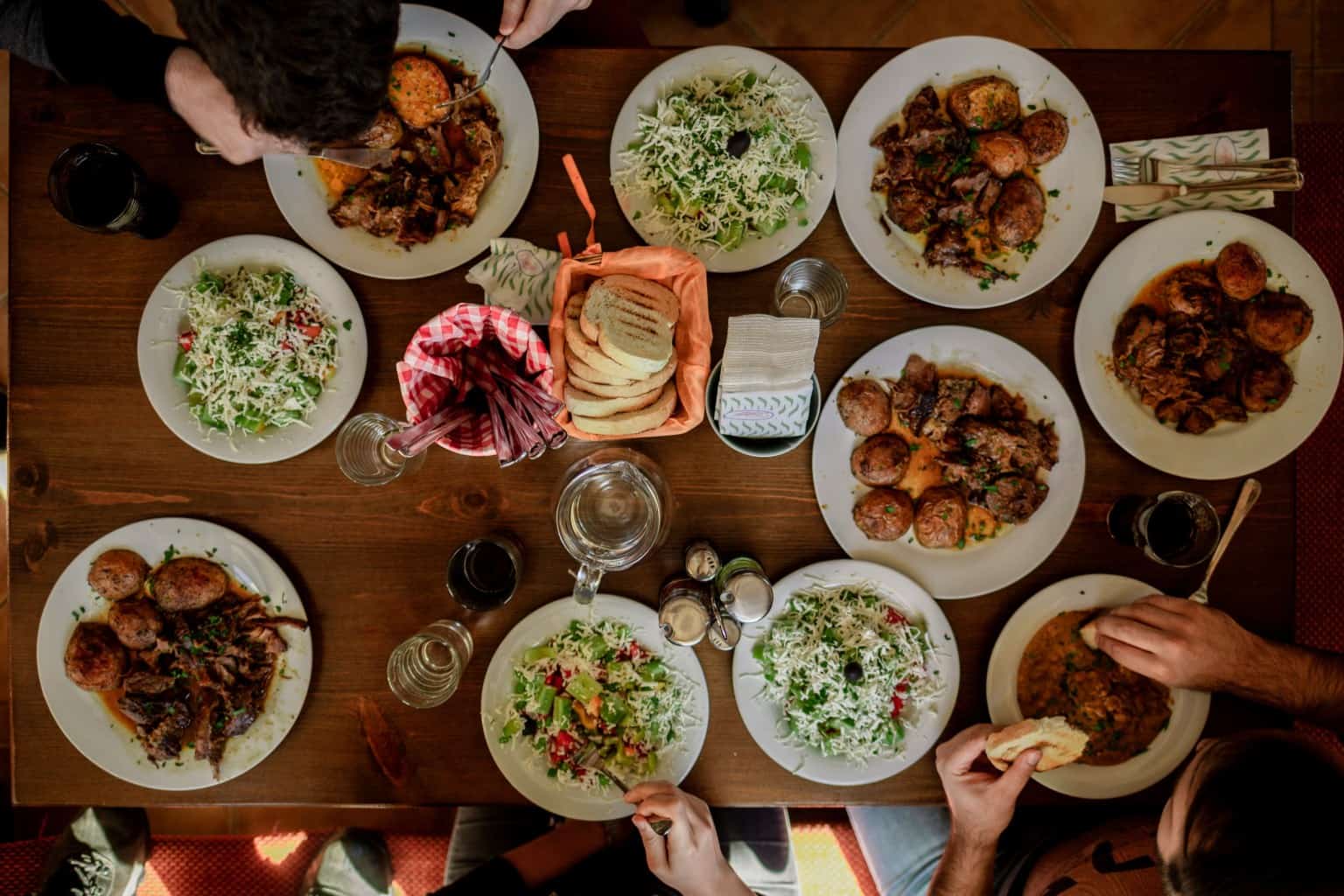
Family-style sounds generous. It can also turn dinner into a slow passing drill: hot dishes changing hands, serving spoons abandoned in the wrong bowl, elbows negotiating, and one guest holding a platter far longer than politeness should require.
The problem is almost never the food. It is circulation.
The reach rule
Most people should be able to serve themselves from one nearby main component and two nearby sides without standing, stretching across a neighbor, or starting a relay that crosses the whole table.
That does not mean duplicating everything. It means thinking in zones. On a rectangular table, run two or three service areas rather than one ceremonial pile in the middle, and split the things people reach for constantly — bread, a sturdy side, salad — into two smaller vessels, one per half. On a round table the center has to stay reachable, which tall arrangements and oversized boards quietly prevent. A table does not need a centerpiece if the centerpiece prevents dinner.
Give every dish a job
Four jobs, and each dish should have exactly one.
The anchor is the main event. Carve or portion it before it reaches the table, or put it somewhere it can be served without traveling. Good anchors portion cleanly and do not depend on being eaten within ninety seconds.
A passable side travels safely, portions cleanly, and comes with its own utensil. The test is whether a person can lift it one-handed while seated. If a vessel is awkward to lift when empty, it is not going to become more cooperative when full.
Stationary support stays where it is put: gravy, sauces, anything fragile or prone to spilling. Give it a fixed position, or move it off the table entirely.
Refills — bread, water, ice, extra dressing, the second batch — do not belong on the dining surface at all. Keep them close and off the table.
Heat stays where you put it
Very hot dishes are a different category of traffic. Heavy Dutch ovens, sizzling pans and deep casseroles should not be doing laps.
Fixed trivets, pre-portioning where it makes sense, and one person assigned to serve the hottest or most awkward thing. Bring reserve portions out from the kitchen rather than putting every batch on the table at once.
Food-safety note: holding times, storage, reheating and time at room temperature vary by dish. Follow current authoritative guidance, check ingredient labels, and handle allergy and cross-contact needs before service. See the Salty & Clever food and beverage disclaimer.
Every utensil needs a parking place
Serving spoons cause more disorder than they get credit for. Each dish needs the right utensil and somewhere for it to rest without dripping across the linen or vanishing into a neighboring bowl — a small plate, a rest, a notch in the vessel.
And one spoon should not serve several dishes when anyone at the table is avoiding something. Nobody should have to work out whether the spoon in the vegetables was last in the cream-heavy casserole.
Clear the decorative obstacles
Family-style needs negative space, and candles, flowers, menus, bottles, boards, salt cellars and glassware are all competing for the same few inches.
Keep what improves the meal. Move what merely proves the table was styled. Low decor is less disruptive than tall, but even low decor is a problem when it is sitting in the only safe landing place for a hot dish.
If the flowers need their own traffic plan, the flowers are dinner’s problem.
The check, with the chairs pulled in
Before anyone sits down, test the real table with the chairs where they will actually be:
- Can each guest reach the nearest dishes without standing?
- Can every vessel be lifted safely when full?
- Does each dish have the right utensil, and somewhere for it to rest?
- Are the hot vessels fixed and protected?
- Is there anywhere for empty dishes to go?
- Can water and bread be topped up without stopping dinner?
- Can you sit down once service starts?
If the last one is no, the menu is still asking too much.
When to stop insisting on it
Family-style earns its place when the food portions cleanly, holds through the service window, and survives handling. When dishes are very hot, fragile, messy, heavy, or tied to exact timing, a sideboard or a hybrid works better — portion the anchor in the kitchen, leave the stable sides on the table, and stop asking every guest to pass every platter.
For larger groups I almost always go hybrid, and it has never once read as less generous. Generosity is the food, not the number of bowls in transit.
Family-style should feel abundant because the meal is generous, not because every available surface is occupied. Fewer dishes, better placed, and one clear landing spot for whatever comes out of the oven next.
If the staging is the problem rather than the table, put the sideboard to work. If the kitchen is still doing too much, the fix is further upstream in the last thirty minutes.
Part of Hosting & Service.
Where this goes next
