Carrot Ribbon Salad with Orange, Dates, and Sesame
Broad carrot ribbons instead of shreds, dressed lightly and rested just long enough to bend, with orange, dates, mint, and sesame. Charring the orange before you juice it keeps three sweet ingredients from turning into dessert.
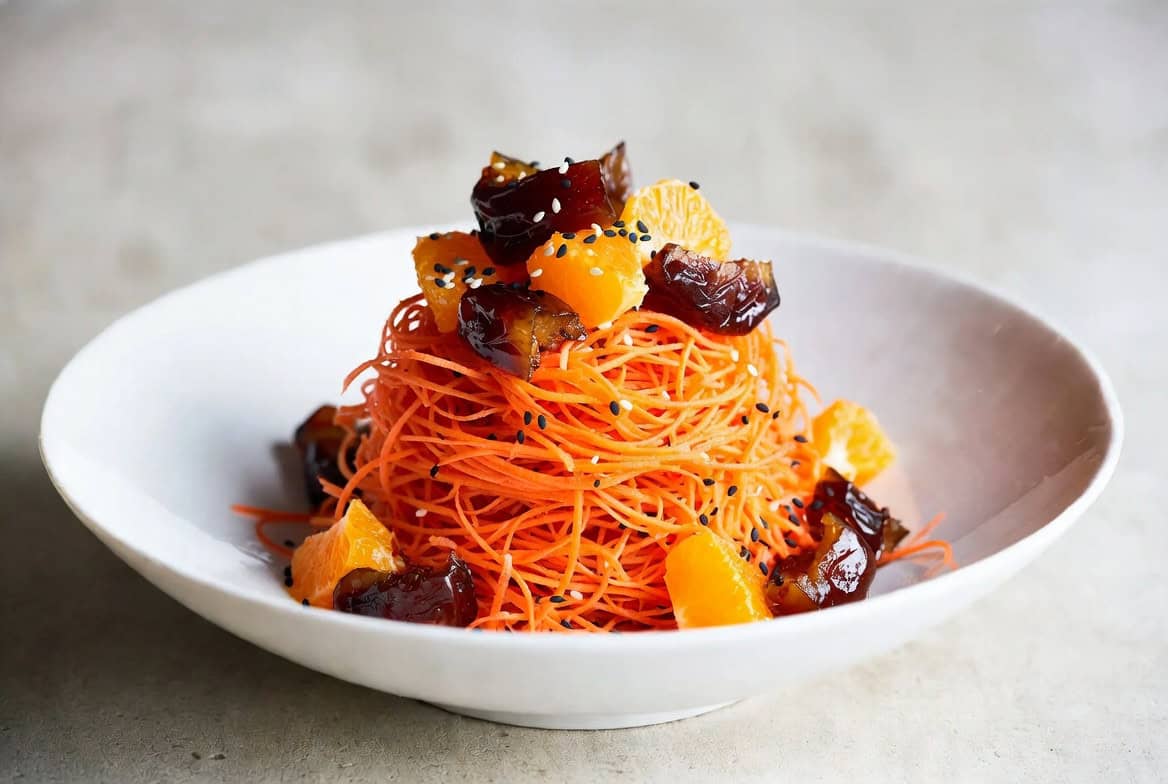
The parts that change whether this works tonight.
These fields come from the published recipe itself. If a recipe has not separately declared an operating fact, the gap stays visible instead of being filled with a guess.
- Servings
- 8 side-dish servings
- Timing
- about 45 minutes
- Equipment
- Not separately declared
- Make-ahead
- Not separately declared
- Holding
- Not separately declared
- Leftovers
- Not separately declared
- Dietary notes
- Not separately declared
- Method map
- 7 ingredient lines · 7 method steps
Pairing
Wine — A dry Muscat, or a Grüner Veltliner. Carrots, orange, and dates are all sweet in different registers, so the wine needs aromatics to keep pace and acid to keep it honest. Mixed drink — Campari and soda with a slice of orange. Bitterness is the one thing missing from this bowl and it arrives far more cheaply in a glass than in the dressing. Teetotaler — Unsweetened iced mint tea, or carrot juice with lemon and salt if you want to commit. Both work; the second is more interesting and the first is more forgiving.
Tools
A genuinely sharp Y-peeler, which is the whole recipe in one object; a dull one shreds instead of shaving and there is no recovering from that. A small serrated knife for supreming the oranges. A dry skillet. A platter wide enough that the ribbons land loose rather than compressed.
Ingredients · swaps in parentheses
Large carrots. Oranges (blood oranges for deeper color and more bitterness, mandarins if fully peeled and drained). Dates (soft dried apricots). Mint. Flat-leaf parsley (cilantro, which pushes the whole thing louder). Sesame seeds (pistachios). Cider vinegar (lemon juice if the oranges run very sweet). Honey. Dijon. Olive oil. Salt. Black pepper. Optional scallion and a pinch of cumin or Aleppo.
Magic
Halve the orange you are juicing and press the cut faces into a dry, screaming-hot skillet until they blacken in patches, about 90 seconds, then squeeze it hot into the dressing. Charred juice comes back tasting like orange with a shadow behind it, faintly bitter and a little smoky, and that shadow is exactly what stops the dates from running the salad. Not feeling brave? Toast the cumin or Aleppo in the dry pan for thirty seconds instead. Less drama, same job.
Gotcha
Orange segments carry a surprising amount of loose juice, and if you tip them in wet along with a heavy hand of dressing, the platter floods within ten minutes and the ribbons go slack. Drain the segments on a paper towel, dress with two-thirds and stop, and add the rest only if the salad looks dull.
Most carrot salads fail in the same place. Someone grates the carrots, the shreds weep, the dressing goes in early, and forty minutes later you are serving orange confetti in a puddle. Ribbons fix it. A broad shaved ribbon has enough structure to bend without collapsing, it catches dressing on its surface rather than absorbing it, and it looks like something rather than like the aftermath of something.
The other half of the fix is sweetness accounting. Carrots are sugary, oranges are sugary, dates are essentially candy. Three sweet things in one bowl and the salad drifts toward dessert unless acid, salt, fat, and a little bitterness show up to hold the line. The dressing here is deliberately restrained and deliberately sharp.
Yield and timing
Yield: 8 side-dish servings. Prep: about 30 minutes. Rest: 15 minutes. Total: about 45 minutes. Best service window: within 1 hour of final assembly.
Ingredients
For the salad
- 2 pounds large carrots, peeled
- 3 medium oranges
- 8 soft dates, pitted and thinly sliced
- 1/2 cup loosely packed mint leaves
- 1/2 cup flat-leaf parsley leaves
- 3 tablespoons toasted sesame seeds
- 2 tablespoons thinly sliced scallion, optional
For the orange-cider dressing
Use 1/4 cup fresh orange juice, 2 tablespoons apple cider vinegar, 1 teaspoon honey, 1 teaspoon Dijon mustard, 3 tablespoons extra-virgin olive oil, 1/2 teaspoon kosher salt, 1/4 teaspoon freshly ground black pepper, and an optional pinch of ground cumin or Aleppo pepper.
Method
- Shave the ribbons. Run the Y-peeler down the length of each carrot to take long, broad ribbons. Rotate the carrot as you go and stop while the core is still wide enough to grip safely. Save the cores for stock.
- Supreme two oranges. Cut away peel and white pith, then cut between the membranes over a bowl to release clean segments. Squeeze the spent membranes into the same bowl.
- Get your 1/4 cup of juice. Halve the third orange and squeeze it, topping up from the membrane bowl as needed. For the magic version, char the cut faces in a dry hot skillet until blackened in patches before you squeeze here.
- Whisk the dressing. Orange juice, cider vinegar, honey, Dijon, salt, black pepper, and the optional spice go in first. Stream in the olive oil while whisking. Taste it on a ribbon, not on a spoon, because a spoonful of dressing always tastes sharper than the same dressing on a carrot.
- Dress and rest. Toss the ribbons and sliced dates with about two-thirds of the dressing. Rest for 10 to 15 minutes, tossing once. The carrots go from rigid to pliable in this window; that is the point of it.
- Fold in the fresh things. Drained orange segments, mint, parsley, optional scallion, most of the sesame. Use your hands. Tongs bruise herbs faster than fingers do.
- Plate loose. Pile onto a broad platter with visible height, then finish with the remaining sesame and a few whole leaves.
What the finished salad should be doing
Ribbons that bend but still snap slightly at the break. Orange segments intact and recognizable, not smeared. Dates showing up as occasional dark punctuation rather than a sweet layer running underneath everything. The herbs should read green and alive; if they look bruised and dark, they went in too early or got stirred too hard. And the platter under the salad should be glossy, not wet. If there is a visible pool, you over-dressed, and the fix next time is less dressing rather than more carrot.
Sweetness accounting, in practice
Taste the salad after the 15-minute rest and before the herbs go in. If it reads sweet, the answer is cider vinegar first, then salt, then black pepper, in small increments. Do not add more orange juice trying to make it taste brighter, because orange juice is sugar with citrus attached and it will make the problem worse while feeling like a solution. Black pepper is underrated here; a quarter teaspoon on sweet vegetables does something acid alone cannot, adding a dry heat at the back of the bite that keeps you eating.
The service timeline
The day before: peel the carrots and make the dressing, stored separately and both refrigerated.
Up to four hours ahead: shave the ribbons and hold them in the fridge between barely damp paper towels. Barely damp is doing real work in that sentence; soaking wet towels waterlog the ribbons and dilute everything downstream.
One hour ahead: supreme the oranges and slice the dates. Oil the knife blade lightly before slicing dates, or they weld themselves into a sticky brick and you will be picking them apart with your fingers while guests arrive.
Fifteen minutes before service: dress the carrots, rest, then fold in citrus, herbs, and sesame.
Leftovers, honestly
This does not hold beautifully, and pretending otherwise helps nobody. Refrigerate within two hours and use inside two days. By day two the ribbons have gone limp and the herbs are finished, but the flavor is still good, which makes it useful chopped roughly and piled next to grilled lamb or folded through sturdy greens with a fresh splash of vinegar. Add new sesame and a few new herb leaves when you serve it again. The original crunch is not coming back and no amount of stirring will convince it otherwise.
Part of Recipes & Technique.
Recipe provenance: Salty & Clever editorial formulation, built from established culinary technique and the traditions identified in the article. No chef, restaurant, family, or firsthand cultural provenance is claimed unless it is explicitly named and sourced. How we write and check recipes


