Crab-Cake Benedict with Brown-Butter Hollandaise and Celery-Lemon Relish
Lump crab cakes replace the English muffin under poached eggs, with nutty brown-butter hollandaise and a cold celery-lemon relish to keep the whole thing sharp.
Serve alongside
Serve within 10 minutes of poaching; keep hollandaise warm for no more than about 30 minutes.
Tools
Mixing bowls, parchment-lined plate, large skillet, wide saucepan, slotted spoon, immersion blender, tall blending cup, small saucepan, heatproof measuring cup, instant-read thermometer, thin wide spatula
Ingredients · swaps in parentheses
Lump crab, panko, eggs, mayonnaise, Dijon, seafood seasoning, lemon, chives, celery, capers, olive oil, unsalted butter, optional cayenne, neutral oil, vinegar, kosher salt, black pepper
Magic
Fold crab gently chill cakes before searing add warm brown butter slowly to the yolks keep hollandaise warm rather than hot preserve the cold celery relish until plating.
Before you begin
Shape and chill crab cakes, make the celery-lemon relish, brown the butter, and set up the poaching water before making hollandaise.
The parts that change whether this works tonight.
- Yield
- 4 servings
- Time
- About 1 hour 30 minutes
- Equipment
- Mixing bowls, parchment-lined plate, large skillet, wide saucepan, slotted spoon, immersion blender, tall blending cup, small saucepan, heatproof measuring cup, instant-read thermometer, thin wide…
- Make-ahead
- One day ahead: Shape the crab cakes and make the celery relish. Refrigerate separately
- Holding
- Within 10 minutes of poaching the eggs
- Leftovers
- Refrigerate cooked crab cakes and leftover relish within two hours and use within 2 days
- The method
- 26 ingredients · 7 steps
From this recipe’s own yield and timing lines, Kitchen Kit, make-ahead, holding, and batching section and storage and food-safety limits section. Nothing here is a guess.
Eggs Benedict is already a rich breakfast. Putting a crab cake underneath it and then pretending the answer is simply more hollandaise would be a fairly efficient way to make four bites feel like twelve. The better move is to let the crab cake replace the bread entirely, brown the butter for depth, and put a cold lemony celery relish on the plate where acidity and crunch can actually interrupt the richness.
This is a show-off breakfast. It earns the extra work only if the crab still tastes like crab and the hollandaise arrives silky rather than as a butter blanket.
Yield and timing
- Yield: 4 servings
- Prep: 30 minutes
- Chill: 30 minutes
- Cook: 30 minutes
- Total: About 1 hour 30 minutes
- Best service window: Within 10 minutes of poaching the eggs
Ingredients
For the crab cakes
- 1 pound lump crab meat, picked over for shell
- 1/3 cup panko breadcrumbs
- 1 large egg
- 2 tablespoons mayonnaise
- 1 teaspoon Dijon mustard
- 1 teaspoon seafood seasoning
- 1 teaspoon finely grated lemon zest
- 2 tablespoons finely chopped chives
- 1 tablespoon fresh lemon juice
- 2 tablespoons neutral oil, for searing
For the celery-lemon relish
- 2 celery stalks, very finely diced
- 1 tablespoon capers, drained and chopped
- 2 tablespoons chopped chives
- 1 tablespoon fresh lemon juice
- 1 teaspoon olive oil
- Freshly ground black pepper
For the brown-butter hollandaise
- 10 tablespoons unsalted butter
- 3 large egg yolks
- 1 tablespoon fresh lemon juice
- 1 tablespoon warm water, plus more as needed
- 1/2 teaspoon Dijon mustard
- Pinch of kosher salt
- Pinch of cayenne, optional
For the eggs
- 4 large eggs
- 1 tablespoon white vinegar, optional
- Chives and lemon wedges, for finishing
Method
Where the time goes
- 30 minBuild the crab cakes
- Make the relish
- 4–6 minBrown the butter
- Make the hollandaise
- 3–4 minSear the crab cakes
- 3–4 minPoach the eggs
- Assemble
- Build the crab cakes: In a bowl, whisk egg, mayonnaise, Dijon, seafood seasoning, lemon zest, chives, and lemon juice. Fold in crab and panko with as few turns as possible. Divide into four cakes about 3 1/2 inches wide. Place on a parchment-lined plate and refrigerate 30 minutes.
- Make the relish: Combine celery, capers, chives, lemon juice, olive oil, and black pepper. Refrigerate until service. Taste before adding salt; capers have already made a contribution.
- Brown the butter: Melt butter in a small saucepan over medium. Continue cooking until the milk solids turn deep golden and smell nutty, 4 to 6 minutes. Pour immediately into a heatproof measuring cup, scraping in the browned bits. Let cool for several minutes; it should be hot but not violently so.
- Make the hollandaise: Put egg yolks, lemon juice, warm water, Dijon, salt, and cayenne in a tall narrow container. Blend with an immersion blender for 10 seconds. With the blender running, stream in the warm brown butter very slowly until the sauce thickens and emulsifies. If too thick, blend in warm water 1 teaspoon at a time. Keep warm, not hot, while you finish the dish.
- Sear the crab cakes: Heat neutral oil in a large skillet over medium. Cook crab cakes for 3 to 4 minutes per side until deeply golden and heated through. Turn only once and use a thin wide spatula.
- Poach the eggs: Bring a wide saucepan of water to a bare simmer; add vinegar if using. Crack each egg into a small cup, slide into the water, and poach 3 to 4 minutes until the whites are set and yolks remain soft. Lift with a slotted spoon and blot briefly on a clean towel.
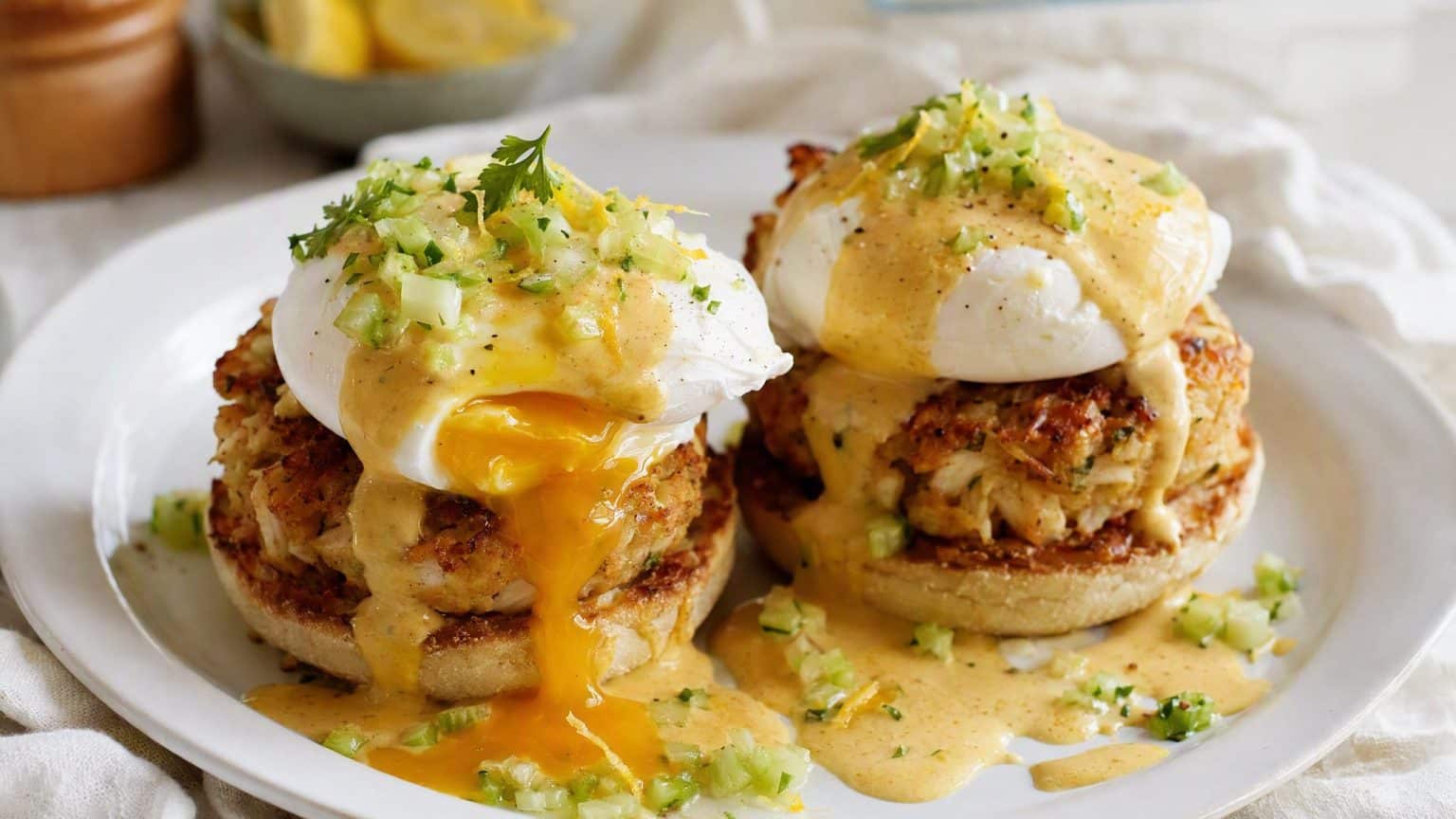
- Assemble: Put one crab cake on each warm plate. Add a poached egg, spoon over enough hollandaise to coat the top without hiding the crab cake, and add a spoonful of celery-lemon relish beside or partly over the sauce. Finish with chives, black pepper, and lemon.
Plating the benedict
The crab cake needs to remain visible. Put hollandaise over the egg and allow it to fall naturally onto part of the cake rather than flooding the plate. Keep the celery relish bright and discrete so the plate shows the textural logic: golden crab, white egg, glossy brown-butter sauce, pale-green celery, chives, and a cut yolk.
Make-ahead, holding, and batching
One day ahead: Shape the crab cakes and make the celery relish. Refrigerate separately. Brown the butter and refrigerate, then warm gently before making hollandaise.
Up to 30 minutes ahead: Poach eggs, transfer to ice water, and refrigerate if needed. Rewarm them for 30 to 45 seconds in hot—not boiling—water immediately before plating.
Hollandaise: Make as close to service as practical. Hold it warm for no more than about 30 minutes, stirring occasionally. If it thickens, whisk or blend in a teaspoon of warm water.
Substitutions that work
- Fresh claw crab: Can replace lump crab; the cakes will be less visually chunky but still flavorful.
- Salmon cakes: Use cooked flaked salmon in the same format and reduce seafood seasoning to taste.
- Clarified butter: Makes a more classic hollandaise but loses the nutty brown-butter note.
- Fennel: Replace half the celery with finely diced fennel for a more aromatic relish.
- Fried eggs: Operationally easier than poaching and still very good if brunch timing is already misbehaving.
Likely failure points
The crab cakes break: The mixture was too wet, insufficiently chilled, or handled repeatedly in the skillet. Chill fully and turn once.
The crab disappears into filler: Too much panko was used or the crab was shredded while mixing. Fold gently and stop once the cake holds together.
The hollandaise splits: Brown butter was too hot or added too quickly. Let it cool slightly and stream slowly. If the sauce breaks, blend 1 tablespoon warm water with a fresh yolk in a clean container and slowly blend the broken sauce into it.
The plate is too salty: Crab, capers, seafood seasoning, and Dijon all arrive seasoned. Taste every component before adding extra salt.
Everything is rich at the same temperature: The relish got warm or disappeared under sauce. Keep it cold until the plate is assembled.
Storage and food-safety limits
Refrigerate cooked crab cakes and leftover relish within two hours and use within 2 days. Reheat crab cakes to 165°F. Hollandaise is best made fresh and should not be saved after extended warm holding. Because the sauce and poached eggs may contain undercooked yolk, use pasteurized eggs when serving people at higher risk for foodborne illness.
Kitchen Kit
Pairing: Sparkling lemon-celery tonic, strong coffee, or a very dry sparkling wine if this is that kind of brunch. Nothing creamy. The plate has covered that department.
Goods: Lump crab, panko, eggs, mayonnaise, Dijon, seafood seasoning, lemon, chives, celery, capers, olive oil, butter, optional cayenne, neutral oil, vinegar, salt, and black pepper.
Gear: Mixing bowls, parchment-lined plate, large skillet, wide saucepan, slotted spoon, immersion blender, tall blending cup, small saucepan, heatproof measuring cup, instant-read thermometer, and thin wide spatula.
Before: Shape and chill the crab cakes, make the cold relish, brown the butter, and set up the poaching water before emulsifying the hollandaise.
Magic: Protect the lump crab from overmixing, chill the cakes before searing, stream brown butter slowly into the yolks, and keep the cold celery relish separate enough to do its job.
This is brunch excess with a governing idea. The crab is the base, the yolk and hollandaise are the sauce, and the celery-lemon relish is the reason you want the next bite.
Part of Recipes & Technique.
Recipe provenance: Salty & Clever editorial formulation, built from established culinary technique and the traditions identified in the article. No chef, restaurant, family, or firsthand cultural provenance is claimed unless it is explicitly named and sourced. How we write and check recipes
Where this goes next

