Salmon Burgers with Ginger, Scallion, and Sesame Slaw
Hand-chopped salmon burgers built at two different chop sizes, so the patty binds itself and still flakes. A cold sesame slaw does the cutting.
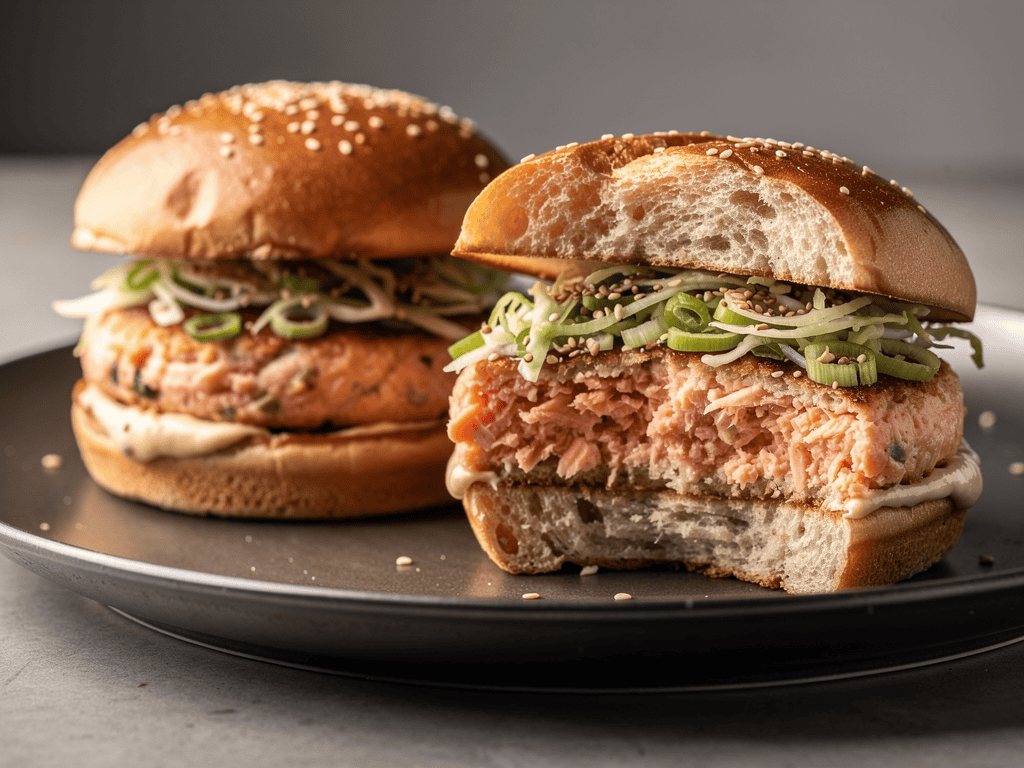
The parts that change whether this works tonight.
- Yield
- 4
- Time
- 35 minutes
- Equipment
- A knife you have actually sharpened this year, a wide cutting board, a microplane for the ginger, and a heavy skillet with a thin…
- The method
- 15 ingredients · 5 steps
From this recipe’s own recipe card. Nothing here is a guess.
Pairing
Wine — Grüner Veltliner or dry cider. Mixed drink — Whisky highball with ginger and lime. The burger is already rich; the drink should be long and cold. Teetotaler — Ginger-sesame limeade. Ginger, scallion, and sesame slaw want something peppery-green, not a buttery white.
Tools
A knife you have actually sharpened this year, a wide cutting board, a microplane for the ginger, and a heavy skillet with a thin metal spatula. No food processor. That is the whole point.
Ingredients · swaps in parentheses
Skinless salmon, scallions, fresh ginger, soy sauce (tamari), toasted sesame oil, panko, egg white, neutral oil, buns (brioche or a soft potato roll), green cabbage (napa), carrot, rice vinegar (cider vinegar), honey (maple syrup)
Magic
Take the sesame oil out of the patty mix and brush it on at the end instead. Toasted sesame oil is almost entirely aroma, and aroma is the first casualty of a hot pan: a teaspoon stirred into raw fish and then seared for eight minutes is a teaspoon you bought and will never smell. Painted over the burgers the second they leave the skillet, that same teaspoon reaches the table ahead of the burger. Not feeling brave? Half in the mix, half brushed on, and hold the two up to your nose before you decide.
Gotcha
Salmon goes from succulent to chalky in under a minute. Pull the patties while the center is still faintly translucent; the residual heat closes the gap while you are toasting buns.
Beef set the standard for burgers, and that standard is wrong for salmon. The fat is different. Salmon carries plenty of it, but it is soft, quick-melting fat that leaves early, which shrinks the cooking window to something closer to a steak than a patty. So the seasoning has to be decided before the fish touches the pan. Ginger, scallion, and sesame do that job without pretending the fish is not there.
Serves: 4
Time: 35 minutes
Ingredients
- 1 1/4 pounds skinless salmon
- 2 scallions, finely sliced
- 1 tablespoon grated ginger
- 1 teaspoon soy sauce
- 1 teaspoon toasted sesame oil
- 1/2 cup panko
- 1 egg white
- 1 tablespoon neutral oil
- 4 buns
Slaw
- 3 cups shredded cabbage
- 1 small carrot, grated
- 1 tablespoon rice vinegar
- 1 teaspoon soy sauce
- 1 teaspoon sesame oil
- 1 teaspoon honey
Method
Where the time goes
- Chop at two scales
- 15 minMix and chill
- Dress the slaw
- 3–4 minSear
- Build
- Chop at two scales. Cut one-third of the salmon into very small pieces, almost a mince. Chop the remainder into 1/4-inch pieces. Keep the two piles separate in your head even if they end up in the same bowl; you are building a structure, not a mixture.
- Mix and chill. Combine the salmon with scallion, ginger, soy, sesame oil, panko, and egg white. Form four patties, dimple the centers slightly with your thumb, and chill 15 minutes.
- Dress the slaw. Toss the cabbage and carrot with rice vinegar, soy sauce, sesame oil, and honey. Do it now so the cabbage has time to slump a little, and taste it before it goes anywhere near a bun.
- Sear. Heat the neutral oil in a skillet over medium-high heat until it shimmers and moves fast when you tilt the pan. Cook the burgers 3 to 4 minutes per side, until deeply browned and barely opaque at the center. Turn once. Turning twice is how patties come apart. For the magic version, leave the sesame oil out of the patty mix and brush it across the burgers here, the moment they come off the heat.
- Build. Toast the buns in the pan drippings, stack burger then slaw, and serve while the crust is still loud.
“Why not use the food processor?” “Because paste is efficient and a burger should still have texture.”
Two sizes of salmon, one job each
The fine mince is the glue. Chopped small enough, salmon releases sticky myosin, the same protein that lets a sausage hold together, and that tack is what binds the patty. The 1/4-inch pieces are the payload: they stay intact through the sear, so the burger flakes when you bite it rather than compressing into a puck. A food processor destroys both jobs at once. It smears the protein into an emulsion and pulverizes the pieces, and what comes out is a pale, springy disc with the texture of a supermarket fish cake. Fifteen minutes of knife work buys a burger that cannot be bought.
Keep the fish cold while you chop. Salmon that has warmed up on the board gets soft and gummy under the blade, and the pieces start tearing instead of cutting. If the fish is sliding around, put it back in the fridge for ten minutes and sharpen the knife while you wait.
The knife is not a flourish here, it is the structure. A dull blade tears the quarter-inch pieces instead of cutting them, the torn edges leak, and the patty binds itself into exactly the paste the food processor would have given you for free. Sharpen before you shop, not after the fish is on the board.
The chill does actual work
Fifteen minutes in the fridge is not a resting ritual. Two things happen. The panko finishes drinking the moisture the salmon and the egg white have released, which is the difference between a binder and a handful of dry crumbs sitting in wet fish. And the surface fat firms up, so the patty holds its shape for the first thirty seconds in the pan, which is exactly when it is most likely to slump and split. Skip the chill and you will be pressing a collapsing patty back together with a spatula, which is a losing negotiation.
The thumbprint in the center matters for the same reason it matters with beef. Protein contracts as it cooks, and a flat patty domes. A dimpled one comes out level, which is the difference between a burger that sits on a bun and one that rolls off it.
Neither of those is fussiness. Fifteen minutes in the refrigerator and a thumb pressed into the middle are the two cheapest interventions on this page, they cost nothing except waiting, and they are the two most often skipped because neither one looks like cooking.
Heat, and knowing when to quit
Medium-high is the target, and the pan should be hot enough that the patty sizzles the instant it lands. Too low and the fish steams in its own moisture, going gray and weeping into the pan before any crust forms. Too high and the panko scorches while the interior is still raw, which reads as bitter more than burnt.
The doneness cue is visual and it is at the edge, not the top. Watch the side of the patty: opacity climbs from the bottom as it cooks. When it has traveled about three-quarters of the way up, flip once. When it has closed to a thin translucent seam at the center, take it out. Salmon carries enough residual heat to finish itself on the plate, and a burger that looks perfect in the pan is already a burger that will be dry on the bun.
What belongs on the bun, and what does not
Keep the slaw cold and add it at the last moment. It is doing two things: the vinegar cuts the richness of the fish, and the raw cabbage gives the sandwich a crunch that the soft patty cannot supply on its own. Dressed early, it weeps, and a wet slaw turns the bottom bun to pulp in about ninety seconds.
Those two instructions are not in conflict, though they read that way. Dress the slaw when you start, so the cabbage slumps and stops tasting like a raw vegetable. Then leave it in the bowl. The ninety seconds only begins once it is on bread.
Restraint above the patty. Pickled cucumbers are welcome. A smear of chile crisp is welcome. Both, plus mayonnaise, plus a tomato, and the sandwich loses jurisdiction over itself and you are eating condiments with a fish garnish. The burger should be browned outside, tender within, and confident enough that no one at the table brings up beef.
Part of Recipes & Technique.
Recipe provenance: Salty & Clever editorial formulation, built from established culinary technique and the traditions identified in the article. No chef, restaurant, family, or firsthand cultural provenance is claimed unless it is explicitly named and sourced. How we write and check recipes
Where this goes next
