Fishy Business Tuna Melt Bites with Kimchi Pickle
Small crisp melts built on seared fresh tuna broken up by hand, with sour kimchi squeezed dry and enough sharp cheddar to hold the whole thing together.
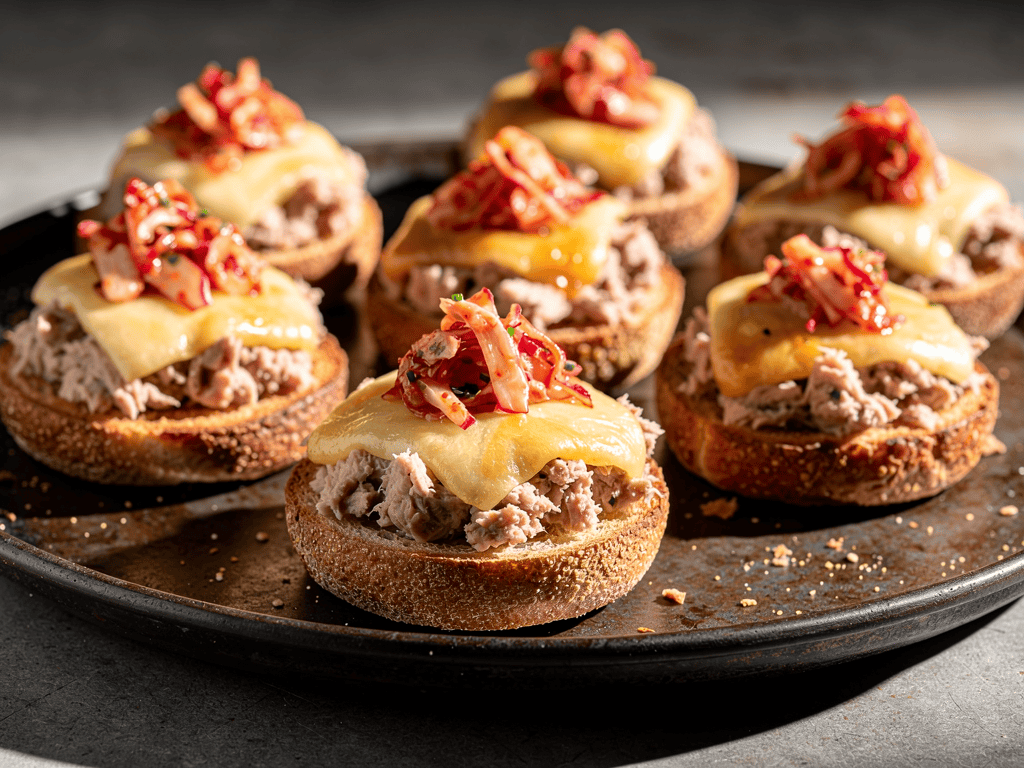
The parts that change whether this works tonight.
- Yield
- 16 bites
- Time
- 25 minutes
- Equipment
- A heavy skillet with a lid, which is what lets the cheese melt before the bread burns
- The method
- 10 ingredients · 5 steps
From this recipe’s own recipe card. Nothing here is a guess.
Pairing
Wine — Grüner Veltliner, or a cold pilsner. Mixed drink — Highball of Japanese whisky, soda, and a lemon peel. It cools the bite and leaves the pickle in charge. Teetotaler — Ginger beer with a splash of kimchi brine. Kimchi and cheddar are the fight. The drink should take the pickle’s side.
Tools
A heavy skillet with a lid, which is what lets the cheese melt before the bread burns. Box grater, since pre-shredded cheddar is coated in starch and melts badly. A serrated knife and the willpower to wait two minutes before using it.
Ingredients · swaps in parentheses
Fresh tuna steak (fresh albacore), olive oil, napa cabbage kimchi, scallions, mayonnaise (Kewpie), Dijon mustard, kimchi brine, rye or pullman bread, sharp cheddar (Gruyère), softened butter
Magic
The kimchi does not have to go in raw. When the tuna comes out of the skillet, tip the squeezed kimchi straight into that hot oil and fry it until the edges darken and the smell turns jammy instead of sharp, about two minutes. Raw kimchi arrives as a bright interruption you taste separately from everything else; fried, it goes deep and faintly sweet and settles underneath the cheddar rather than shouting across it. The teaspoon of raw brine still goes into the mayonnaise, so nothing gives up its acid. Not feeling brave? Fry half and fold the rest in raw.
Gotcha
Medium-low heat is not a suggestion. Turn the burner up and the bread goes dark brown in ninety seconds while the cheese in the middle is still a cold grated pile, and there is no way back from that.
The diner tuna melt is a good sandwich weighed down by a bad habit, which is filling it until the bread cannot close. Cut the volume by a third, sharpen the cheese, and cook it slowly enough that the cheese actually melts, and the thing becomes something you would order twice.
Fresh tuna changes the character more than you would expect. Where a canned fish gives a soft, uniform, slightly gray filling, a seared steak broken up by hand gives you distinct meaty pieces with browned edges, and those edges survive the pan. The kimchi supplies acid and funk from the Korean pantry it came from, and it is doing the job that a limp pickle chip does in the diner version, only much better.
Makes: 16 bites
Time: 25 minutes
Ingredients
- 12 ounces fresh tuna steak, about 1 inch thick
- 1 tablespoon olive oil
- 1/3 cup finely chopped kimchi, squeezed dry
- 2 scallions, sliced
- 2 tablespoons mayonnaise
- 1 teaspoon Dijon mustard
- 1 teaspoon kimchi brine
- 8 slices rye or pullman bread
- 6 ounces sharp cheddar, grated
- 2 tablespoons softened butter
Method
Where the time goes
- 5 minSear the tuna
- Mix the filling
- Build the sandwiches
- 3–4 minCook covered, then uncovered
- Rest, then cut
- Sear the tuna. Pat the steak dry and salt it. Heat the olive oil in a skillet until it is just short of smoking and sear the tuna 90 seconds per side, so the outside is browned and the middle is still rare. Let it rest 5 minutes, then break it into rough chunks with a fork and your fingers. For the magic version, fry the squeezed kimchi in the empty skillet here for two minutes, until the edges darken, and let it cool before it meets the mayonnaise.
- Mix the filling. Fold the tuna with the kimchi, scallion, mayonnaise, Dijon, and kimchi brine. Keep the pieces chunky. It should look like fish held together by dressing, not like a paste.
- Build the sandwiches. Butter one side of each slice. Lay four slices butter-side down, divide the filling and the cheddar among them, and close with the remaining slices, butter-side up.
- Cook covered, then uncovered. Cook in a covered skillet over medium-low heat until the first side is crisp and the cheese has started to go, 3 to 4 minutes. Flip and cook uncovered until deeply browned.
- Rest, then cut. Two minutes on a board, then cut each sandwich into four squares.
The lid is the whole technique
A grilled sandwich has two clocks running at different speeds. The bread browns from below in a couple of minutes; the cheese in the middle needs closer to five to reach the temperature where it flows. Covering the pan traps steam and heats the interior from all sides, which brings those two clocks into agreement.
Take the lid off for the second side. By then the inside is hot and what you want is dry heat and a hard, even crust, and a lid at that stage would soften what you just built.
Squeeze the kimchi like you mean it
Chopped kimchi holds a startling amount of liquid, and every drop of it goes into your bread. Wet filling produces a sandwich that browns on the outside and stays steamed and floppy inside, which is the most common way this goes wrong.
Squeeze it in your fist over the sink until it stops dripping, then save a teaspoon of that brine and put it back into the mayonnaise. The flavor belongs in the filling. The water does not. Older, more sour kimchi is better here than fresh, since the fermentation has gone further and the acid is what cuts the cheddar.
Grate your own cheese
Bagged shredded cheddar is dusted with cellulose or potato starch to keep it from clumping, and that coating is specifically designed to stop the cheese from fusing, which is the exact opposite of what you need. It melts into something slightly grainy that never quite becomes a single molten layer.
Sharp cheddar over mild, always. The filling is rich and funky and a mild cheese contributes fat and nothing else. Gruyère works and pushes the sandwich in a nuttier direction that suits the rye.
Cutting, timing, and feeding people
The two-minute rest lets the cheese set just enough that it grips the filling instead of sliding out the side when the knife goes through. Use a serrated blade and a sawing motion rather than pressing down, which compresses the whole sandwich and squeezes the filling out the far end.
These are best passed hot in small batches, straight from the board. A tuna melt waits for no cocktail hour. If you are making several rounds, hold the cut squares on a rack in a 200°F oven rather than stacking them on a platter, where the trapped steam undoes the crust in about four minutes.
Part of Recipes & Technique.
Recipe provenance: Salty & Clever editorial formulation, built from established culinary technique and the traditions identified in the article. No chef, restaurant, family, or firsthand cultural provenance is claimed unless it is explicitly named and sourced. How we write and check recipes
Where this goes next

