Smoked Haddock Chowder with Corn and Dill
A smoked haddock chowder thickened by its potatoes rather than by flour, poached at a whisper so the fish stays in sheets instead of shreds.
The parts that change whether this works tonight.
- Yield
- 6
- Time
- 45 minutes
- Equipment
- A heavy-bottomed soup pot, because thin aluminum will scorch milk while you are looking at your phone
- The method
- 13 ingredients · 6 steps
From this recipe’s own recipe card. Nothing here is a guess.
Pairing
Wine — Chenin Blanc, Vouvray sec, or a dry cider. Mixed drink — Scotch highball, extra ice, lemon peel. Smoke and dill already live in the bowl; the drink should stay long. Teetotaler — Strong lemon-dill iced tea, or sparkling water with lemon and white pepper. Smoke and cream need acid and a little orchard fruit, not more dairy.
Tools
A heavy-bottomed soup pot, because thin aluminum will scorch milk while you are looking at your phone. A slotted spoon for lifting the fish out in one piece.
Ingredients · swaps in parentheses
Butter, leek (onion), celery, Yukon Gold potatoes (not russet), whole milk, fish or chicken broth, bay leaf, smoked haddock (smoked cod or smoked pollock), corn kernels, cream, dill, black pepper, lemon wedges
Magic
Blister the corn in the dry pot before anything else touches it. Two minutes over high heat, no butter, no oil, until the kernels take dark spots and start snapping at you, then tip them into a bowl and begin the recipe properly. They go back in at exactly the moment they always did. What changes is that the sweetness now has scorched edges, and scorched edges are the thing that keeps a pale pot of milk and potato from sounding like an apology. Not feeling brave? Blister half and add the rest straight from the bag.
Gotcha
A rolling boil ruins this twice over: the milk proteins catch on the bottom and taint the whole pot with scorch, and the haddock seizes into rubber. If you see more than a lazy blip at the surface, drop the heat.
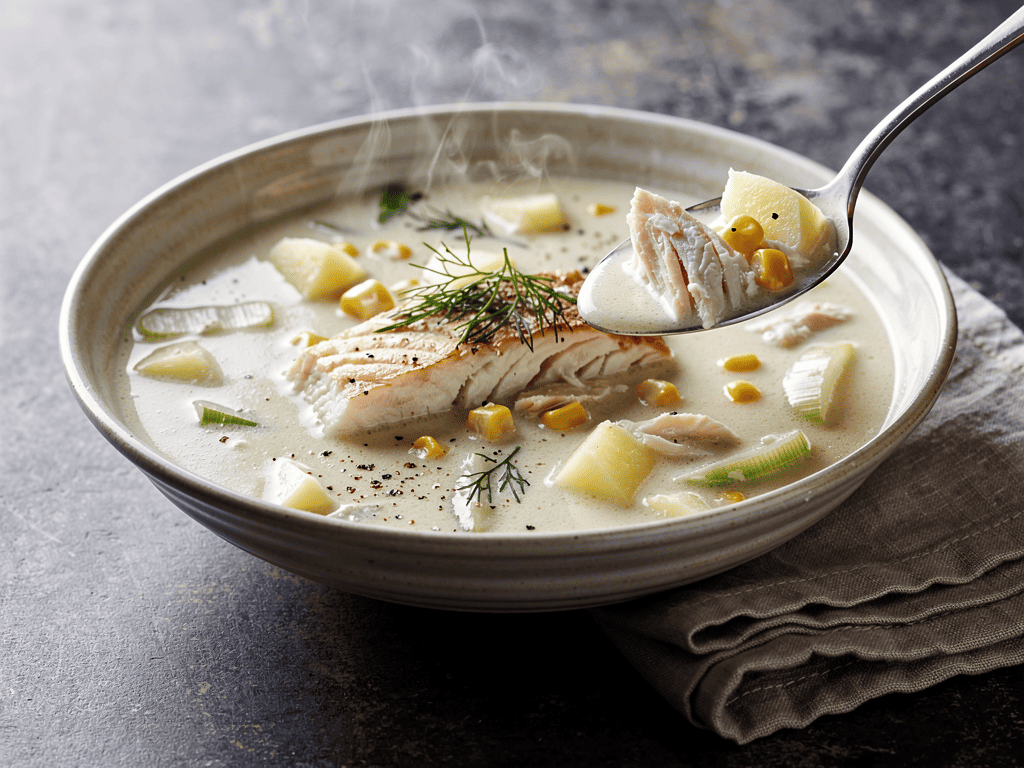
Chowder should coat the spoon. It should not hold the spoon upright. Somewhere along the way the word came to mean a paste of flour and heavy cream with seafood suspended in it like specimens, and the version worth making is thinner than that, cloudy rather than opaque, with enough movement in the bowl that you can see the corn. Smoked haddock is the reason it works. It seasons the liquid from the inside, so the broth does not have to be enriched into submission to taste like something.
Serves: 6
Time: 45 minutes
Ingredients
- 1 tablespoon butter
- 1 leek, white and pale green parts sliced
- 2 celery stalks, chopped
- 1 pound Yukon Gold potatoes, cut into 1/2-inch cubes
- 3 cups whole milk
- 2 cups fish or chicken broth
- 1 bay leaf
- 12 ounces smoked haddock, skin removed
- 2 cups corn kernels
- 1/2 cup cream
- 2 tablespoons chopped dill
- Black pepper
- Lemon wedges
Method
Where the time goes
- 7 minSoften the aromatics
- 12–15 minBuild the liquid
- 5–7 minPoach the fish
- Break and return
- Finish
- Serve
- Soften the aromatics. Melt the butter in a soup pot. Cook the leek and celery with a pinch of salt until soft, 7 minutes. Keep the heat moderate; you want them collapsed and sweet, with no color at all. For the magic version, blister the corn in the dry pot here, before the butter, and set it aside until step three.
- Build the liquid. Add the potatoes, milk, broth, and bay. Bring it up slowly and simmer gently until the potatoes are tender, 12 to 15 minutes.
- Poach the fish. Add the smoked haddock and corn. Simmer very gently until the fish flakes, 5 to 7 minutes. The surface should barely move.
- Break and return. Lift out the fish, break it into large pieces, and return it to the pot. Large pieces, not shreds.
- Finish. Stir in the cream, dill, and black pepper. Taste before adding salt; smoked fish may have supplied enough.
- Serve. Ladle into bowls and serve with lemon on the side.
“Should I thicken it with flour?” “Not unless the spoon has applied for permanent residency.”
Where the body comes from
There is no roux in this and there does not need to be one. Yukon Golds sit between waxy and starchy, and as they simmer in the milk they shed just enough starch to thicken the liquid slightly and hold it together, which is a completely different texture from flour-thickened soup. Flour coats the tongue and mutes everything behind it. Potato starch clouds the broth and leaves the flavors where they are.
This is why the potato variety is not a suggestion. Russets will disintegrate entirely and turn the pot into a loose mash; a fully waxy potato will hold its shape but contribute nothing to the liquid. Half-inch cubes matter too. Larger and they need more time than the milk should spend on the heat, smaller and they surrender completely.
The temperature you cannot see
Everything that goes wrong with a dairy soup goes wrong because of heat. Milk proteins denature and stick to the bottom of the pot, and once a layer of them scorches, that flavor is in the entire batch permanently. There is no rescuing it. A heavy pot buys you margin, but the real protection is bringing the liquid up slowly and holding it at a bare simmer, the kind where a bubble surfaces every few seconds rather than a steady churn.
The haddock has an even narrower tolerance. Smoked fish is already partly firmed by curing, so it starts closer to the finish line than fresh fish does. Held at a boil for five minutes it goes stringy and squeaks against the teeth. Poached at a whisper, it stays in tender, damp sheets that fall apart under a spoon. Lifting it out to break it up is not fussiness; it lets you handle the fish once, gently, instead of chasing it around a hot pot with a spoon and reducing it to floss.
Salt arrives last, if at all
Smoked haddock is cured in salt and then gives most of it up to the liquid it cooks in, so the pot gets progressively saltier during the five to seven minutes the fish is in there. Any seasoning decision made before that point is a guess. Salt the leeks lightly at the start for their own sake, then leave the pot alone until the fish is back in and the cream has gone in, and taste then. Plenty of batches need nothing.
The cream at the end is a rounding agent, not a thickener. Half a cup across six servings is enough to soften the edges of the smoke without turning the broth into a sauce. Stir it in off the boil so it does not have a chance to break.
The bowl itself
Lemon goes on the table, not into the pot. Acid and hot dairy are a risky pairing at scale, and more to the point, a squeeze belongs to the person eating: the first few spoonfuls want the clean smoky milk, and the last few want cutting. Add it to the whole batch and you have made that choice for everyone, plus you risk a curdled surface.
Brown bread, crackers, or a sharp cabbage salad on the side. The chowder should be creamy, smoky, and loose enough that it moves when the bowl does, with visible corn, visible dill, and pieces of fish big enough to identify.
Part of Recipes & Technique.
Recipe provenance: Salty & Clever editorial formulation, built from established culinary technique and the traditions identified in the article. No chef, restaurant, family, or firsthand cultural provenance is claimed unless it is explicitly named and sourced. How we write and check recipes
Where this goes next

