Gluten-Free Raspberry Almond Cake with Lemon Syrup
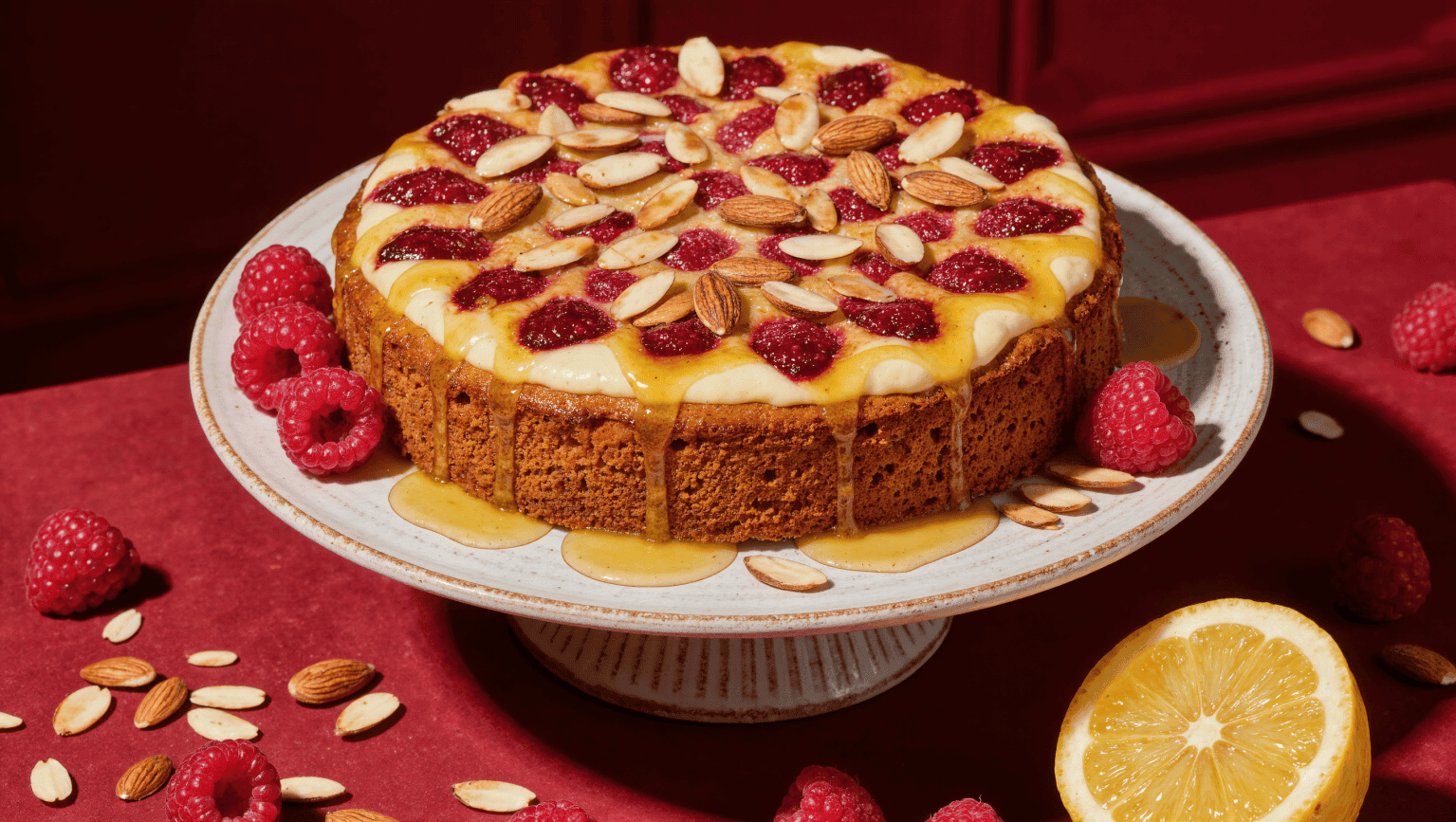
An almond-flour cake with no apology in it: raspberries in two stages, a sharp lemon syrup, and one hard rule — do not slice it warm.
The parts that change whether this works tonight.
These fields come from the published recipe itself. If a recipe has not separately declared an operating fact, the gap stays visible instead of being filled with a guess.
- Servings
- 8 to 10
- Timing
- Not separately declared
- Equipment
- Not separately declared
- Make-ahead
- Not separately declared
- Holding
- Not separately declared
- Leftovers
- Not separately declared
- Dietary notes
- Not separately declared
- Method map
- 16 ingredient lines · 10 method steps
Pairing
Wine — Moscato d'Asti, or a demi-sec Vouvray. The lemon syrup keeps this cake tart, and a lightly sweet fizzing wine sits beside it without smothering the raspberries. Mixed drink — A limoncello spritz, or an amaretto sour. One follows the syrup and the other follows the almond flour — both work, and neither introduces a third idea. Teetotaler — Iced almond milk with lemon, or a strong Earl Grey. The cake is soft and moist, and it wants something either colder or more tannic than itself.
Tools
A 9-inch round cake pan lined with fresh parchment, two bowls, a whisk prepared for two honest minutes of work, a small saucepan for the syrup, a pastry brush, a toothpick, and a cooling rack you promise to actually use.
Ingredients · swaps in parentheses
Fine blanched almond flour, tapioca starch (arrowroot), gluten-free baking powder, fine sea salt, eggs, granulated sugar, full-fat Greek yogurt, unsalted butter, vanilla extract, almond extract, lemon zest, fresh raspberries (small blackberries or blueberries), sliced almonds. Syrup: fresh lemon juice, sugar, salt.
Magic
Steep a small rosemary sprig in the warm lemon syrup and fish it out before brushing. Rosemary and raspberry are better friends than the pastry canon admits; the resin keeps the almond crumb from reading like marzipan. Not feeling brave? A wide strip of extra lemon zest in the syrup instead.
Gotcha
Almond-flour cakes finish setting as they cool. Slice while warm and a properly baked cake will look gummy and underdone; wait until it is fully cool before you pass judgment or a knife.
Gluten-free cakes tend to apologize. They arrive with disclaimers, they get judged on a curve, and everyone at the table says “you’d never know” in a tone confirming they knew. This one does not need the curve. Almond flour, handled well, makes a crumb wheat should envy — tender, damp in the good way, still worth eating on day three.
Handled badly, it makes grease and regret. Almond flour is generous with moisture and stingy with structure, so this cake borrows a little elasticity from tapioca starch, its lift from properly whisked eggs, and some acidity from Greek yogurt. The raspberries go in at two stages, half folded through the batter and half scattered on top, so some stay suspended and the rest bake visibly into the surface.
The lemon syrup at the end is thin on purpose. It is not a glaze. It sharpens the berries and keeps the crumb supple, and you are allowed to stop brushing before it is gone.
Structure, borrowed
There is no gluten here to trap air or hold up walls, which is why the method is less casual than it looks. Baking already punishes improvisation; gluten-free baking fines you double. The eggs and sugar get whisked hard for 90 seconds to 2 minutes, not for ceremony but because that modest foam is most of the support the almond flour will ever get. No mixer required, no ribbon stage, but the mixture must visibly lighten before the yogurt and fat go in. Skipping this is how almond cakes end up with a wet crater in the middle.
Ninety seconds by hand is longer than it sounds and shorter than it feels. It is the only part of this recipe that asks anything of you, and it is therefore the part that gets quietly shortened. Two minutes saved at the bowl is forty spent in front of the oven finding out.
Tapioca starch does the rest. It lends a little stretch without the chalkiness a big dose of cornstarch brings, and it keeps the batter thick enough to hold raspberries aloft. If your yogurt runs thin, strain it briefly or hold back a tablespoon. A loose batter is how every berry ends up in a damp stripe along the bottom.
If you are baking for celiac disease
Buy almond flour, tapioca starch, and baking powder labeled gluten-free; baking powder in particular varies by brand and market. Check the vanilla, any confectioners’ sugar, and flavored yogurts or dairy substitutes. Then look at the kitchen itself. Almond flour tends to live next to wheat flour, and scoops migrate between containers, so keep a dedicated scoop, line the pan with fresh parchment rather than a wheat dusting, and use a clean rack, server, and knife in any kitchen that also bakes with wheat. None of this changes the recipe. All of it changes whether someone can eat it.
Serves: 8 to 10
Estimated time: 1 hour 20 minutes, including cooling
Pan: 9-inch round cake pan
Ingredients
For the cake
- 2 cups fine blanched almond flour
- 1/3 cup tapioca starch
- 1 teaspoon gluten-free baking powder
- 1/2 teaspoon fine sea salt
- 3 large eggs, room temperature
- 3/4 cup granulated sugar
- 1/2 cup plain full-fat Greek yogurt
- 6 tablespoons unsalted butter, melted and cooled
- 1 teaspoon vanilla extract
- 1/2 teaspoon almond extract
- 1 tablespoon finely grated lemon zest
- 1 1/2 cups fresh raspberries, divided
- 2 tablespoons sliced almonds
For the lemon syrup
- 3 tablespoons fresh lemon juice
- 3 tablespoons granulated sugar
- Pinch of salt
Method
- Heat the oven to 350°F. Butter a 9-inch round cake pan and line the base with parchment.
- Whisk almond flour, tapioca starch, baking powder, and salt in a medium bowl, breaking up any almond-flour clumps.
- In a large bowl, whisk eggs and sugar vigorously for 90 seconds to 2 minutes, until the mixture lightens slightly and looks foamy.
- Whisk in yogurt, melted butter, vanilla, almond extract, and lemon zest.
- Fold the dry ingredients into the wet mixture until no dry pockets remain. Fold in 1 cup raspberries gently.
- Spread the batter into the prepared pan. Scatter the remaining 1/2 cup raspberries and sliced almonds across the top.
- Bake 38 to 46 minutes, until the top is golden and a toothpick inserted near the center comes out with moist crumbs but no wet batter. If the almonds darken quickly, tent loosely with foil for the final 10 minutes.
- While the cake bakes, combine lemon juice, sugar, and salt in a small saucepan. Warm just until the sugar dissolves, then cool. For the magic version, steep a small rosemary sprig in the warm syrup here and remove it before brushing.
- Let the cake cool in the pan 15 minutes. Run a knife around the edge and invert carefully onto a rack, then turn right-side up.
- Brush the warm cake gradually with the lemon syrup. You may not need every drop; stop if the surface begins to look saturated. Cool completely before slicing.
Berries: dry, and occasionally swapped
Washed raspberries hold water in their little cavities and will hand every drop straight to the crumb. Spread them on a towel and let them dry honestly before folding. Wet fruit makes gummy pockets, and the cake breaks around them when sliced. If sinking berries are a recurring grief in your kitchen, toss them in a teaspoon of tapioca starch first.
Blackberries work if they are small; halve the giants. Blueberries fold in without breaking and are the easy structural choice, though you trade away some of the raspberry’s sharpness. Chopped peaches are fine too, patted dry and kept small, because stone fruit brings substantially more water to the party.
Blueberries are the safe answer and a slightly worse cake. That is a real trade rather than a consolation: you gain a clean crumb and give up the sharpness that was keeping the almond and the butter honest. Make the swap on purpose, or do not make it.
Reading a finished almond cake
The usual visual cues lie with almond flour, so it helps to know what you are looking at. A small dip in the center is normal and not worth mourning. A wet crater means underbaked, too much liquid, or eggs that never got their foam. An oily, heavy cake usually points to coarse almond meal — fine blanched flour absorbs far more predictably — or a generous hand with the butter.
And a gummy crumb, most of the time, means nothing went wrong except your timing. These cakes finish setting as they cool. Cut one warm and it will look underdone even when it is not. Full cool, then decide.
It improves with a rest
Give it a few hours and the crumb settles while the syrup finishes distributing itself. This is a bake-in-the-morning, serve-at-dinner cake, and it is perfectly happy made a full day ahead, covered, at cool room temperature if your kitchen is not hot. Refrigerate for anything longer. Leftovers hold about 4 days in the refrigerator; bring slices back toward room temperature for the softest crumb. Plain slices also freeze well, wrapped individually and thawed overnight in the fridge.
Which makes this the rare cake that is better for having been ignored. Bake it before lunch, leave it alone, and the syrup spends the afternoon traveling through the crumb instead of sitting on top of it. Nothing you could do at seven o’clock improves on that.
No frosting. A spoonful of yogurt, crème fraîche, or barely whipped cream if it is playing dessert, plus fresh raspberries and a little zest. Nothing at all if it is playing brunch. The syrup already supplied the finish, and an aggressively sweet sauce would only talk over it.
Part of Recipes & Technique.
Recipe provenance: Salty & Clever editorial formulation, built from established culinary technique and the traditions identified in the article. No chef, restaurant, family, or firsthand cultural provenance is claimed unless it is explicitly named and sourced. How we write and check recipes


