Leeks, Plainly
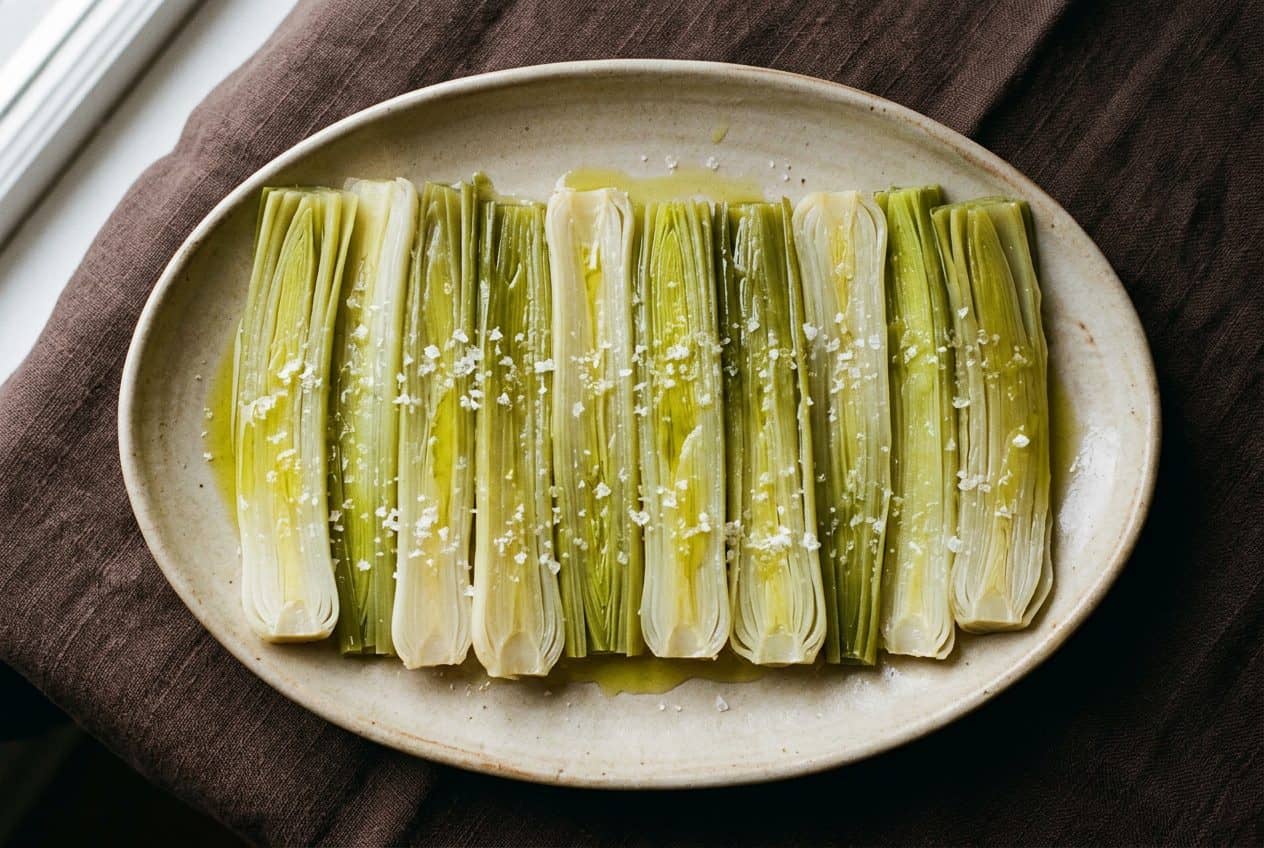
Leeks boiled soft and served warm with good olive oil and flaky salt — no dressing, no crumb, no herb oil, the deliberately plain dish next to a potato that took forty minutes.
Pairing
Wine — Muscadet sur lie — saline, lean and faintly chalky, it treats a boiled leek the way it treats an oyster, and there is no oak or fruit weight to bury a dish this quiet. Mixed drink — A chilled junmai sake, poured cold with a wide strip of lemon peel dropped in the glass — the rice umami gives a plain vegetable something to lean on, which a spirit-forward drink would simply flatten. Teetotaler — Cold tomato water — ripe tomatoes blitzed and hung through a cloth until the liquid runs clear — served over ice with salt and a spoonful of the same olive oil floated on top, savory and faintly sweet and pointedly not a soft drink.
Tools
A pot wide enough that the leeks lie in a single loose layer (crowd them and the ones in the middle stay squeaky while the outside ones fall apart), a colander, the tip of a paring knife as your only doneness test, tongs, and a platter you have actually warmed — there is no fat and no sauce in this dish to hold heat, so a cold plate takes it from good to pointless in about four minutes
Ingredients · swaps in parentheses
Leeks (young scallions boiled for two or three minutes stand in, but they are milder and sweeter — a different plain vegetable in the same role rather than a swap), kosher salt in quantity for the water, olive oil good enough that you would drink it from a spoon, since with three ingredients a dull supermarket oil is not a small compromise but the whole dish, flaky sea salt, and a lemon if you want the one addition the recipe permits
Magic
Do not bin the dark green tops. Rinse them, drop them into the pot while the water comes up, and boil them for five minutes before the split whites go in — then fish them out and cook as written. Plain salted water pulls flavor out of a leek by simple gradient, which is exactly why boiled vegetables can taste washed water that already tastes of leek has nothing to pull. The whites come out tasting more like themselves, which is the only move available on a dish where nothing is allowed on the plate. It costs five minutes and an ingredient you already own. Tops already gone? Use the smallest pot the leeks will fit in and less water, for the same reason — less water, less to leach into.
Before you begin
Grit is what ruins this, not timing: split the leeks and fan every layer under running water, because soil sits deep between them and one gritty bite is the whole memory of the dish. Cook them past tender to genuinely soft — a knife should meet no resistance at all, since an underdone leek is fibrous and squeaks against the teeth. Then drain hard and let them steam-dry a minute or two, or the water clinging in the layers thins the oil into a puddle on the platter. If service slips, hold them boiled and undressed somewhere warm and dress at the last second a warm leek and a cold one are effectively two different vegetables.
The parts that change whether this works tonight.
- Yield
- 8 servings
- Time
- 25 minutes
- Equipment
- A pot wide enough that the leeks lie in a single loose layer (crowd them and the ones in the middle stay squeaky while…
- Make-ahead
- None — boil close to serving
- Holding
- Warm, dressed with oil and salt, this holds acceptably for about 20 minutes before it cools past the point of being genuinely pleasant — it's not a disaster cold, but…
- The method
- 4 ingredients · 6 steps
From this recipe’s own recipe card. Nothing here is a guess.
Editor’s note: the leeks go with the main in Nothing in This Room Is Finished, the rebuilt World, as plainly as ever. The recipe is unchanged.
Leeks, trimmed, split, boiled in salted water until they’re properly soft, drained hard, and served warm with good olive oil and flaky salt. No dressing, no crumb, no herb oil, no bacon. This is the deliberately plain dish sitting next to a potato dish that took forty minutes of somebody’s hands, and the contrast is the point — a couture fitting needs at least one seam left visibly, honestly unfinished, and this is it.
I am the wrong person to ask about restraint on a table — I cook by throwing things in to see what happens — which is exactly why I trust this dish. Nothing on it is a choice I would make under pressure at seven o’clock. It is a pot of water, a colander and two ingredients you pour on at the end, and it is the one thing on the table that will not care if the potatoes run late.
Yield and time
- Yield: 8 servings, written for a table of 8; multiplies directly
- Active time: 10 minutes
- Total time: 25 minutes
- Make-ahead window: None — boil close to serving
Ingredients
- Leeks, trimmed of dark green tops and root end, split lengthwise and washed thoroughly — 8 medium
- Kosher salt (Diamond Crystal), for the boiling water — 2½ tablespoons per 3 quarts water
- Good olive oil — ¼ cup
- Flaky sea salt (Maldon or similar), to finish — about 1 teaspoon
Method
- Split the leeks lengthwise from just below the root end and rinse thoroughly under running water, fanning the layers apart with your fingers — leeks trap grit between their layers, and this is the step that actually gets it out.
- Bring a large pot of water to a rolling boil and salt it until it tastes distinctly of the sea.
- Add the leeks and cook for 8–10 minutes, until a knife slides through the thickest part with no resistance and the layers have gone properly soft, not merely tender.
- Drain thoroughly in a colander, pressing gently with the back of a spoon to push out excess water, and let them sit for a minute or two to steam-dry further.
- Arrange on a warm platter, still warm from cooking.
- Finish with a generous pour of good olive oil and a scatter of flaky salt, and serve immediately — nothing else goes on this dish.
Make-ahead
There is genuinely nothing to do ahead beyond trimming and splitting the leeks, which can be done a few hours in advance if they’re kept covered and refrigerated. Boil close to service; this dish has no ingredients rich enough to disguise a leek that’s gone cold and been reheated.
Holding and service
Warm, dressed with oil and salt, this holds acceptably for about 20 minutes before it cools past the point of being genuinely pleasant — it’s not a disaster cold, but it loses the point, since a warm leek and a cold one taste like two different vegetables. If service is running behind, hold the boiled, undressed leeks covered in a warm spot and dress them the moment they’re actually needed, rather than plating and dressing on the original schedule and letting them sit and cool on a counter somewhere.
Scaling
The pot is the constraint, same as any large-batch boiling — a crowded pot cooks unevenly, so past about 16 leeks, boil in two batches rather than one very full pot. Salt the water fresh for each batch rather than reusing it, since leeks release a fair amount of their own liquid into the pot as they cook, diluting the salt level for whatever goes in after them.
Substitutions
- No leeks in season — young, thin scallions, kept whole and boiled for a much shorter 2–3 minutes, give a related but genuinely milder, sweeter dish; it is not a direct swap so much as a different plain vegetable serving the same role.
- Want it slightly richer without breaking the plain rule — a squeeze of lemon over the top at the very end adds brightness without adding a single new texture or component to the plate.
A food-safety note
Leeks trap soil deep between their layers, and grit that isn’t rinsed out is the actual failure mode of this dish far more often than anything to do with cooking time — take the extra two minutes to properly fan the layers apart under running water before they go anywhere near the pot.
Why this dish, at Nothing in This Room Is Finished
It belongs to Nothing in This Room Is Finished, the one dish on this table with no technique to show off — a boiled leek, oil, salt, and the honest admission that not everything on a considered table needs to prove it’s considered.
The Occasion Study for that evening lives on Tangled Thistle; the recipes live here, and this is the one I would keep if I could only keep one, because it is the only dish on the list that gives the host their hands back. This recipe was developed by reasoning from method rather than from a tested bench run, which is how most of what we publish begins; Salty & Clever’s standing note on how we write and check recipes applies to it. Trust the knife going through the leek over anything a timer tells you.
Part of Recipes & Technique.
Recipe provenance: Salty & Clever editorial formulation, built from established culinary technique and the traditions identified in the article. No chef, restaurant, family, or firsthand cultural provenance is claimed unless it is explicitly named and sourced. How we write and check recipes
Where this goes next
