One Pot of Lentils, Three Dinners Before It Starts Feeling Like Meal Prep
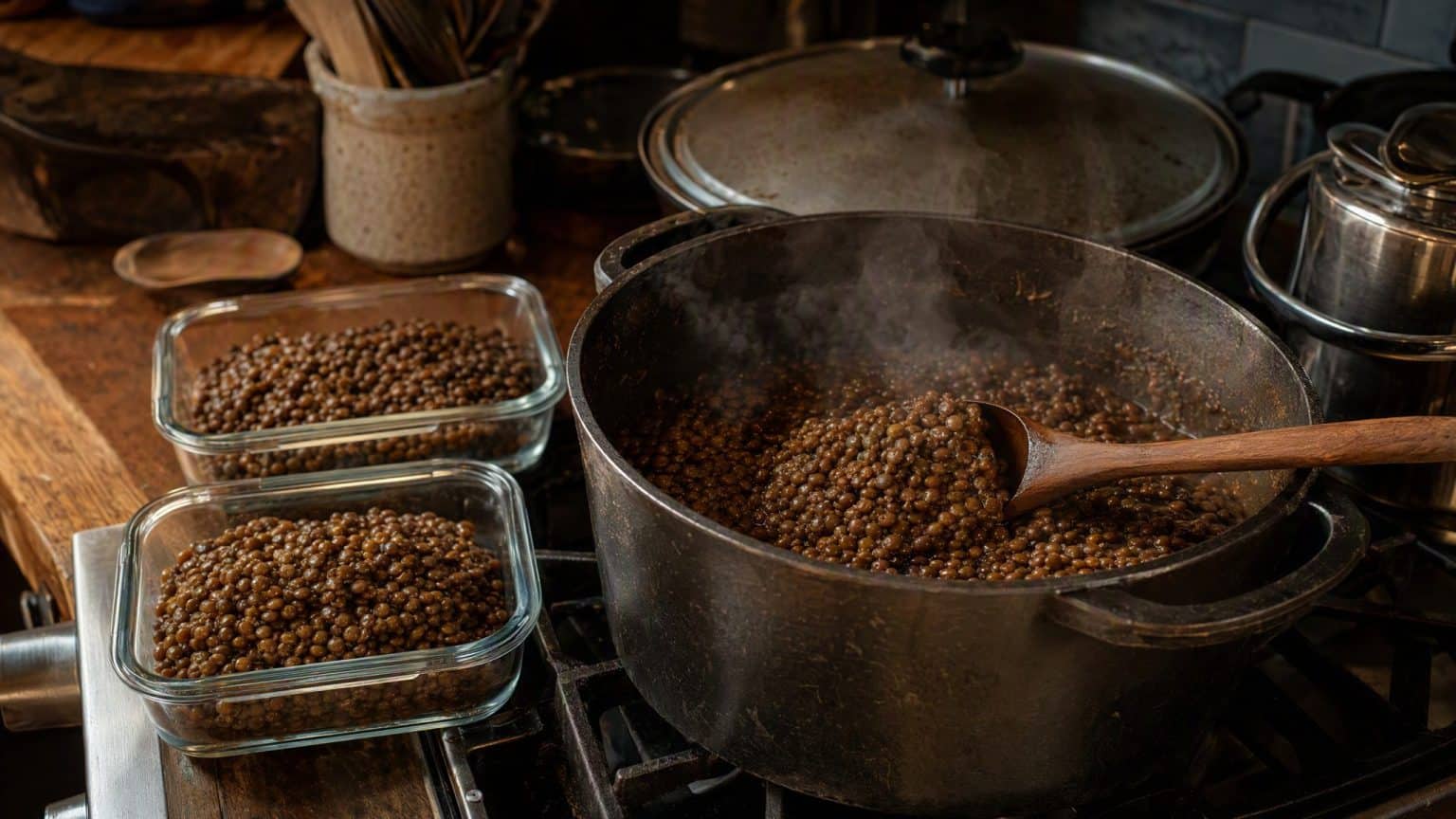
Cook lentils once, measure the cooked yield, and change their job across the week: brothy dinner, crisp-edged patties, then a real slab pie that already exists in the Salty corpus.
THE SEVEN-CUP EXAMPLE
The cooked lentils are the inventory. The pot they came from is not.
3 cups cooked lentils
Brothy lentils, greens, lemon, egg.
2 cups cooked lentils
Crisp lentil patties, cucumber yogurt.
2 cups cooked lentils
Existing mushroom-lentil slab pie.
Seven cups is an example cooked checkpoint. Different lentils, cooking times, and drain levels change yield, so measure what came out of your pot before allocating it.
Planned leftovers get suspiciously meat-shaped if you are not paying attention.
Pork shoulder makes sense because it takes hours. Brisket makes sense because nobody casually cooks a brisket on Wednesday. Roast chicken makes sense because the oven is already hot and the carving board is already dirty.
But the technique is bigger than large proteins. Lentils are almost a better demonstration because they expose the actual idea: cook a useful base once, keep it neutral enough to move, then let each later meal give it a different texture and personality.
The bad version is seven identical containers lined up like you have enrolled in a wellness challenge you do not remember agreeing to.
The good version is dinner one being spoonable, dinner two being crisp, and dinner three disappearing inside pastry with mushrooms and cheddar.
Cook for texture first, because mush has nowhere to go
For this arc, use brown lentils, French green lentils, or another variety that keeps its shape. Red lentils are excellent, but they are built to soften and collapse; that makes them a different planning system.
Cook the lentils in well-salted water until tender but still distinct. Drain them thoroughly. If they are wet enough to leave a puddle under the colander, they are not ready to become inventory yet.
Then measure the cooked lentils.
If you have seven cups, use the allocation above. If you have six, shrink dinner one or skip the third meal. If you have nine, freeze some while you still feel benevolent toward lentils.
Do not keep cooking more simply because the article has seven cups in a box. The box is an example, not a summons.
Dinner one: brothy lentils with greens, lemon, and soft eggs
The first meal should use the lentils in their calmest form. No crisping, no pastry, no disguise. Just enough broth and acid to make them feel like dinner rather than a side dish waiting for instructions.
For four people, use: 3 cups cooked lentils; 2 tablespoons olive oil; 1 medium onion, thinly sliced; 2 garlic cloves, sliced; 4 cups low-sodium vegetable or chicken stock; 1 bunch kale, chard, or escarole, chopped; 1 lemon; 4 eggs; black pepper; and salt as needed. Add Parmesan, feta, or yogurt if that is where your evening is headed.
Cook the onion in the olive oil until soft and beginning to brown. Add garlic for the last minute. Add stock and lentils and bring to a simmer. Stir in the greens and cook until tender.
Meanwhile, cook the eggs however you prefer them for a bowl: poached, soft-boiled, or fried. I am not going to turn this into an egg manifesto.
Finish the lentils with lemon juice and black pepper. Spoon into bowls, add an egg, and use cheese or yogurt only if the bowl needs more richness.
The first dinner is warm, soft-edged, and brothy. That matters because dinner two is going in the opposite direction.
Reserve dinner two before the broth gets involved
This is the same separation logic used throughout the Planned Leftovers cluster. If all seven cups go into broth, the next meal inherits broth whether it wants it or not.
Before dinner one is assembled, set aside two cups of plain cooked lentils for the next meal and two cups for the third. Refrigerate them according to the storage plan in The Leftover Plan Starts Before Dinner.
The general allocation argument already exists in the parallel draft The Leftover Allocation Rule, so I am not going to rewrite it here. The important point for lentils is moisture: later meals need the reserved lentils drained, plain, and structurally intact.
Dinner two: crisp lentil patties with cucumber yogurt
If dinner one is spoon food, dinner two should require a knife or at least a confident fork.
Use 2 cups cooked lentils for eight small patties, which gives four people two each. Add flatbread or a tomato salad if you want more volume.
You will need: 2 cups cooked lentils; 1 large egg; 1/2 cup panko or fresh breadcrumbs; 1/3 cup finely chopped scallions; 1 teaspoon ground cumin; 1/2 teaspoon smoked paprika; 1 tablespoon Dijon mustard; 2 tablespoons chopped parsley; 1/2 teaspoon kosher salt, adjusted to the lentils; black pepper; and 2 tablespoons olive oil for the pan.
For the cucumber yogurt: 1 cup plain Greek yogurt; 1/2 cucumber, grated and squeezed dry; 1 tablespoon lemon juice; 1 tablespoon olive oil; dill or mint if you have it; and salt.
Roughly mash about one-third of the lentils with a fork. Leave the rest whole. Add the egg, crumbs, scallions, cumin, paprika, Dijon, parsley, salt, and pepper. Let the mixture sit ten minutes so the crumbs hydrate.
Form eight patties. If they feel loose, add another spoonful of crumbs instead of squeezing them into dense hockey pucks.
Heat the olive oil in a wide skillet and cook the patties over medium heat until deeply browned and firm enough to turn, about four minutes on the first side and three on the second. Do not fuss with them early. Crust is the structure.
Mix the yogurt with cucumber, lemon, olive oil, herbs, and salt. Serve the hot patties against the cold sauce.
Now the lentils are crisp outside, creamy inside, spiced, and eaten from a plate. That is enough change to make them feel like a new dinner without pretending they came from a different planet.
The texture change is doing more work than the seasoning
Leftover advice tends to overfocus on flavor swaps. Mexican one night, Mediterranean the next, curry on Wednesday, as if cuisine labels alone solve repetition.
Texture is usually the bigger lever.
Soft meat wants a crisp edge. Cold rice wants a hot skillet. Roasted vegetables want to be chopped into a filling. Lentils that were brothy on Monday want to be browned on Wednesday.
This is why Crisp Is a Deadline belongs in the same neighborhood even though it was not written as a leftover article. The principle travels.
Dinner three: let an existing recipe take over
The third reserve is two cups, and Salty already has a recipe that asks for exactly that amount: Charred Mushroom-Lentil Slab Pie with Smoked Cheddar.
That recipe uses 2 cups cooked brown or green lentils, well drained, plus deeply browned mushrooms, onion, smoked cheddar, sharp cheddar, and puff pastry.
This is a better third meal than me inventing another lentil recipe simply because a series demands symmetry. The site already did the work. Use it.
The shift is substantial: brothy bowl → skillet-crisp patty → pastry-covered main. The lentils get less visible each time while the dinner gets structurally more different.
But the slab pie is more work. Does that break the rule?
Not necessarily.
The third meal does not have to be the easiest meal if it is deliberately placed on a night when you want to cook. The point of planned leftovers is not to eliminate cooking. It is to stop repeating the expensive base work when you do not need to.
The slab pie recipe still asks you to brown mushrooms, build the filling, and handle pastry. If that sounds hostile on a Thursday, freeze the two-cup lentil reserve and make the pie on a weekend.
That is a much better use of the freezer than keeping cooked lentils in the refrigerator out of optimism until nobody wants to discuss them.
The bridge groceries are ordinary on purpose
This arc needs onions, greens, eggs, lemon, yogurt, cucumber, breadcrumbs, scallions, herbs, mushrooms, cheese, and pastry.
That is more than one bag of groceries, but each meal uses a different subset and most of the ingredients have obvious uses outside this project. Nothing is here solely to rescue leftovers from themselves.
That matters. Planned leftovers should reduce waste and decision load, not create a second constellation of half-used garnishes orbiting the original food.
What if you only have four cups of cooked lentils?
Then you have two dinners, not a failed three-dinner system.
Use two and a half cups for the brothy bowl and one and a half cups for smaller patties. Or use two cups for dinner one and freeze two cups specifically for the slab pie.
Do not cut every dinner into increasingly symbolic portions simply so the headline remains technically true.
Quantity is the constraint. The editorial idea answers to the food, not the other way around.
Where planned leftovers stop being a meat strategy
The useful pattern is not pork, brisket, chicken, fish, repeat.
It is base → reserve → change the job.
Lentils prove it cleanly because the base is inexpensive, neutral enough to move, and sturdy enough to survive more than one treatment when cooked properly.
The only thing I am not willing to do is eat the same lentil bowl three times and call that discipline.
Start with The Big-Cut Economics for the cooked-yield logic even though lentils are not a big cut. Use The Leftover Plan Starts Before Dinner for storage. Then finish the arc with the slab pie when the week has room for pastry.
Part of Kitchen Systems.
Where this goes next

