The failure is never “I could not cook it”. The failure is “I could not cook all of it at once, in this room, with these objects” — and that is a capacity problem, which means it has an answer, and the answer is arithmetic.
A menu gets chosen from a magazine and then carried into a room with one oven, two usable burners, eleven inches of counter that is not currently holding the post, and four serving dishes two of which are the same dish. Nothing in the recipe mentions any of that, because a recipe assumes an empty kitchen and an idle cook.
The finding nobody publishes for a home cook
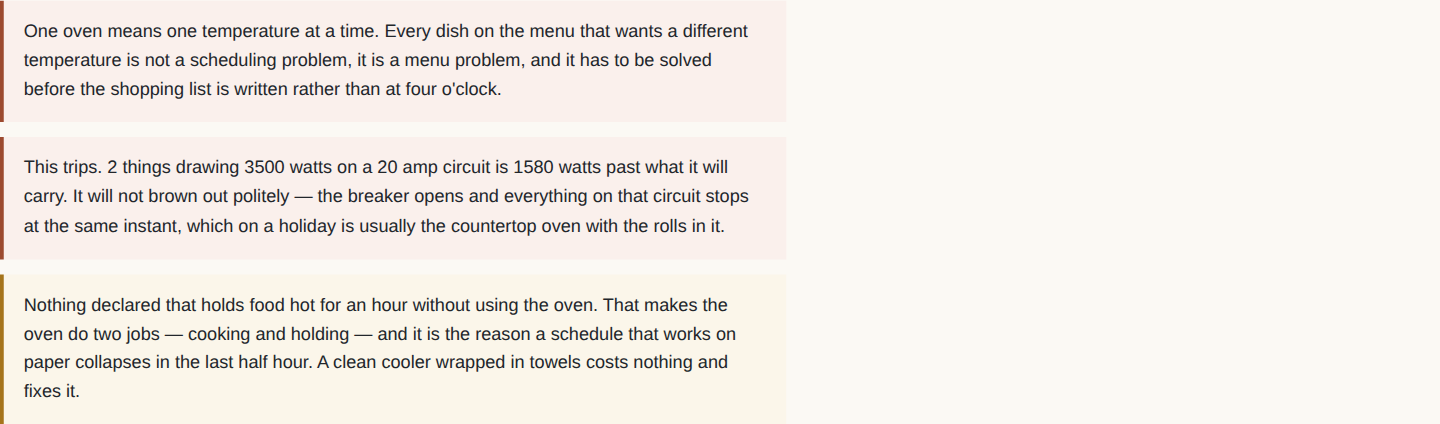
An American kitchen small-appliance circuit is twenty amps at a hundred and twenty volts, and a continuous load is capped at eighty percent of it: 1,920 watts. In an older house it is fifteen amps and 1,440. An air fryer draws 1,400. A countertop oven draws 1,700. A portable induction hob draws 1,800. Two of those on one circuit is not a slow kitchen — it is a dark one, and a walk to the panel in the middle of service, and it is always the countertop oven with the rolls in it. The two outlets on one backsplash run are almost never on separate circuits; the counters either side of a sink usually are. That is the one fact here you can act on without an electrician.
What it measures
- Oven area, not rack count. A rack is not a shelf — you lose an inch of clearance on each side to air movement, and a dish six inches tall takes the rack above it out of service whether or not that rack is empty. A 24×19 cavity is 456 square inches on paper and 396 in practice.
- Burners by what they will do. Not four burners: one power, one large, one medium, one that has not worked properly since 2019. A pan more than two inches wider than its burner browns in a ring and stays pale at the rim, and you find that out at the table.
- The circuit. Every countertop appliance with its real running wattage, continuous draw added and the largest burst added once, against what the circuit will actually carry — with the fix when it will not.
- Counter as staging, not as chopping. Prep surface is not what runs out. Finished food with nowhere to go is what runs out, and a 9×13 dish set down claims about 1.2 square feet once you leave room to pick it up again.
- Serving vessels. A dish cannot be served from a pan that is still in the oven, or from a bowl holding something else. Every dish matched to something that will genuinely hold it, and named plainly when nothing will.
- Holding. Six ways a finished dish can wait, what each costs you, and what each does to the food. The most under-used object in domestic hosting is a clean cooler wrapped in towels: four hours above 140°F, and the roast rests better in it than on a board.
- Recovery. A normal dishwasher cycle is 115 minutes. You get one during an event if it is started before anybody sits down, and none at all if it is not — so how many vessels you are willing to dirty is a menu decision, made at the moment you choose the dishes and at no later moment.
- Cold space. The same shelf-area packer as The Cold Problem, because refrigeration is part of what a kitchen can execute, plus the ice arithmetic and the two-hour clock.
What comes out
A ranked answer to one question: what runs out first. Oven temperatures, oven area, burners at the worst minute, staging counter, refrigerated area, serving vessels, and hands in the last twenty minutes — each as wanted against available, sorted by how hard it binds. You can only fix one thing, so it tells you which one, and says plainly that fixing the others first will not change the evening.
What is included
One self-contained HTML file, about 170 KB. Two working panels — your kitchen and cold space — plus the vessel matcher, the circuit check and the recovery arithmetic. Printable.
How it works
Double-click and it opens in your browser. Nothing installs, nothing leaves your computer, and it works offline forever. No account, no server, no subscription.
What stays free
The oven traffic and pan size calculators stay free and answer their own questions. This file is the declaration underneath them: you describe the room once, and every limit is then measured against that room instead of against an average one.
Who this is not for
If you have two ovens, a lot of counter and a dishwasher you never fill, most of this will tell you what you already suspected — that you are fine. It earns its price in a small or awkward kitchen, which is most kitchens. It is also not an electrical authority: the wattages are standard published appliance figures and the circuit limits are the ordinary residential ones. If a breaker trips repeatedly, that is an electrician’s question, not a hosting one.
Version
Edition sn.host.kitchen-capability, version 1.0.0. Corrections stay available to anyone who has bought it.