Trail Boss Brisket Potato-Skin Canoes with Coffee-Barbecue Glaze
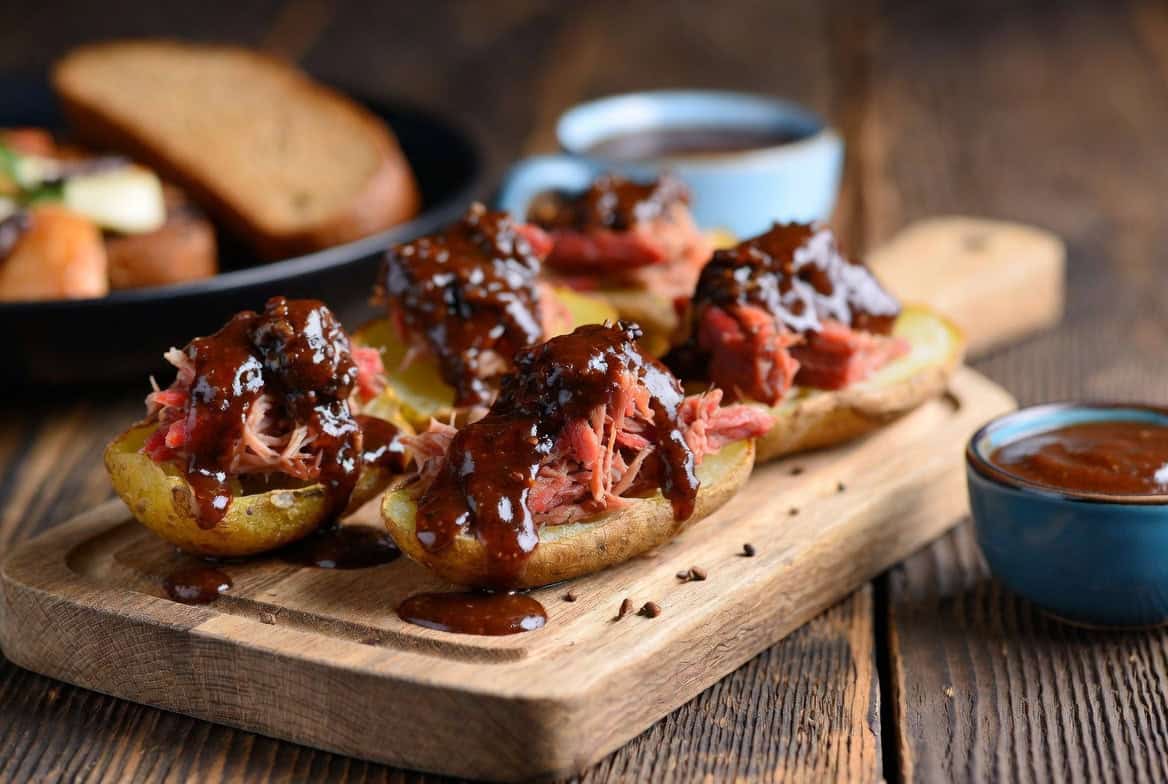
Crisp potato skins carry chopped brisket, smoked cheddar, pickled jalapeño, and a dark coffee-barbecue glaze.
Tools
Chef’s knife, Cutting board, Mixing bowl, Sheet pan, Saucepan, Whisk, Refrigerator space, Instant-read thermometer
Ingredients · swaps in parentheses
8 small russet potatoes, 2 tablespoons neutral oil, 1 1/2 teaspoons kosher salt, divided, 12 ounces cooked smoked brisket, chopped, 1 cup shredded smoked cheddar, 1/3 cup sliced pickled jalapeños, 3 scallions, thinly sliced, 1/2 cup sour cream
Magic
Protect the crisp element from moisture and assemble close to service texture is doing as much work as flavor here. Apply the final sweet glaze late so it shines and clings without scorching or softening the exterior. The acid is structural, not decorative: it keeps the rich, creamy, or fried elements from becoming heavy. Do not rush the browning. Deep color supplies the savory backbone and prevents the finished bite from tasting flat.
Before you begin
Allow the full chilling or marinating window before cooking or assembly.
The parts that change whether this works tonight.
- Yield
- 16 potato skins; serves 8 as an appetizer
- Time
- About 1 hour 35 minutes
- Equipment
- Chef's knife, Cutting board, Mixing bowl, Sheet pan, Saucepan, Whisk, Refrigerator space, Instant-read thermometer
- Make-ahead
- One day ahead: Bake and hollow the potatoes; cool completely before covering and refrigerating
- Holding
- Within 20 minutes of final baking
- Leftovers
- Refrigerate leftovers within two hours. Store the cold garnishes separately when possible
- The method
- 16 ingredients · 7 steps
From this recipe’s own recipe card. Nothing here is a guess.
Loaded potato skins often arrive buried under enough toppings to require excavation. These keep the architecture visible: a crisp russet shell, distinct pieces of smoked brisket, melted cheddar, pickled jalapeño, and a coffee-barbecue glaze that adds roast and bitterness without turning the appetizer into candy.
They are called canoes because the shape works, not because anyone needs to locate miniature paddles.
Yield and timing
- Yield: 16 potato skins; serves 8 as an appetizer
- Prep: 25 minutes
- Cook: 65 to 75 minutes
- Total: About 1 hour 35 minutes
- Best service window: Within 20 minutes of final baking
Ingredients
- 8 small russet potatoes, scrubbed and thoroughly dried
- 2 tablespoons neutral oil, divided
- 1 1/2 teaspoons kosher salt, divided
- 12 ounces cooked smoked brisket, chopped into small distinct pieces
- 1 cup shredded smoked or sharp cheddar
- 1/3 cup sliced pickled jalapeños, well drained
- 3 scallions, thinly sliced
- 1/2 cup sour cream
Coffee-barbecue glaze
- 1/2 cup strong plain brewed coffee
- 1/3 cup ketchup
- 2 tablespoons molasses
- 1 tablespoon cider vinegar
- 1 tablespoon Worcestershire sauce
- 1 teaspoon prepared mustard
- 1/2 teaspoon smoked paprika
- Freshly ground black pepper
Method
Where the time goes
- 45–55 minBake the potatoes425°F
- 10 minShape the shells
- 5–8 minCrisp the canoes
- 10–12 minReduce the glaze
- Fill
- 8–10 minFinish hot165°F
- Finish cold
- Bake the potatoes: Heat the oven to 425°F. Rub the potatoes with 1 tablespoon oil and 1 teaspoon salt. Bake on a sheet pan or directly on the oven rack for 45 to 55 minutes, until the skins feel dry and a small knife enters the centers with little resistance.
- Shape the shells: Cool for about 10 minutes. Halve lengthwise and scoop out most of the flesh, leaving an even 1/4-inch wall. Save the potato flesh for hash, soup, mashed potatoes, or croquettes. I say that knowing how often a tub of scooped potato goes grey in the back of my own fridge. Decide which one you are actually making before you put it away, or make the hash tomorrow and be done with it.
- Crisp the canoes: Brush the inside and outside with the remaining oil and season lightly with the remaining salt. Arrange cut-side down on a wire rack set over a sheet pan. Bake 10 minutes, turn cut-side up, and bake 5 to 8 minutes more. The edges should be deep golden and the shells should hold their shape when lifted.
- Reduce the glaze: While the shells crisp, combine the coffee, ketchup, molasses, vinegar, Worcestershire, mustard, smoked paprika, and several grinds of black pepper in a small saucepan. Simmer for 10 to 12 minutes, stirring occasionally, until reduced to about 1/2 cup. It should coat a spoon in a glossy layer rather than run like coffee. Taste before adding salt; the brisket and cheese may provide enough. That reduction window was reasoned from method rather than from a tested batch, which is how most of what I publish begins, and Salty & Clever’s standing note on how recipes here get written and checked applies to it; coffee strength and ketchup sweetness both vary, so go by the spoon rather than the clock.
- Fill: Toss the chopped brisket with about 1/3 cup glaze. Divide it evenly among the shells without packing it down. Top with cheddar.
- Finish hot: Bake for 8 to 10 minutes, until the cheese is melted, the brisket is steaming, and the center of the filling reaches 165°F.
- Finish cold: Add a small spoonful of sour cream, drained jalapeños, scallions, and a thin final drizzle of glaze. Serve immediately.
Flavor architecture
The potato and cheddar provide salt, fat, and comfort; brisket supplies smoke and savory depth; coffee reins in the molasses; cider vinegar and pickled jalapeño keep the bite from becoming heavy. Coffee is the part I put in and the part I am least willing to give up, but it should register as a darker barbecue flavor—not as a mocha announcement.
Arranging the skins
Arrange the skins cut-side up with the curved potato edges still visible. Do not mound brisket so high that the shell disappears. Keep the sour cream in small defined spoonfuls, distribute jalapeño and scallion across the full platter, and apply the last glaze lightly enough that it shines without pooling. For individual service, plate two skins per person with a few extra scallions and jalapeño slices between them.
Make-ahead, batching, and holding
One day ahead: Bake and hollow the potatoes; cool completely before covering and refrigerating. Make the glaze and refrigerate separately.
Before service: Rewarm the glaze gently, crisp the shells, and warm the brisket before filling. Fully assembled skins may be held on a rack in a 200°F oven for up to 20 minutes before adding sour cream, jalapeños, and scallions. Longer holding softens the shells.
For a larger party, crisp and fill in two waves rather than crowding the pan. A second hot tray is more useful than sixteen increasingly flexible potato boats.
Substitutions that work
- Pulled pork: Use the same quantity and keep the glaze slightly more acidic.
- Deeply browned mushrooms: Use 12 ounces cooked mushrooms for a meatless version; season them fully before glazing.
- Sharp cheddar: Use when the brisket is already heavily smoked.
- Monterey Jack: Produces a milder, stretchier finish.
- Roasted green chile: Replace the jalapeños for softer heat and less acidity; add a little extra cider vinegar to the glaze.
- Greek yogurt: Can replace sour cream, though it will taste tangier and look slightly less glossy.
Likely failure points
The shells are soft: The potatoes were not dried before baking, too much flesh was left inside, or the filled skins sat too long. Return unfilled shells to the oven cut-side up until crisp.
The glaze tastes sweet: Add cider vinegar one teaspoon at a time and a few grinds of black pepper. Do not solve it with more coffee alone.
The brisket falls out: It was left in pieces that are too large or piled too high. Chop it smaller and distribute it in a shallow layer.
The cheese overwhelms the brisket: Reduce the cheese rather than adding more glaze. The meat should remain visible.
The skins taste too salty: Brisket, cheese, Worcestershire, and pickled jalapeños compounded. Use unsalted potato shells and omit any added salt from the glaze.
Storage and reheating
Refrigerate leftovers within two hours. Store the cold garnishes separately when possible. Reheat the skins uncovered on a rack in a 400°F oven for 8 to 12 minutes, until hot and crisp at the edges; then add fresh sour cream, jalapeños, and scallions. Microwave reheating softens the shells.
Kitchen Kit
Pairing: Malbec or a cold lager. Teetotaler: coffee-barbecue shrub. Smoke, cheddar, and pickle want dark fruit or fizz, not a delicate white.
Goods: Russet potatoes, smoked brisket, cheddar, pickled jalapeños, scallions, sour cream, coffee, ketchup, molasses, cider vinegar, Worcestershire, mustard, and smoked paprika.
Gear: Sheet pan, wire rack, small saucepan, pastry brush, sturdy spoon, and instant-read thermometer.
Magic: Preserve the shell, chop rather than mash the brisket, reduce the glaze until it clings, and add every cold garnish after the final bake.
The finished bite should remain recognizably a potato skin—just one with better bark, better acid, and considerably more self-respect.
Part of Recipes & Technique.
Recipe provenance: Salty & Clever editorial formulation, built from established culinary technique and the traditions identified in the article. No chef, restaurant, family, or firsthand cultural provenance is claimed unless it is explicitly named and sourced. How we write and check recipes
Where this goes next
The next thing you will need.
Make it with
 Recipe
The Reveal
Also for the sheet panPour alongside
 Drink
Drink