The One Drink and the No-Drink
Twenty Minutes: Toasted Barley, Chamomile and Rooibos
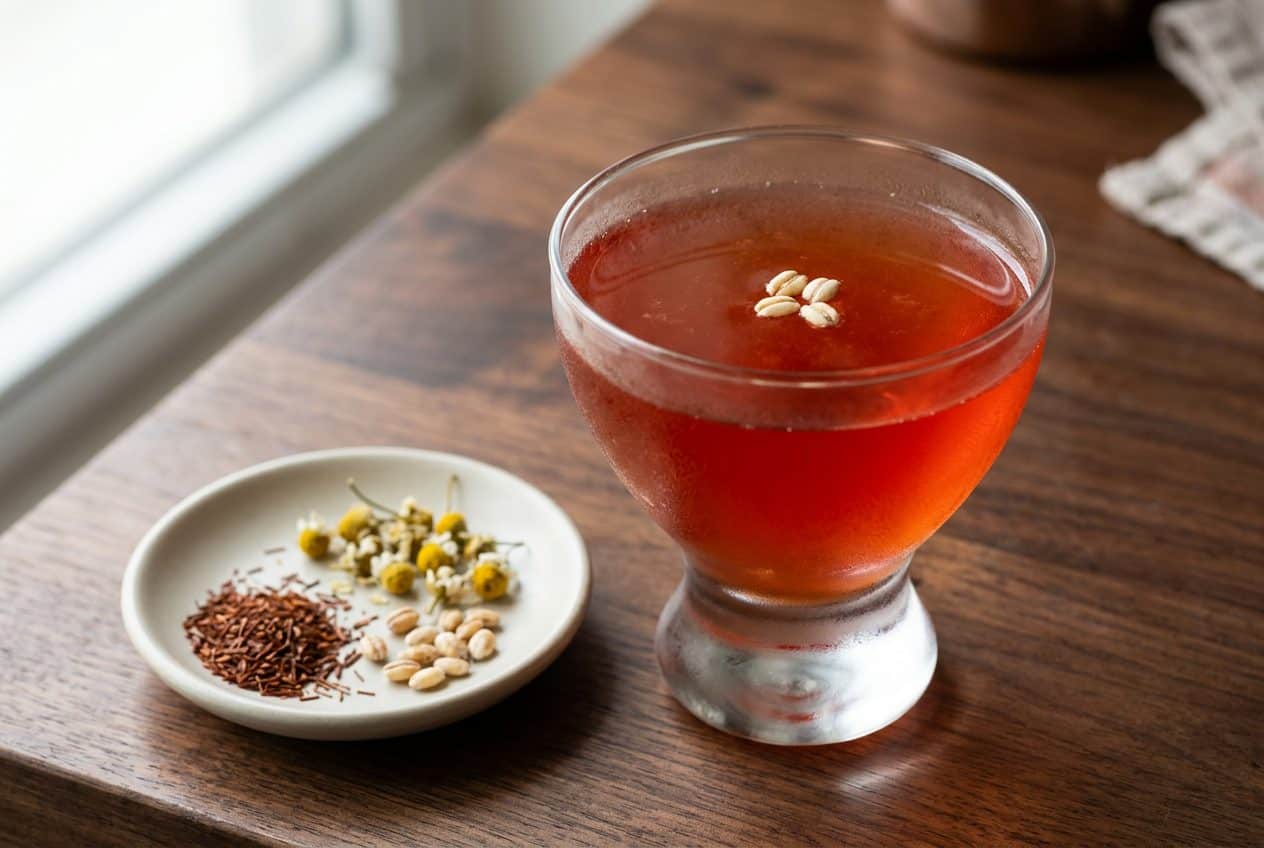
A zero-proof drink built on grain and tannin rather than on fruit, designed as its own thing rather than as a cocktail with the spirit taken out — and it is not sweeter.
Serve alongside
Everything the other drink gets, at the same moment and off the same tray: the warm pork and fennel rolls at arrival, the loaf and butter on the table. Where it goes further than the bourbon is dinner itself — the tannin and the verjus hold up against braised beef and against smoked trout and horseradish, which almost nothing in the category manages, so leave a stoppered pitcher of it on the table through the main course rather than treating it as an arrival drink that has done its job. Never on a separate table, never behind a bar, and never announced in its own sentence.
Tools
A dry heavy pan for the barley, used in loads of 2 to 3½ oz — past about 5 oz it toasts unevenly and you get pale and burnt in the same pan, which tastes muddy — a digital scale, since ⅛ oz of chamomile is three loose tablespoons of something so light that volume means nothing, a timer you will actually obey for those four minutes, a kettle you can hold at 205°F, a fine sieve and a square of cheesecloth for a second pass, a five-quart batching vessel, four hours of fridge at 39°F or colder, stoppered pitchers for the table, and coupes identical to the ones the bourbon drink goes into — the same glass is the design rather than a courtesy, because nobody scanning a candlelit room should be able to tell from across a table who is drinking which
Ingredients · swaps in parentheses
Pearl barley (toasted buckwheat groats are a genuinely equivalent gluten-free swap, if anything more aromatic, at 1¾ oz rather than 2 because buckwheat gives itself up faster), dried chamomile flowers, loose rooibos — brewed deliberately too hard, which rooibos tolerates where black tea would turn harsh — verjus, whose acidity varies enormously between producers and which is the reason you taste before batching (¼ oz of lemon juice plus ⅛ oz water stands in for ⅜ oz of verjus and makes a citrus drink rather than a grain drink: brighter, less savory, not worse), burnt honey syrup weighed rather than measured (dark barley malt extract loosened with hot water is the vegan version, and it happens to be the same grain the drink is already built on), fine sea salt and warm water for the saline, and nothing else at all — no fruit juice, which is the reflex that makes most zero-proof drinks sweet and thin
Magic
Steep the chamomile twice, at two temperatures. The hot four minutes stays exactly as written, because that is where the body comes from. Then, once the batch is mixed and properly cold, add a second small charge — about ½ teaspoon per quart — tied in cheesecloth, leave it in the fridge overnight, and pull it out before service. Heat extracts chamomile's bitterness alongside its perfume, which is why eight minutes hot turns the drink medicinal, but cold water barely touches those bitter compounds and takes the volatile apple-and-hay top notes almost neat. What comes back is a drink that smells markedly more floral without tasting any more of tisane, which matters in a room where the nose is doing work the eyes cannot. Pull the cheesecloth out before you pour, and do not stretch this past the 48-hour rule — plant matter sitting in a starchy, low-acid, non-alcoholic liquid is precisely the thing that recipe note is warning you about. Prefer not to have a bag floating in the batch? Steep the second charge in a scant ½ cup of the cold infusion for a couple of hours instead and stir that back in.
Before you begin
The barley decides everything and the cue is a smell: raw cereal, then bakery, then coffee, and you pull it at bakery-going-on-coffee. Anything sharp or acrid means the whole drink will taste of ash, and starting again costs two ounces of barley, so start again. Time the chamomile with a timer rather than by feel — four minutes is apple and hay, eight is a chest infection remedy — and stir the finished drink for ten seconds only, because there is no alcohol holding the flavor up and a watered version of this is a cup of cold tea. In the batch there is deliberately no added water: this one's infusions are the water, and applying the cocktail batching rule here gives you a drink at 87 percent of its intended strength. Taste and adjust before you commit four quarts, and adjust in the right direction — flabby wants more verjus, sharp wants more barley infusion, never more honey. Then the safety line, which is not decorative: the barley infusion is starchy, low in acid and has nothing in it that preserves anything, so keep it covered and cold, use it inside 48 hours, and throw it out if it smells sour rather than toasty. Poured glasses turn stewed and tannic by hour three, roughly an hour sooner than the bourbon drink does, so hold half back and pour a second wave. And make at least a quarter of the total drink count this one — under-catering the zero-proof drink is the commonest failure at a large dinner, and it is always noticed by exactly the people you would least like to notice it.
The parts that change whether this works tonight.
- Yield
- One drink of 3¼ oz
- Equipment
- A dry heavy pan for the barley, used in loads of 2 to 3½ oz — past about 5 oz it toasts unevenly and…
- Make-ahead
- Weeks out: the burnt honey. The day before: both infusions, and the batch mixed and refrigerated
- Holding
- The batch holds well for 48 hours refrigerated and is at its best on day one
- The method
- 10 ingredients · 7 steps
From this recipe’s own recipe card. Nothing here is a guess.
Most zero-proof drinks fail for one structural reason. When you take a spirit out, you remove weight, warmth, bitterness and a slight astringency all at once, and the reflex is to replace all four with fruit. Fruit brings sugar and acid, which is two of the four, so you end up with something noticeably sweeter and thinner than the drink it was standing in for, and everybody at the table can tell.
This one replaces the missing structure with the things that actually provide it: toasted grain for body and a roasted sweetness that is not sugar, hard-brewed rooibos for tannin and grip, verjus for a soft acid that does not taste of a specific fruit, and burnt honey for depth. It is dry, savory, a little bitter, and it holds up against a plate of braised beef, which is more than can be said for most of the category.
It goes out on the same trays, in the same glasses, announced in the same breath as the bourbon drink. If you find yourself adding “and there’s a non-alcoholic option too” as a separate sentence, you have undone the work.
Yield
One drink of 3¼ oz, scaled below to a batch of forty. Written for a hundred and fifty guests: make at least a quarter of your total drink count as this one. Under-catering the zero-proof drink is the most common failure at a large dinner and it is always noticed by exactly the people you least want to notice it.
Time
Active: 25 minutes. Total: 1 hour 30, including cooling. Make-ahead window: the infusions are best made the day before and must not be made more than 48 hours out.
Ingredients
Toasted barley and chamomile infusion (makes about 3¾ cups):
- 2 oz pearl barley (about ⅓ cup)
- 1 quart water
- ⅛ oz dried chamomile flowers (about 3 tablespoons, loosely packed — it is very light and volume is close to meaningless here, so weigh it)
Hard rooibos (makes about 2 cups):
- ½ oz loose rooibos
- 2 cups water at 205°F
For one drink:
- 2 oz toasted barley and chamomile infusion, cold
- ¾ oz hard rooibos, cold
- ⅜ oz verjus
- ⅛ oz burnt honey syrup (about ¼ oz — weigh it when batching)
- 2 drops saline solution (¾ oz fine sea salt in ⅓ cup warm water)
Method
- Toast the barley in a dry heavy pan over medium heat, shaking often, for 8 to 10 minutes. It goes from pale straw to a deep nut brown and the smell moves from raw cereal to something like a bakery, then to coffee. Pull it at bakery-going-on-coffee. If it smells sharp or acrid, it is burnt and the whole drink will taste of ash — start again, it costs two ounces of barley.
- Add the quart of water to the hot pan — it will hiss and steam — bring to a bare simmer and hold it there for 20 minutes, uncovered. The liquid goes the color of weak tea and smells strongly of toast.
- Take it off the heat, scatter in the chamomile, and steep exactly 4 minutes. Chamomile is the ingredient that decides whether this drink is elegant or medicinal; four minutes gives you apple and hay, eight gives you a chest infection remedy. I am not a methodical cook and I set a timer for very little, and I would set one for this.
- Strain through a fine sieve, pressing lightly, then again through cheesecloth if you want it clear. Cool, then refrigerate. It will throw a faint starchy sediment; decant off it.
- Separately, brew the rooibos hard: ½ oz in 2 cups at 205°F for a full 8 minutes. This is deliberately over-brewed. Rooibos does not go harshly bitter the way black tea does, so you can push it for tannin and grip without paying for it. Strain, cool, refrigerate.
- To build one drink: combine everything in a mixing glass, add three cubes of ice and stir for 10 seconds only — you are chilling, not diluting; the drink is already water-based and does not want more water. Strain into a chilled coupe.
- Taste one before you commit. Verjus varies enormously in acidity between producers, and this drink lives or dies on the balance between the verjus and the honey. If it is flabby, add 8 drops more verjus per drink. If it is sharp, add 8 drops more barley infusion, not more honey. Honey is the reflex, and it is the wrong one: sweetening a savory drink to fix its acid is how this whole category earned its reputation.
Glass, ice and garnish
Glass: the same small heavy-based coupe as the bourbon drink, chilled. Same glass is not a courtesy, it is the design. Anybody scanning a dark room with two hundred candles in it should not be able to tell from across a table who is drinking what.
Ice: none in the glass, and almost none in the making — ten seconds of stirring, no more. A zero-proof drink over ice dilutes far faster than a spirit drink does because there is no alcohol holding the flavor up, and a watery version of this is a cup of cold tea.
Garnish: none, matching the cocktail. If you want one for a lit room where there is no fire consideration, three toasted barley grains floated on the surface is quietly good and costs nothing.
The batch, with dilution accounted for
For 40 drinks, in a 5-quart vessel:
- 80 oz toasted barley and chamomile infusion (three batches of the above)
- 30 oz hard rooibos (two batches)
- 15 oz verjus
- 7½ oz burnt honey syrup (about 5 fl oz)
- ⅛ oz saline
- No added water. Unlike the bourbon batch, this one needs no dilution built in — the infusions are the water. Adding the stirring dilution here would give you a batch at about 82% of its intended strength, which is the mistake people make when they apply a cocktail batching rule to a drink that never had a spirit in it.
Total 130 fl oz, 3¼ oz per glass. Refrigerate at least four hours; serve at 39°F or colder.
Thirty-nine degrees is not fussiness. Cold is the last piece of structure this drink gets, and the only one that can still be added after the batch is mixed. Poured at cellar temperature it reads flat within two sips, and nobody at the table will be able to tell you why.
Throughput
Built to order, about one a minute, same as anything stirred. Poured from a chilled pitcher into pre-set glasses, about eight a minute. Forty drinks in five minutes.
The two-minute question matters here for a specific reason: at a large event, the zero-proof drink is usually the one that runs out or the one that has to be made from scratch while somebody waits at a bar being visibly accommodated. Batch it, pour it in advance, and put it on the same tray, and that entire failure mode disappears.
Make-ahead
Weeks out: the burnt honey. The day before: both infusions, and the batch mixed and refrigerated. The morning of: chill glassware. Ninety minutes before doors: pour.
What must not be done ahead: the barley infusion more than 48 hours out. It is a starchy, low-acid, non-alcoholic liquid — it is exactly the kind of thing that goes cloudy and sour if it sits, so keep it refrigerated, keep it covered, and if it smells at all sour rather than toasty, throw it away. Nothing in this drink preserves anything.
Holding and service
The batch holds well for 48 hours refrigerated and is at its best on day one. A poured glass is excellent for the first hour and fine for two. At hour three, warm, the tannin comes forward and it turns stewed — that is the point at which it stops being worth serving, and it arrives about an hour sooner than it does for the bourbon drink, which is the one genuine operational disadvantage of a zero-proof pour. Hold half the glasses back and pour a second wave.
On the table, in stoppered pitchers, alongside the other one. Not on a separate table. Not behind the bar. That rule came out of Tangled Thistle’s plan for a hundred and fifty and I would keep it for six: it is the entire difference between a choice and an accommodation.
Scaling
Everything multiplies linearly. What does not scale is the toasting pan: barley toasted more than about 5 oz at a time cooks unevenly, and you get a mixture of pale and burnt that tastes muddy. Toast in batches of 2 to 3½ oz and combine.
The pan is the one step with no batch discount, and it is also the cheapest thing to get wrong: two ounces of barley. The expensive version of that mistake is the one nobody catches, where a muddy pale-and-burnt mix goes into six quarts and gets tasted for the first time at the pour.
The steeping time does not scale either — 20 minutes is 20 minutes whether it is one quart or six, and the chamomile is still 4 minutes. Above about 2 gallons of finished drink, the method changes: brew the barley in a stockpot, but steep the chamomile separately in a small quantity of hot infusion and add it back, because scattering 1 oz of flowers into a stockpot means you cannot strain them out fast enough and the four minutes becomes seven.
Substitutions
Roasted buckwheat for the barley, for a gluten-free version. Toasted buckwheat groats give a very similar nutty body and are, if anything, slightly more aromatic. Use 1¾ oz rather than 2, because buckwheat gives up more quickly. This is a genuinely equivalent swap and the drink is just as good.
Which is worth saying plainly, because it is rare. The gluten-free version is not the lesser one, so it does not need a separate jug, a label, or a sentence of explanation at the door. Make the whole batch that way and the question never comes up.
Lemon juice and a little water for the verjus. Works, and changes the drink: verjus is acidic without being lemony, so the substitution makes something that reads as a citrus drink rather than a grain drink. Use ¼ oz lemon plus ⅛ oz water in place of ⅜ oz verjus, and expect a brighter, less savory result. Not equivalent, but not worse.
For a vegan version, swap the burnt honey for dark barley malt extract loosened with hot water to a pourable syrup — which is, pleasingly, the same grain the drink is already built on, and makes it more coherent rather than less.
Reasoned from technique rather than tested in volume; Salty & Clever’s standing note on method and AI applies. Taste and adjust the verjus before you batch four quarts.
Why this is here
The name is not a joke about how long it takes to make. At One Match, a room on Tangled Thistle that starts in total darkness and lights itself over eleven minutes from a single flame, the eleven minutes is how long the candles take. Twenty minutes is roughly how long the human eye takes to finish adapting to the dark, which is to say the room is still getting better to look at long after the last wick is lit. The two drinks are named for the two clocks running in that building, and neither is the junior version of the other. Its counterpart is Eleven Minutes; the full drinks design is Everything Is Already on the Table.
A drink named for the time the eye takes to catch up is not a consolation prize, and it should not reach the table like one.
Part of Drinks & Zero-Proof.
Where this goes next
