Charred Radicchio, Whipped Anchovy Cream, Burnt Lemon
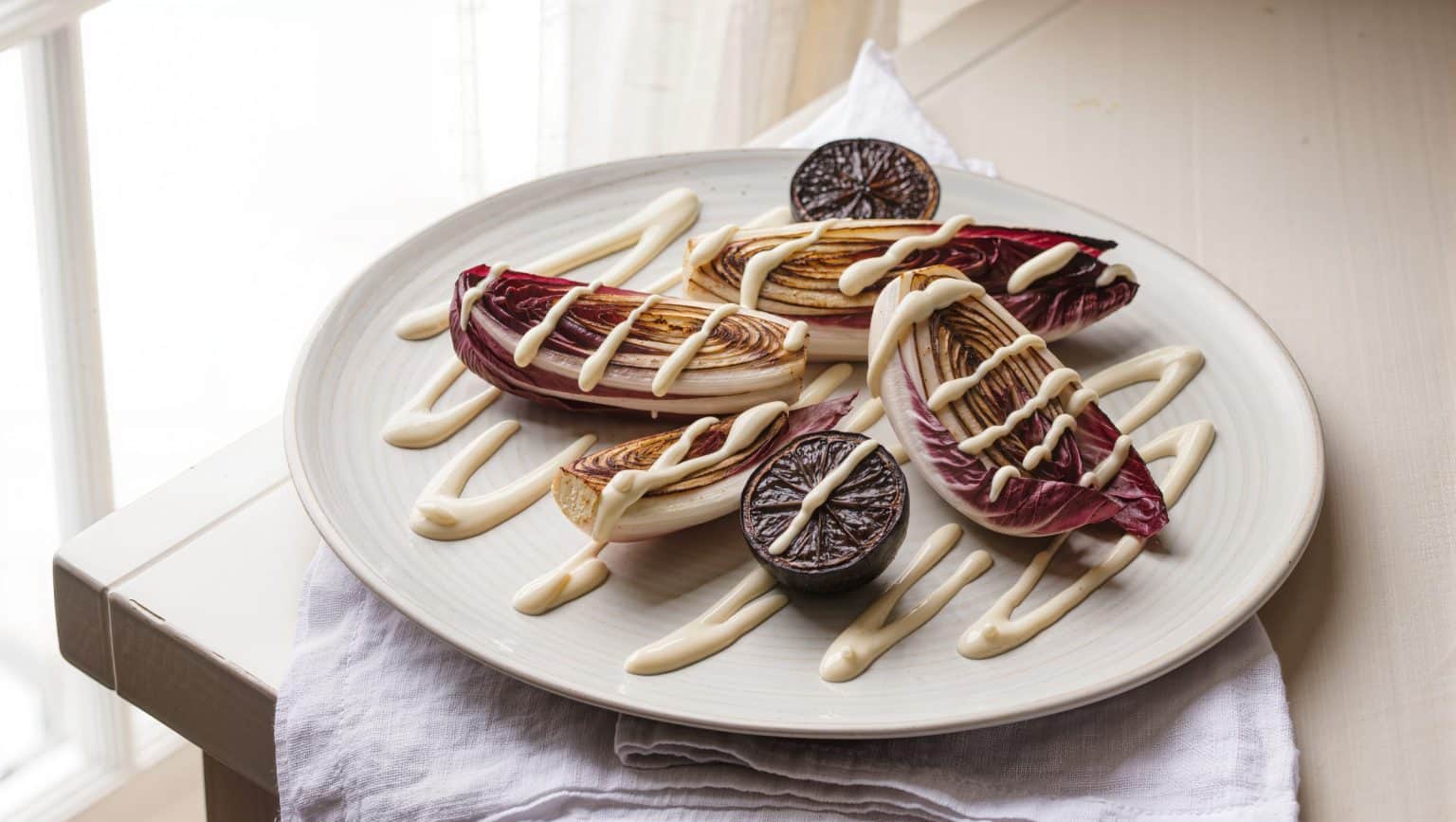
Radicchio charred black on the cut face, laid warm over cold whipped anchovy cream with a burnt lemon half — the first course that corrects a room that just ate cake.
Pairing
Wine — A Ligurian Vermentino, properly cold. It is saline and slightly bitter at the finish, which means it meets the radicchio rather than trying to sweeten it, and it has the acid to get through a cream that is essentially whipped salt. Mixed drink — A Bitter Giuseppe — Cynar, sweet vermouth, lemon juice and orange bitters, on ice. Cynar is built on artichoke and the same family of bitter compounds as chicory, so it reads as a continuation of the plate instead of an interruption. Teetotaler — Verjus over ice, topped with soda, a pinch of salt and a bruised sprig of tarragon. Verjus is sour without being sharp the way lemon is, the salt does for the drink what it is doing for the radicchio, and the tarragon's anise note sits against burnt citrus better than anything sweet could.
Tools
A heavy cast-iron or carbon-steel pan that will take a dry, empty, screaming heat without you worrying about it — this dish is decided by how hot that surface is and a nonstick pan cannot legally get there, plus a second pan or a flat-top if you are past eight servings because you can only char what fits in a single layer, a sharp knife for halving heads through the core, a mortar or small processor for the anchovy paste, a bowl and whisk for the cream, tongs, and a working extractor or an open window, because a blackened radicchio face means real smoke in the room
Ingredients · swaps in parentheses
Radicchio, Chioggia or Treviso (halved Belgian endive is the honest stand-in — same bitterness and shape, but it chars a minute faster so watch it), olive oil for brushing, kosher salt, oil-packed anchovy fillets and a spoonful of their oil (leave them out and whip the cream with fine salt and a lot of black pepper instead — you lose the savory depth and keep the hot-over-cold structure, which is most of the dish), cold heavy cream, lemons for burning, black peppercorns
Magic
Sit the halved radicchio in a bowl of ice water for twenty minutes before you oil it, then dry it aggressively — cloth, not a shake. Two things come of it. Cold water pulls some of the harshest bitter compounds out of the cut leaves, and the leaves drink up enough water that the inside steams while the face is blackening, which buys you the extra ninety seconds it takes to get from dark brown to genuinely black without the whole head going leathery. Char is the entire flavor of this course, and this is the difference between a face that is charred and a face that is merely marked. The drying is not optional: a damp cut face will sit in the pan hissing and steaming and never blacken at all. Twenty minutes you do not have? Ten in cold tap water does perhaps half the job, and failing that, pull the radicchio a minute earlier and salt it harder.
Before you begin
Fold the anchovy paste through the whipped cream by hand and stop while it is still streaked — blitzed to an even beige it turns into a dip and loses the pockets of pure salt that make it work. Once the radicchio is cut-side down, leave it alone for the full four to five minutes every look costs you char. And the clock starts the moment it comes off the heat: charred radicchio holds about twenty minutes before it starts weeping liquid onto the plate and the char goes soft against the cream, so char in batches as tables sit rather than pre-plating a room. The lemons want to be blackened and smoking, not gently caramelised — if they look pretty, they are not done.
The parts that change whether this works tonight.
- Yield
- 6 servings
- Time
- 40 minutes, plus time to chill the anchovy cream
- Equipment
- A heavy cast-iron or carbon-steel pan that will take a dry, empty, screaming heat without you worrying about it — this dish is decided…
- Make-ahead
- Anchovy cream: up to 2 days ahead. Radicchio: charred and dressed to order, not before
- Holding
- Twenty minutes is the honest number and it is also the trap: somebody has to stand at that pan while the room fills up, and if that somebody is the…
- The method
- 8 ingredients · 6 steps
From this recipe’s own recipe card. Nothing here is a guess.
This is the first thing anyone sits down to, and its whole job is to be savory enough that it reads as a correction after the cake at the door. Radicchio goes black on the cut face — genuinely black, not caramelized — and gets laid warm over a cold, salty, whipped anchovy cream, with a burnt lemon half on the side for the guest to squeeze themselves. Hot over cold, bitter against salt, and a scorched citrus note that has nothing sweet left in it anywhere. It is a plated first course, which after a hallway full of people eating with their hands is its own small relief.
Yield and time
- Yield: 6 servings, written for a table of 6; multiplies by table
- Active time: 25 minutes
- Total time: 40 minutes, plus time to chill the anchovy cream
- Make-ahead window: Anchovy cream: up to 2 days ahead. Radicchio: charred and dressed to order, not before.
Ingredients
- Radicchio heads (Chioggia or Treviso), halved through the core — 3 heads for 6 servings
- Olive oil, for brushing — about 2 tablespoons
- Kosher salt (Diamond Crystal) — 2 teaspoons, plus more to finish
- Anchovy fillets in oil — 8 fillets (about 1 oz), plus 1 tablespoon of their oil
- Heavy cream, cold — ¾ cup
- Cold water, a splash, to loosen if needed
- Lemons — 3, halved crosswise, for burning and squeezing
- Black pepper, coarsely ground, to finish
Method
- Make the anchovy cream first: pound or blitz the anchovy fillets with their oil to a rough paste, then whip the cold cream to soft peaks and fold the anchovy paste through by hand until evenly streaked, not fully blended — you want to still see it. Refrigerate.
- Halve the lemons and lay them cut-side down in a dry, very hot pan or directly on a grill for 3–4 minutes, until the cut face is properly blackened and starting to smoke — this is not the same as a squeeze of raw lemon and shouldn’t taste like one; set aside.
- Brush the radicchio halves with olive oil and season with the kosher salt on the cut face.
- Lay them cut-side down in the same hot pan (or grill) and leave them alone for 4–5 minutes, resisting the urge to move them, until the face is genuinely black and the outer leaves have gone limp and slightly translucent.
- Spread a thick smear of the cold anchovy cream across each plate.
- Lay the hot radicchio, cut face up, over the cream while it’s still warm enough to soften the cream slightly at the edges, finish with black pepper and a little more salt, and set a burnt lemon half on each plate for the guest to squeeze at the table.
Make-ahead
The day-two claim here comes from reasoning from method — how a salted, emulsified cream behaves — rather than from a tested bench run, which is how most of what we publish begins; Salty & Clever’s standing note on how we write and check recipes applies to it. The anchovy cream holds well for up to 2 days, tightly covered and refrigerated — in fact it firms up and holds its whip better on day two. The lemons can be burnt a few hours ahead and left at room temperature; they don’t need to be hot, just genuinely blackened. The radicchio itself should be charred within about 20 minutes of the table sitting down — it loses its point once it’s cold.
Holding and service
Twenty minutes is the honest number and it is also the trap: somebody has to stand at that pan while the room fills up, and if that somebody is the host, the real choice is between greeting people and charring lettuce. I know which one I pick, and it is not the lettuce. Charred radicchio holds its shape for about 20 minutes off the heat before it starts to weep liquid onto the plate and the char loses its edge against the cream. This is not a dish to pre-plate for a big room; char it in batches as tables sit, or accept a shorter window between charring and serving as the guest count rises.
Scaling
The serving counts in this section are Tangled Thistle’s, sized to an occasion rather than to a home stove, which is worth knowing before anyone reads the pan advice as advice for their own pan. The anchovy cream scales cleanly — whip it in one large batch rather than many small ones, it holds structure better. The radicchio does not scale in the pan the way the cream scales in the bowl: you can only char what fits in a single layer without steaming, so past about 8 servings you need either a second pan working simultaneously or a hot flat-top with more surface area, not a bigger single pan.
Substitutions
- No anchovies, or a guest who won’t eat fish — whip the cream with 1 teaspoon fine sea salt and a generous grind of black pepper instead; it loses the savory depth but keeps the hot-over-cold structure of the dish, which is most of what makes it work.
- No radicchio, or it’s out of season — halved and charred Belgian endive is the closest substitute in bitterness and shape, though it chars faster, so cut the time in the pan by a minute.
Why this dish, at The Cake Arrives First
It belongs to The Cake Arrives First, where nothing served after ten past seven is allowed to be sweet. This is the dish that draws the line hardest — bitter, salty, scorched, and about as far from a slice of cake as a plate can get.
Part of Recipes & Technique.
Recipe provenance: Salty & Clever editorial formulation, built from established culinary technique and the traditions identified in the article. No chef, restaurant, family, or firsthand cultural provenance is claimed unless it is explicitly named and sourced. How we write and check recipes
Where this goes next

