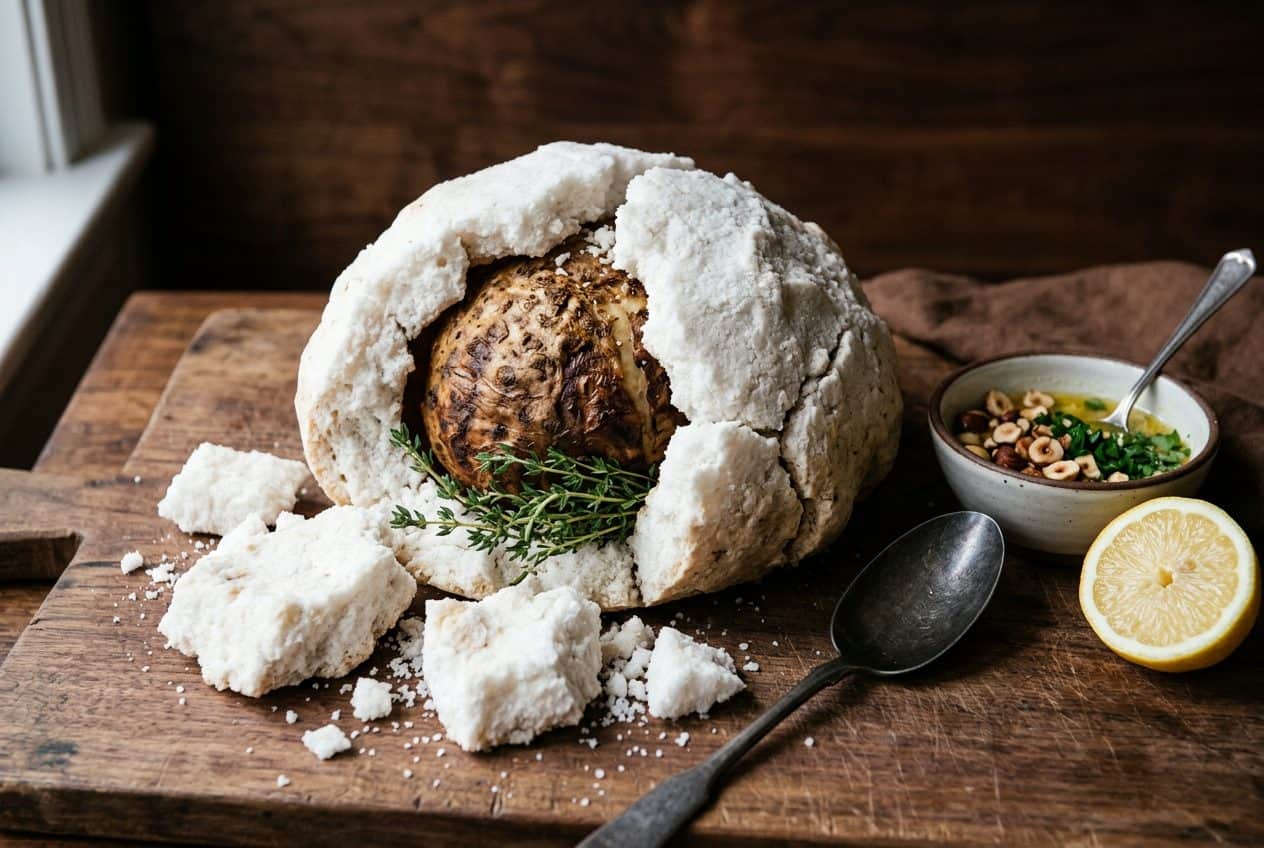
A whole celeriac in a salt crust, cracked with the same spoon
The vegetarian and vegan main for this evening, built as the same event: same crust, same board, same gesture, same minute.
Pairing
Wine — A Savagnin from the Jura, made under flor: nutty, dry and slightly oxidative, which meets the hazelnuts and the browned butter head-on where a fresher white would just disappear. Mixed drink — A dry saison, cold and poured with a big head — the pepper in the yeast lines up with the black pepper on the board, and the carbonation lifts the butter off the palate between mouthfuls. Teetotaler — Cold buttermilk, salted, with a hard grind of black pepper and chopped dill stirred through it — the buttermilk left over from churning the cultured butter is exactly the thing, and its sourness does the same job against a buttery vegetable that a glass of sharp white would.
Tools
A digital scale, a bowl big enough to work 4½ lb of salt by hand (allow 20 minutes of mixing per 9 lb and do it in batches), a long thin skewer, which is the only test that counts here, a heavy spoon for cracking, a pastry brush, a small knife and a cloth for peeling back the skin, a pan for the butter or oil, a board to serve off, and somewhere warm to park a finished boulder for up to three hours
Ingredients · swaps in parentheses
A celeriac of about 2¼ lb, scrubbed hard with the skin on (a large beet takes 1 hour 15 and wants red wine vinegar and walnuts instead, rutabaga takes 20 minutes longer and wants brown butter, kohlrabi behaves exactly like celeriac), coarse sea salt, all-purpose or rice flour, eggs for the whites, thyme, butter — or good olive oil warmed with a smashed garlic clove and a strip of lemon peel for the vegan version, which loses the nuttiness, so put it back with ¾ oz more hazelnuts — hazelnuts, a lemon, parsley, flaky salt, plenty of black pepper, and a tin of English mustard powder if you are doing the trick
Magic
Slake a teaspoon of English mustard powder in two teaspoons of cold water and leave it ten minutes while the celeriac rests, then whisk it into the melted butter off the heat, just before it goes over the board. Dry mustard powder has no heat at all until it meets water — the pungency is made by a reaction that needs about ten minutes to run — and it is then destroyed by sustained heat, so slaking cold and adding off the heat is the difference between a sauce with a nose on it and a sauce that tastes of nothing. What you get is the pungency of celeriac remoulade, the dish celeriac is best at, arriving hot in a butter that would otherwise be flat, and it cuts the fat in a way lemon alone does not. Too much? A teaspoon of wholegrain mustard stirred through the parsley gives you a gentler version with the same idea.
Before you begin
The skewer is the whole recipe. It must pass through the center with no resistance whatever, the way it would through soft butter — anything short of that and the celeriac is fibrous and faintly bitter, and it will not improve on the plate, so give it another 20 minutes and test again. Time it by the size of each vegetable, not the number of them: 2¼ lb wants 1 hour 45 to 2 hours, 3¼ lb wants 2 hours 30, and three of them together take exactly as long as one. Dress at the table and not a minute before, because butter poured over ten minutes early soaks in and leaves the surface dull. Do not purée it and do not plate it neatly — it is meant to look like the fish. And once it is cracked there is no going back: it will not reheat, it goes watery, and a boulder cracked at ten is a cold vegetable by eleven, whereas one left sealed is still excellent.
The parts that change whether this works tonight.
- Yield
- one 2¼ lb celeriac serves 3 to 4 as a main
- Time
- 2 hours 15 minutes
- Equipment
- A digital scale, a bowl big enough to work 4½ lb of salt by hand (allow 20 minutes of mixing per 9 lb and…
- Make-ahead
- Crust 1 day; celeriac baked up to 3 hours ahead and held in its crust
- Holding
- Cracked, dressed and on the board it is good for 25 minutes and fine for 40
- The method
- 11 ingredients · 7 steps
From this recipe’s own recipe card. Nothing here is a guess.
Most vegetarian main courses at large dinners are apologies. This one is not, and the test is simple: it comes to the table in the same white crust, on the same board, and is cracked with the same spoon at the same moment as the fish. Nobody at the table can tell which board is which until the crust comes off.
The thing that decides whether it works is time. A celeriac in a salt crust needs the best part of two hours, roughly four times as long as the fish, and it is not done until a skewer goes through the middle with no resistance at all. Undercooked celeriac is fibrous and faintly bitter and it will not improve on the plate. Start it early, hold it in its crust, and crack it when the fish cracks.
Yield and timing
- Yield: one 2¼ lb celeriac serves 3 to 4 as a main. Written for 40 guests at roughly a quarter vegetarian — three celeriacs.
- Active: 20 minutes
- Total: 2 hours 15 minutes
- Make-ahead: Crust 1 day; celeriac baked up to 3 hours ahead and held in its crust
Ingredients
- 1 celeriac of about 2¼ lb, roots trimmed, scrubbed hard, skin left on
- 4½ lb coarse sea salt
- ¾ cup all-purpose flour (or rice flour)
- 4 egg whites
- About ½ cup cold water
- 8 sprigs thyme
- 5 tablespoons butter, or ⅓ cup good olive oil for the vegan version
- ½ cup hazelnuts, toasted and roughly chopped
- 1 lemon
- A handful of parsley, chopped
- Flaky sea salt and black pepper
Method
- Heat the oven to 400°F convection.
- Make the crust exactly as for the fish: salt and flour mixed, egg whites whisked loose and worked in by hand, water added a splash at a time until it holds a squeezed shape like wet sand.
- Sit the celeriac on a ½ inch bed of the mixture, tuck the thyme against it, and pack the rest over the top and down the sides, ½ to ⅝ inch thick everywhere. Press it firm. It should look like a boulder.
- Bake for 1 hour 45 minutes to 2 hours. Test by pushing a thin skewer through the crust into the center — it should go through the whole vegetable with no resistance whatever, the way it would through soft butter. If there is any grip in the middle, give it another 20 minutes and test again. This is the only judgment in the recipe and it is not negotiable. Late and soft beats punctual and fibrous, and there is no way to tell from the outside of a boulder, so test it rather than believing the clock or me.
- Rest in the crust for 15 minutes, or up to three hours if you are holding it.
- Crack at the table with the back of a heavy spoon, brush the salt away, and peel the skin back with a knife and a cloth — it lifts off in sheets and the flesh underneath is pale, dense and steaming.
- Spoon it out in rough chunks. Dress on the board with melted butter or hot olive oil poured over, lemon, hazelnuts, parsley, flaky salt and a lot of black pepper. Do not purée it or plate it neatly; the point is that it is served the same way as the fish.
Make-ahead
The crust mix can be made a day ahead.
Unlike the fish, this can be baked ahead. A celeriac left in its intact crust will hold hot for two to three hours in a warm place, and that is genuinely useful when the oven is needed for something else. Bake it in the afternoon and crack it at ten.
It does not reheat once cracked. It goes watery.
Holding and service
Cracked, dressed and on the board it is good for 25 minutes and fine for 40. It holds heat far better than the fish because of its density, which is a quiet advantage.
The dressing goes on at the table, not in the kitchen. Butter or oil poured over celeriac ten minutes early soaks in and leaves the surface dull.
At hour three, if it has been left uncracked, it is still excellent. If it was cracked at ten it is a cold vegetable by eleven.
Scaling
Three celeriacs fit in a domestic oven at once and take the same time as one. This is the easiest dish here to scale and it should be scaled generously — make one more than you think, because a proportion of the room will want it whether or not they are vegetarian.
Above about 18 lb of celeriac the crust becomes the workload: allow 20 minutes of hand mixing per 9 lb of salt, and mix in batches. That is twenty minutes of somebody’s arms, and it is the job everyone underestimates when they read this page and the job everyone remembers afterward. Do it the day before if you possibly can.
The bake time does not change with the number of celeriacs. It changes with the size of each one: 3¼ lb takes 2 hours 30, and the skewer is still the only test.
Substitutions that keep the idea
- Whole beets in the same crust: 1 hour 15 for a large one, dressed with red wine vinegar instead of lemon and walnuts instead of hazelnuts. Earthier, sweeter, and it stains the salt pink, which is either a feature or a problem depending on your table.
- A whole rutabaga or a large kohlrabi works identically. Rutabaga takes 20 minutes longer and wants brown butter rather than olive oil.
- Vegan: use good olive oil warmed with a smashed garlic clove and a strip of lemon peel instead of butter. Not equivalent — you lose the nuttiness — so add ¼ cup more hazelnuts to put it back.
Where this belongs
This is the vegetarian and vegan main at The Ice Was the Luxury, a Tangled Thistle occasion, and it is the same event as the fish rather than a version of it. The food half of those evenings lands here; the Occasion Study and the Look Book stay over there. Which is also why the numbers on this page are written for forty. If you are cooking one celeriac for four, every judgment above still holds and only the arithmetic changes. It arrives at the same time, on an identical board, in an identical crust. The menu concept sets out why dietary design at this evening is a matter of gesture and timing rather than of substitution.
This recipe was developed by reasoning from method rather than from a tested bench run, which is how most of what we publish begins; Salty & Clever’s standing note on how we write and check recipes applies to it. Celeriac hides its doneness completely under the crust, which is the pleasure of it and the risk. Put a skewer through the crust once rather than cracking it early to look.
Part of Recipes & Technique.
Recipe provenance: Salty & Clever editorial formulation, built from established culinary technique and the traditions identified in the article. No chef, restaurant, family, or firsthand cultural provenance is claimed unless it is explicitly named and sourced.
Where this goes next
The next thing you will need.
Make it with
 Recipe
