Salt-Baked Potatoes That Look Like the Beach They Arrive On
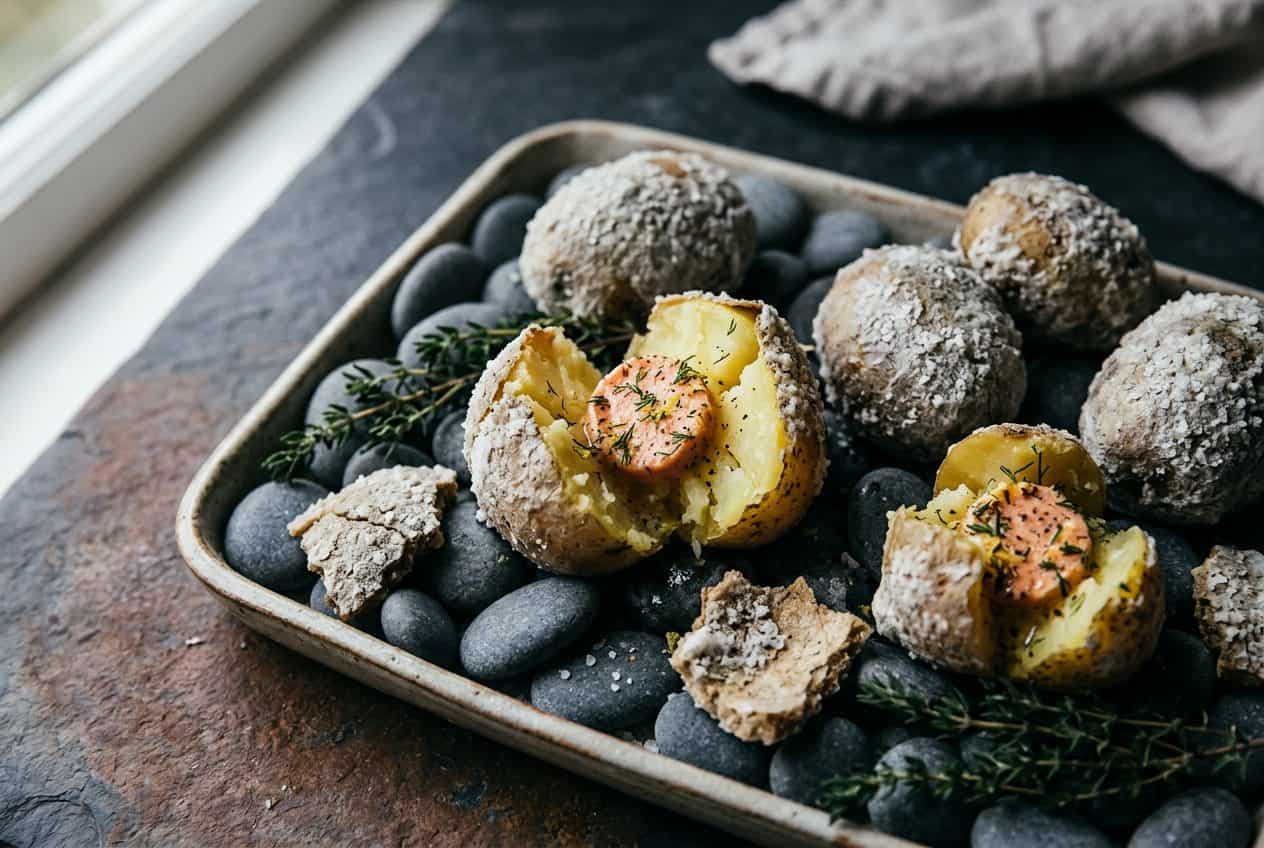
Small potatoes baked in a salt crust, carried down cold sand in a shingle-lined tray, split and pressed with smoked cod's roe butter, and eaten standing with one hand.
Pairing
Wine — A properly cold, bone-dry manzanilla, poured into tumblers rather than glasses. It is the one wine that answers a salt crust with salt of its own, and its bitterness cuts the roe butter without laying fruit over the top of it. Mixed drink — A Gibson, stirred hours ahead and carried in a flask so it arrives colder than anything you could mix outdoors — gin, a restrained amount of dry vermouth, and a pickled onion dropped in at the last moment. The onion brine supplies the sharp note the potato is missing, and a stirred drink survives the walk over sand in a way a shaken one does not. Teetotaler — Cold-brewed lapsang souchong, steeped deliberately weak, with lemon juice and a pinch of salt, served long over ice. It is smoky, savory and genuinely bitter, so it stands up to the roe butter rather than apologizing to it.
Tools
A digital scale — the potatoes must land at 1½–2 oz each and that single number decides whether this works, deep roasting trays (roughly one per 20 potatoes, and four is what a domestic oven bakes evenly), an oven you trust at 400°F convection, a stand mixer or a hand whisk with some commitment for the butter, baking paper for rolling the logs, a spoon for the hollow-tap test, insulated boxes preheated before the trays go in, and a lidded tin for the skins because anything left on tidal sand leaves on the water
Ingredients · swaps in parentheses
Small waxy potatoes (Charlotte, Anya or Ratte — a floury potato collapses into the crust and there is no recovering it), coarse sea or rock salt in quantity (never fine, which sets into a dense paste welded to the skin), egg whites, fresh thyme on the stalk, unsalted butter, smoked cod's roe or a good roe paste (chopped anchovy works and is honest, but it is saltier and insistent and you lose the smoke entirely — for a vegan version, block butter with toasted crumbled dulse and white miso genuinely carries the smoky-marine job), lemons, garlic, dill, black pepper
Magic
Before you zest anything, halve the lemons and char the cut faces hard in a dry pan until they are black in patches, then juice them and use that juice in the butter — keep the zest raw and stir it in as written. The raw zest gives you the lift, and the charred juice puts a bitter, smoky floor under it that reads as an extension of the roe rather than a squeeze of lemon sitting on top, which is what stops the butter drifting into taramasalata by the third potato. Char costs you volume, so squeeze about a third more fruit than you think you need. If standing over a smoking pan is not your evening, a few drops of a good smoked vinegar beaten in at the end gets you most of the way there.
Before you begin
Weigh the potatoes rather than trusting your eye — at 1½–2 oz the middle cooks through in exactly the time the crust takes to set hard, and anything bigger splits its shell before it is done. The crust mixture wants to be wet sand that just holds a squeeze and no wetter, or it will still be soft an hour in. The unforgivable move is cracking the crusts in the kitchen: sealed, they hold serving temperature for ninety minutes, and cracked they give you twenty minutes in still air and a good deal less in wind. Do not bake the day before and reheat, either — a reheated salt-baked potato is dry, and the crust has already given the skin all the salt it has to give.
The parts that change whether this works tonight.
- Yield
- 80 potatoes, which serves 40 as two each
- Time
- 25 minutes active, 1 hour 10 minutes total
- Equipment
- A digital scale — the potatoes must land at 1½–2 oz each and that single number decides whether this works, deep roasting trays (roughly…
- Make-ahead
- Five days out: the roe butter, rolled and refrigerated. It is better after two days. · The day before: wash and dry the potatoes; weigh out the salt
- Holding
- Intact in their crusts, in a preheated insulated box, they hold serving temperature for about ninety minutes and are still pleasantly warm at two hours
- The method
- 11 ingredients · 7 steps
From this recipe’s own recipe card. Nothing here is a guess.
This is the food that meets somebody who has just walked three hundred meters over sand into the wind, at dusk, in a coat. It is hot, it fits in one hand, it needs no plate, it needs no cutlery, and it stays hot for twenty minutes without any equipment at all — because a salt crust is a thermal mass, and a small potato inside one is a stone with a baked potato in the middle of it.
They also happen to look like the wet pebbles on the strand line, which is a pleasing thing when they come down the beach in a tray lined with shingle. That is the visual joke and it is over in a second; the reason they are on the menu is thermal.
Potato size decides this, more than anything you will do to them, and it is the one thing I would go back to the shop for. At 1½–2 oz each they cook through in the crust in the time the crust takes to set hard, and they hold heat for a genuine twenty minutes. Bigger and the crust cracks before the middle is done; smaller and they are cold before the second tray goes out.
Yield and timing
Yield: 80 potatoes, which serves 40 as two each. Written for 40 people standing on sand for twenty minutes before they sit down, which is the exact window this fills.
Time: 25 minutes active, 1 hour 10 minutes total. Make-ahead window: the butter is made up to five days ahead; the potatoes go into their crust the morning of and are baked in the two hours before you leave.
Ingredients
- 80 small waxy potatoes, 1½–2 oz each (about 7¾ lb) — Charlotte, Anya, Ratte or any firm salad potato; a floury potato collapses into the crust
- 6½ lb coarse sea salt or coarse rock salt — coarse, not fine; fine salt makes a dense paste that welds to the skin
- 6 egg whites (about 7½ oz)
- ⅔–1 cup cold water
- ¾ oz fresh thyme, on the stalk
Smoked cod’s roe butter
- 3½ sticks unsalted butter, at proper room temperature — soft enough to take a fingerprint without resistance
- 7 oz smoked cod’s roe, skin removed (or a good smoked cod’s roe paste; taste it first for salt)
- Finely grated zest of 2 lemons and 2½ tablespoons lemon juice
- 1 small garlic clove, grated to a paste
- ½ oz chopped dill
- Black pepper; flaky sea salt only if needed, which it usually is not
Method
- Make the butter first. Beat the soft butter until it is pale and holds a peak, about 3 minutes. Add the roe in three additions, beating between, until it is a uniform coral pink with no darker streaks. Add lemon zest, juice, garlic and dill. Taste. It should be salty, smoky, sharp with lemon, and lighter than it looks; if it tastes flat, it needs more lemon, not more salt. Roll into two logs in baking paper and refrigerate.
- Heat the oven to 400°F convection / 425°F conventional.
- Mix the crust. Salt, egg whites and enough water to bring it to the texture of wet sand that just holds a shape when you squeeze it — that is exactly the test, and on this occasion the reference material is underfoot. Too wet and it takes an hour to set; too dry and it crumbles off the potato.
- Pack. A ½ inch bed of the salt mixture in deep roasting trays, thyme scattered over it, potatoes sat on top with a small gap between each, then salt packed over and around each one so every potato is fully enclosed in a shell about ⅝ inch thick. It does not need to be neat. It needs to be sealed.
- Bake 45–55 minutes. Done when the crust has gone hard, pale and slightly cracked, and sounds hollow and dry when tapped with the back of a spoon rather than dull. Test one: a skewer should go through with no resistance at all.
- Leave them in the crust. This is the whole trick. Do not crack them in the kitchen. The trays go into insulated boxes as they are, sealed, and travel intact.
- On the sand: crack, brush off the loose salt, split each potato with a thumb, press in a coin of the cold roe butter so it melts on contact, and load into a shingle-lined tray. Two people can crack and load 80 in about six minutes.
Make-ahead
Five days out: the roe butter, rolled and refrigerated. It is better after two days.
The day before: wash and dry the potatoes; weigh out the salt. Do not mix the crust — it stiffens overnight.
The morning of: mix and pack. Trays can sit packed and unbaked for four hours refrigerated.
Two hours before the crossing: bake, and go straight into hot boxes without cracking. What must not happen: baking them the day before and reheating. A reheated salt-baked potato is dry, and the crust has given the skin all the salt it is going to give.
Holding and service
Intact in their crusts, in a preheated insulated box, they hold serving temperature for about ninety minutes and are still pleasantly warm at two hours. Once cracked, you have twenty minutes in still air and rather less in wind, which is why they are cracked in batches at the barrow rather than all at once.
Those holding windows are reasoned from what a salt shell does with heat rather than clocked with a probe on a cold beach: this recipe was developed by reasoning from method rather than from a tested bench run, which is how most of what we publish begins, and Salty & Clever’s standing note on how we write and check recipes applies to it. Crack one early and find out what your own crust and your own wind are doing.
Serve them at 19:20, standing, while people are finding their places. Do not plate them. Do not put out a bowl for the skins — put out a lidded tin, because on tidal ground anything left on the sand goes out on the water. At hour one they are still good; past that they are a cold potato and not worth serving, so make what you need and stop. A surplus you carry back up a beach is not generosity, it is just carrying.
Scaling
Potatoes, salt, egg white and butter all multiply straight. The oven does not. The real constraint is tray area — you need roughly one deep roasting tray per 20 potatoes, and four trays is what a domestic oven will bake evenly. Above about 80 potatoes the method has to change: bake in two sittings and hold the first batch in boxes, or bake them in a bread oven or a hired combi. The lemon in the butter also does not scale linearly; at triple quantity use double the zest and taste before adding all the juice.
Substitutions
No cod’s roe: a whipped butter with 3½ oz finely chopped anchovy, the same lemon and dill. Saltier and more insistent, so use a smaller coin per potato. It is a different flavor and an honest one; it is not the same thing, because roe brings a smoky richness anchovy does not.
Vegan and vegetarian: a whipped butter of 10 oz good vegan block butter with 2 oz toasted crumbled dulse, 1 tablespoon white miso, lemon and dill. The dulse and miso between them do the smoky-salty-marine job convincingly, and it is worth making a full batch rather than a token one.
No salt crust — if you have no oven and are cooking on a beach: boil the potatoes in heavily salted water, drain very dry, and hold them in a preheated insulated box. You lose the twenty-minute heat retention and gain about eight minutes instead, so serve them immediately and closer to the table.
The theme
These are the arrival food for The Tide Comes In at Nine, a Tangled Thistle occasion staged on tidal sand and timed to a published tide table, where the lit room contracts course by course as the water takes the edges back. The full menu design — including why there are no oysters, which is a temperature argument rather than a taste one — is in Six Courses Against a Published Number.
Part of Recipes & Technique.
Recipe provenance: Salty & Clever editorial formulation, built from established culinary technique and the traditions identified in the article. No chef, restaurant, family, or firsthand cultural provenance is claimed unless it is explicitly named and sourced. How we write and check recipes
Where this goes next

