A Braise Is Drier Than a Steak and Tastes Wetter
Braised meat has lost more moisture than a medium-rare steak, not less. What makes it succulent is a substance that did not exist when you started cooking.
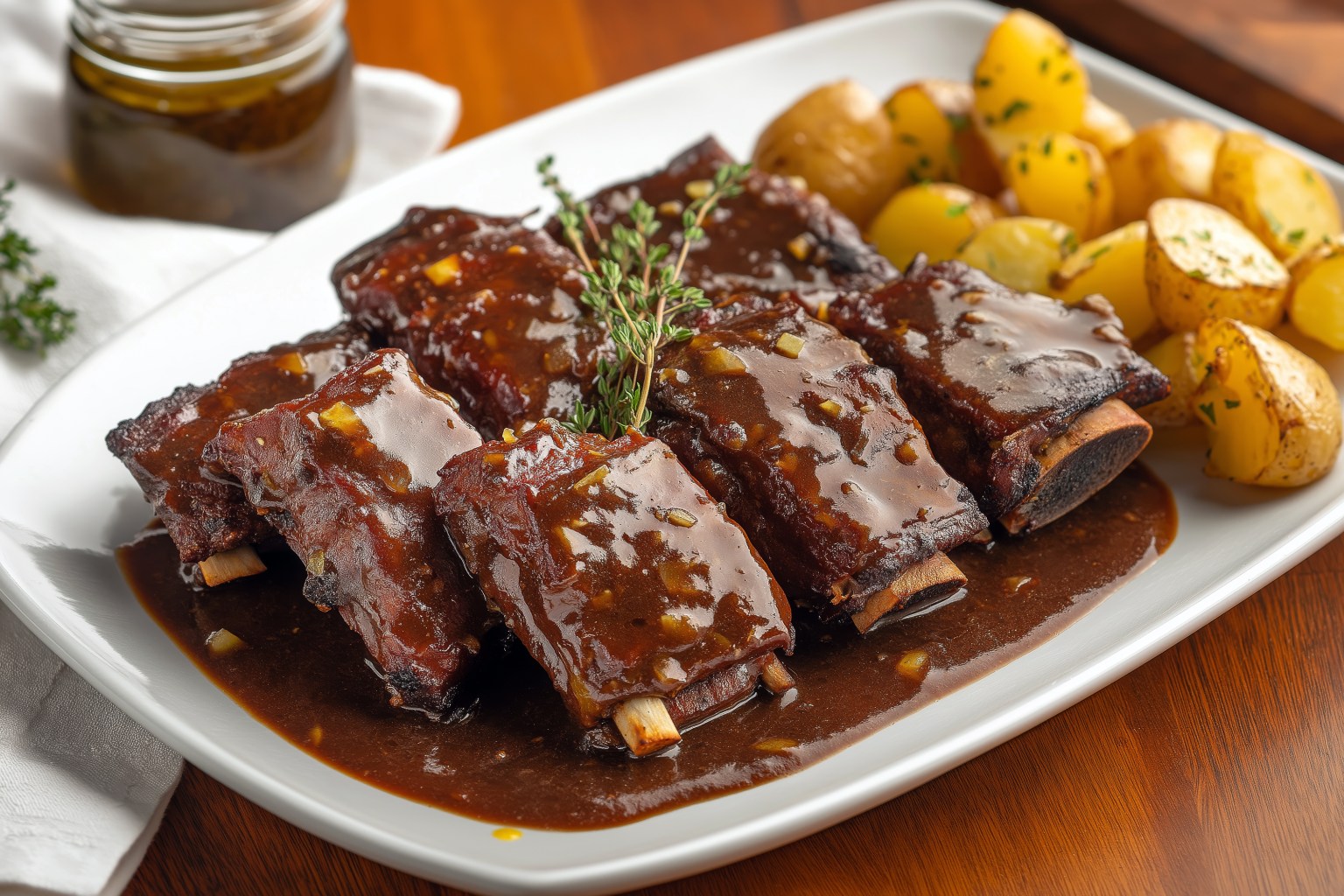
Take a piece of chuck that has been in the oven for four hours and squeeze it. It has lost more moisture than a steak cooked to medium-rare. Measurably more. By any honest accounting it is the drier piece of meat, and yet it is the one that tastes succulent, and the steak cooked to the same internal temperature as that chuck would be inedible.
That contradiction is the whole of low and slow cooking. Something is providing the sensation of moistness, and it is not water. It is a substance that was not in the pot when you started, and understanding where it came from tells you why a braise cannot be hurried, why the thermometer stops being useful, and why the same technique ruins a tenderloin.
Meat is tough for two unrelated reasons
The first kind of toughness is the muscle fiber itself. Heat makes those proteins contract and expel liquid, which is why an overcooked chicken breast is dry and stringy. More cooking always makes this worse. There is no far side to come out on.
The second kind is connective tissue, mostly collagen, which wraps and binds the fibers. Collagen is what makes a shank chewy and a shoulder stubborn. And collagen behaves in the opposite way: given enough heat and enough time it breaks down into gelatin, which is soft, slippery, and dissolves into the surrounding liquid.
Every cut of meat is somewhere on a spectrum between those two problems, and that position, not the price, is what decides the cooking method. Muscles that worked hard have a lot of collagen. Muscles that mostly sat there do not.
So a loin has almost no collagen to convert, which means slow cooking offers it nothing and simply squeezes it dry. A shoulder has so much that cooking it quickly leaves all of it intact and you are chewing rope. This is not about tough cuts being cheap and needing rescue. It is two different materials that happen to be sold at the same counter.
Gelatin is the thing doing the work
When collagen converts, it produces gelatin, and gelatin holds many times its weight in water and coats the mouth in a way that reads unmistakably as richness. It is the reason a good stock sets in the refrigerator and the reason braising liquid clings to a spoon.
It is also, specifically, the reason braised meat tastes moist despite having given up more water than the steak. The fibers are drier. The spaces between them are full of gelatin and liquid, and your palate is not running a moisture assay. It is registering lubrication.
This reframes what you are actually cooking toward. You are not trying to keep water in. That battle is lost early and losing it is part of the plan. You are trying to manufacture gelatin, and gelatin takes time.
Time is the ingredient, and heat cannot substitute for it
Collagen conversion is a slow reaction that starts to matter somewhere above roughly 140°F and speeds up as the temperature climbs. The instinct, then, is to climb: hotter oven, faster dinner.
It does not work, for two reasons. The higher the temperature, the harder the muscle fibers contract and the more moisture they expel, so you are buying collagen conversion by making the fibers worse. And once the liquid actually boils, you have added mechanical agitation to the problem, which shreds the outside of the meat while the middle is still tough.
What you want is a bare simmer, or an oven somewhere around 300°F, which produces a pot that is barely moving. A braise that is bubbling vigorously is not going faster. It is going worse.
The most striking demonstration of the trade is a short rib held at 135°F for two or three days, which comes out both genuinely rare and completely tender. That is collagen conversion running at a temperature so low the fibers barely contract at all, given enough time to get there. You do not need the equipment to take the lesson: at these temperatures, hours are the lever, not degrees.
This is why the thermometer stops helping
For a steak or a roast, internal temperature is the whole answer, and the number you pull at matters enormously.
For a braise it tells you very little. Two pieces of chuck can both be sitting at 190°F, and one will be tender and one will still be tight, because one has been there for three hours and the other for twenty minutes. Doneness here is a time-at-temperature relationship, not a temperature.
Which is why the honest test is mechanical. A fork or a skewer should meet no meaningful resistance going in and, more tellingly, should slide back out without lifting the meat with it. Fork tender is not a folksy phrase standing in for a number. It is the only measurement available.
A braise can absolutely be overcooked
The comfortable belief is that slow cooking is forgiving and more time is always safe. It is forgiving for a window, and then it is not.
Past the point of tenderness, the fibers keep expelling what little they have left and the gelatin that was holding everything together continues dissolving away into the liquid. The meat stops being succulent and starts being stringy and simultaneously mushy, which is a genuinely unpleasant combination and one that no amount of reducing the sauce will fix. The gelatin is not gone from the pot. It has just left the meat, which is where you needed it.
Slow cookers left on all day are the usual scene of this. The technique did not fail. It ran eleven hours past the finish.
Which is why a braise really is better the next day
This one is true and it has a mechanism, which is more than most kitchen folklore can claim.
Cooling the meat in its liquid lets it take some of that gelatin-rich liquid back as it contracts. The fat separates and sets on top, where you can lift it off and decide how much of it you actually want, rather than having it emulsified through the sauce. And flavor compounds continue moving between the solids and the liquid overnight, which evens out a sauce that tasted layered and slightly separate on the first evening.
The practical instruction that falls out of it: cool the meat in the liquid, never out of it. Meat pulled from a braise and refrigerated on its own dries out and tightens, and you have thrown away the best feature of the whole method. This is the same logic behind storing leftovers as components, with one loud exception, because here the component is the liquid and the meat belongs in it.
It also makes braises the most honest make-ahead food there is. Not merely tolerable on day two. Better, for reasons you can name. That is the argument behind cooking the bigger cut on purpose.
How to pick, standing at the counter
The question is not whether a cut is cheap or expensive. It is whether that muscle did any work.
Shoulder, shank, cheek, oxtail, short rib, neck, and chuck all did. They are full of collagen, they want hours, and they punish speed. Loin, tenderloin, and most chicken breast did not. They have little to convert, they want speed and a low finishing temperature, and they punish patience.
The cuts that cause trouble are the ones in between, like a whole leg or a pork loin roast, where there is some collagen but not enough to survive the treatment it would need. Those are usually best cooked like the tender cuts and then sliced thin against the grain, letting the knife do what time cannot.
And a rest does much less for a braise than it does for a roast, because a rest is mostly about a pressure gradient and a braise does not have much of one. What a braise wants is not twenty minutes on the counter. It is a night in the refrigerator, in its own liquid, with the lid on.
Part of Recipes & Technique.


