Boil More Potatoes Than Dinner Needs
The useful leftover potato is not the one already covered in cheese, cream, or rosemary. Boil a neutral batch, weigh what you cooked, and let the next two dinners choose the personality.
Dinner 1: 24 oz warm potatoes · Dinner 2: 20 oz potato salad · Dinner 3: 20 oz crisp hash
This is a planning example based on cooked weight, not a promised yield from a five-pound bag.
There is a particular kind of optimism involved in buying a five-pound bag of potatoes for one dinner. It usually ends with three raw potatoes rolling around the pantry two weeks later, looking increasingly philosophical.
The better plan is not to make an enormous potato dish. It is to cook more potatoes than the first dinner needs before you decide what the rest of them are going to taste like.
That distinction matters. A tray of potatoes already roasted with rosemary, garlic, Parmesan, and enough olive oil to qualify as a small climate event has fewer good second lives. A neutral boiled potato has options. It can stay soft. It can go sharp and cold. It can hit a skillet and become crisp enough to stop feeling like a leftover at all.
This is the same logic behind storing the parts instead of the plate, but potatoes deserve their own operating instructions because their second-day texture is not a consolation prize. In some applications it is the reason to cook them ahead.
Start with the potato you want tomorrow
For this particular three-dinner arc, use a waxy or all-purpose potato: Yukon Gold, yellow potatoes, red potatoes, or another variety that can be boiled until tender without immediately collapsing. Russets have many virtues, but a large pot of boiled russets is asking for mashed potatoes whether you intended that or not.
Scrub the potatoes. Leave small potatoes whole. Cut larger ones into halves or large even chunks. Put them in cold well-salted water, bring the pot up gradually, then simmer rather than violently boil. You want a knife to enter with little resistance while the potato still has enough structure to survive cooling, cutting, and another round of cooking.
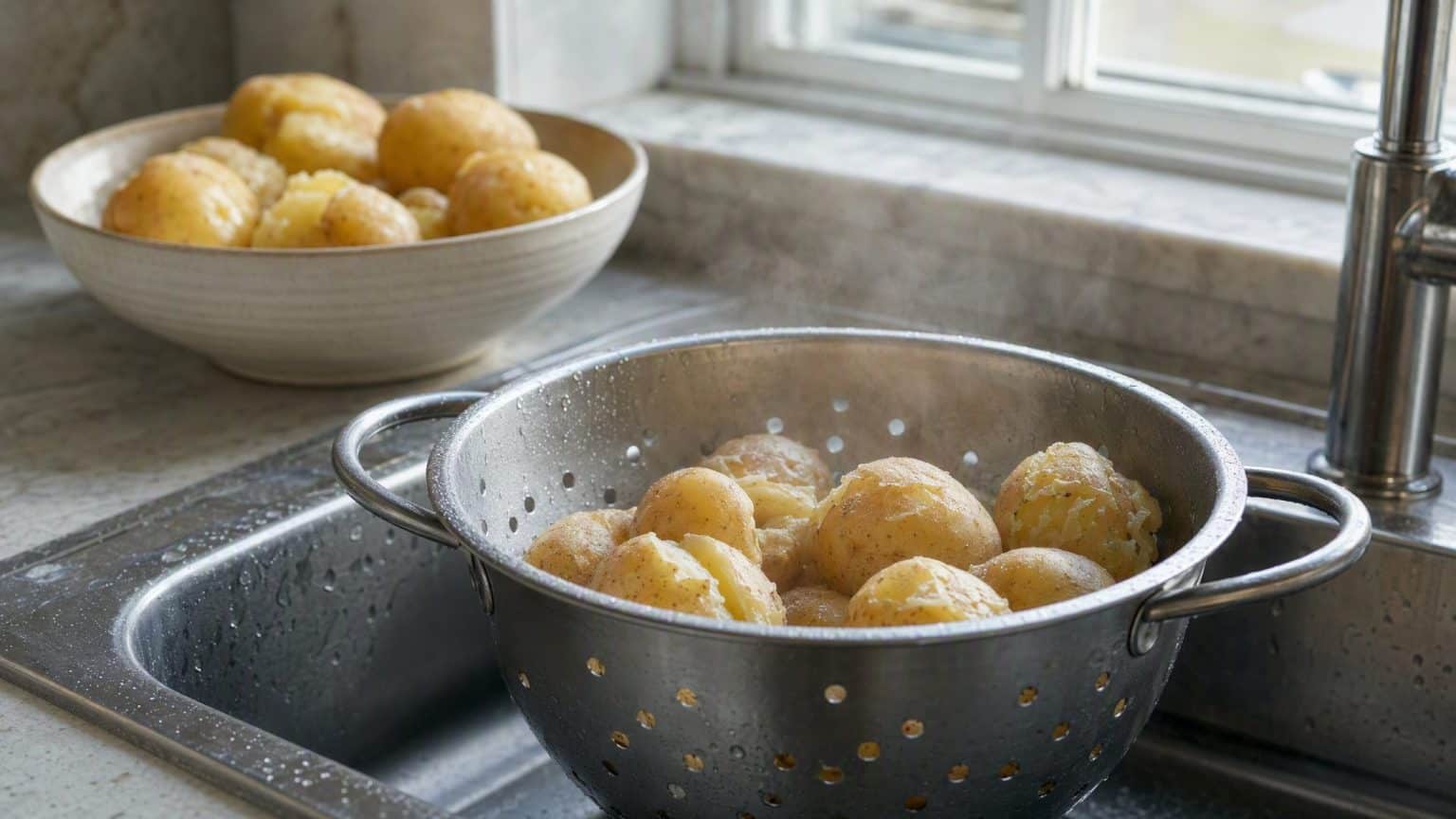
Drain them well. Let steam escape for several minutes. Then do the part that keeps this entire article honest: weigh the cooked potatoes you actually have.
I use cooked checkpoints throughout the Planned Leftovers work because grocery-store math and cooked-food math are not the same thing. Trimming, variety, potato size, and how aggressively somebody attacked the peeler all move the number. The scale takes four seconds and does not care about your intentions.
The 64-ounce example
Suppose the pot leaves you with 64 ounces — four pounds — of cooked potatoes. For a four-person household, I would divide them before Dinner One gets anywhere near the table:
24 ounces for Dinner One. That is 6 ounces per person as a substantial side.
20 ounces for Dinner Two. Enough for a potato salad that can carry eggs, smoked fish, chicken, beans, or simply a pile of bitter greens beside it.
20 ounces for Dinner Three. Enough for a crisp skillet hash with eggs and something green, or to tuck into breakfast wraps.
The precise numbers are not sacred. The act of dividing them is. The allocation rule exists because the easiest way to lose tomorrow’s dinner is to let tonight’s table believe the entire pot is available.
Dinner One: warm potatoes that are allowed to be simple
The first meal does not need to prove that you know twelve ways to season a tuber. Warm potatoes with butter or good olive oil, salt, pepper, and perhaps chopped parsley are enough when the rest of the plate is doing something interesting.
For four people, use the 24-ounce Dinner One portion. While still warm, toss with 2 tablespoons butter or olive oil and enough salt to make them taste finished. Add lemon zest or herbs if they fit the rest of dinner, but keep the flavor direction relatively quiet.
This is not culinary timidity. It is asset protection.
If Dinner One turns every potato into mustard-dill potato salad, Dinner Two is going to be mustard-dill potato salad again or an increasingly desperate attempt to disguise it. If Dinner One leaves two-thirds of the batch neutral, tomorrow still gets to make a decision.
Dinner Two: make the temperature change count
Cold potatoes are not warm potatoes that have suffered a setback. Their starch structure changes as they cool, the flesh firms, and they can take a vinaigrette without disintegrating into dressing-thickened paste.
That makes potato salad the obvious second job — but I mean actual potato salad with contrast, not a mayonnaise storage facility.
Take the 20-ounce reserved portion and cut it into bite-size pieces. Add:
- 2 tablespoons cider vinegar or lemon juice
- 1 teaspoon Dijon mustard
- 3 tablespoons olive oil
- 2 scallions or 2 tablespoons minced shallot
- a large handful of dill, parsley, or chives
- something sharp: chopped cornichons, capers, pickled onion, or a spoonful of pickle brine
If it is meant to be dinner rather than a side, add four jammy eggs, smoked trout, cannellini beans, or shredded chicken. The potatoes are carrying the structure; they do not have to carry every gram of protein too.
There is already a useful proof of this idea in Morning Balance Jammy-Egg Asparagus Potato Salad. The point of the planned-leftover version is that you are not starting by boiling potatoes on Tuesday. That work is already gone.
Dinner Three: now earn the crispness
By the third meal, soft potato is over. The leftover has to earn a hard texture change.
Cut the remaining 20 ounces into 3/4-inch pieces. Heat a wide skillet — not a polite little sauté pan — with 2 tablespoons neutral oil or olive oil. Add the potatoes in one layer and leave them alone long enough to brown. Season after the crust begins to form. Add sliced onion, scallion, peppers, leftover greens, or cooked sausage only after the potatoes have had a head start.
For dinner, put four eggs over the top and cover the skillet just long enough to set the whites. Add hot sauce, salsa verde, or a spoonful of yogurt. If breakfast-for-dinner is unwelcome in your house for reasons I cannot personally defend, fold the crisp potatoes into warm tortillas with green chile and eggs; Sunrise Fishing Wraps already demonstrate that architecture.
The important thing is that Dinner Three is not reheated boiled potatoes. It is a skillet dinner whose raw material happens to have been boiled Sunday.
Do not season the entire batch for the most specific future
Planned leftovers can get weirdly controlling at this point. You do not need to predict every dinner on Sunday night. You need to preserve enough optionality that Wednesday has somewhere to go.
Potatoes respond especially well to a two-stage seasoning model:
Stage one: salt the cooking water and stop.
Stage two: add the personality when each portion gets its job.
The same 20 ounces can become curry-spiced potato cakes, a dill-and-pickle salad, crisp potatoes under eggs, or a warm Spanish-ish tortilla depending on what else the week produces. Salt is infrastructure. Smoked paprika, ranch dust, truffle oil, and mustard are commitments.
I enjoy commitments. I simply prefer to know which dinner I am committing them to.
What about mashed potatoes?
Mashed potatoes are excellent leftovers. They are simply a different system.
Once butter, milk, cream, cheese, roasted garlic, or whatever else has entered the bowl, the mash is already a composed component. It can become croquettes, duchesse potatoes, a topping for a pie, or fried cakes. That is useful, but it is not the same flexible base as a pot of boiled potatoes.
If the purpose is to create options, stop before mashing. If the purpose is specifically to make a second dish from mash, then make extra mash on purpose and plan that second dish. Planned leftovers are not about keeping food undecided forever. They are about deciding at the useful moment.
The refrigerator does not improve a badly stored potato
Once Dinner One is portioned, cool the reserved potatoes promptly and refrigerate them in shallow containers rather than leaving the whole hot pot to slowly negotiate with room temperature. USDA guidance is to refrigerate leftovers within two hours and use most refrigerated leftovers within three to four days. That means a Sunday potato batch is a Monday-through-Wednesday asset, not a mysterious Saturday opportunity. See the USDA’s current leftovers guidance.
Keep dressings and wet garnishes separate until the potatoes get their next job. Cold boiled potatoes need to be dry enough to brown when Dinner Three arrives. A container full of condensation is not helping.
When extra potatoes are not worth it
Do not create a planned surplus just because potatoes are inexpensive.
If your week includes two restaurant nights, a late meeting, and a flight on Thursday, make Dinner One and stop. If your refrigerator is full enough that another container requires structural engineering, stop. If your household will happily eat potato salad once and will mutiny at the sight of another potato for six days, believe the household.
Not every leftover deserves a container, and not every ingredient deserves to become a planned leftover either.
The calculation is not “Can this keep?” It is “Does cooking this now remove useful work later?”
Why potatoes earn the space
A good planned leftover should become easier while remaining interesting. Potatoes meet that test unusually well.
The first cook does the slow work: scrubbing, cutting, bringing a large pot to temperature, cooking the centers until tender. Dinner Two borrows that work and changes temperature. Dinner Three borrows it again and changes surface texture.
Three dinners. One pot of boiling water. No sad scoop of reheated rosemary potatoes staring back from the microwave.
That is enough of a return for me.
Part of Kitchen Systems.
Where this goes next

