Cabin Morning Apple-Cheddar Dutch Baby
A puffed skillet pancake with apples, sharp cheddar, and maple for slow cabin mornings and shared breakfasts.
Tools
10-inch cast-iron or ovenproof skillet, oven, blender or whisk, mixing bowl or batter bottle, oven mitts, apple corer, knife, cutting board, serving spatula
Ingredients · swaps in parentheses
Eggs, milk, flour, salt, optional Dijon, butter, crisp apple, thyme, sharp cheddar, black pepper, maple syrup, optional flaky salt
Magic
Use a genuinely hot skillet keep batter loose and near room temperature roast apples briefly keep oven closed serve immediately.
Before you begin
Bring eggs and milk toward room temperature, preheat skillet for at least 15 minutes, blend and rest batter, slice apple, and grate cheese.
The parts that change whether this works tonight.
These fields come from the published recipe itself. If a recipe has not separately declared an operating fact, the gap stays visible instead of being filled with a guess.
- Servings
- 1 ten-inch Dutch baby; serves 4
- Timing
- About 40 minutes
- Equipment
- Not separately declared
- Make-ahead
- One day ahead: Blend the batter and refrigerate it in a sealed bottle. Bring it toward room temperature for 20 to 30 minutes and shake thoroughly before baking.…
- Holding
- Not separately declared
- Leftovers
- The dramatic rise is temporary, but leftovers keep refrigerated for up to two days. Reheat uncovered in a 350°F oven for 8 to 10 minutes. Keep raw egg…
- Dietary notes
- Not separately declared
- Method map
- 12 ingredient lines · 7 method steps
A Dutch baby looks ambitious while asking very little of the cook, which is exactly the sort of bargain cabin mornings deserve. Apples soften in butter, the batter climbs the skillet, and sharp cheddar keeps the whole thing from drifting into dessert before coffee. The dramatic rise depends on a thoroughly heated skillet, room-temperature batter, and an oven door that remains closed until the structure has set.
Serve it before a day outside, with trip ideas and field guidance from Hook the Horizon.
Yield and timing
- Yield: 1 ten-inch Dutch baby; serves 4
- Prep: 15 minutes
- Bake: 20 to 24 minutes
- Total: About 40 minutes
- Best service window: Within 5 minutes of leaving the oven
Ingredients
- 3 large eggs, at room temperature
- 2/3 cup whole milk, at room temperature
- 2/3 cup all-purpose flour
- 1/2 teaspoon kosher salt
- 1 teaspoon Dijon mustard, optional
- 3 tablespoons unsalted butter, divided
- 1 large crisp apple, cored and thinly sliced
- 1/2 teaspoon fresh thyme leaves or 1/4 teaspoon dried thyme
- 1/2 cup grated sharp cheddar
- Freshly ground black pepper
- Maple syrup, for a restrained finish
- Optional flaky salt
Method
Where the time goes
- 15 minPreheat decisively425°F
- 10 minMake the batter
- 5 minCook the apples briefly
- Add batter
- 17–19 minBake without interruption
- 2–4 minSet the center375°F
- Serve immediately
- Preheat decisively: Place a 10-inch cast-iron or ovenproof skillet in the oven and heat to 425°F for at least 15 minutes.
- Make the batter: Blend or whisk eggs, milk, flour, salt, and optional Dijon until smooth. Let stand for 10 minutes while the skillet heats.
- Cook the apples briefly: Carefully remove the hot skillet. Add 2 tablespoons butter, then the apple slices and thyme. Return to the oven for 5 minutes, until the apples begin to soften but still hold shape.
- Add batter: Remove the skillet again. Swirl the remaining tablespoon butter around the edge. Pour in the batter and scatter cheddar evenly across the surface.
- Bake without interruption: Return the skillet to the oven and bake for 17 to 19 minutes without opening the door, until deeply puffed and golden at the edges.
- Set the center: Reduce the oven to 375°F and bake for 2 to 4 minutes more, until the center no longer looks wet.
- Serve immediately: Add black pepper, a restrained drizzle of maple syrup, and optional flaky salt. Cut into four wedges while still puffed.
Texture standard
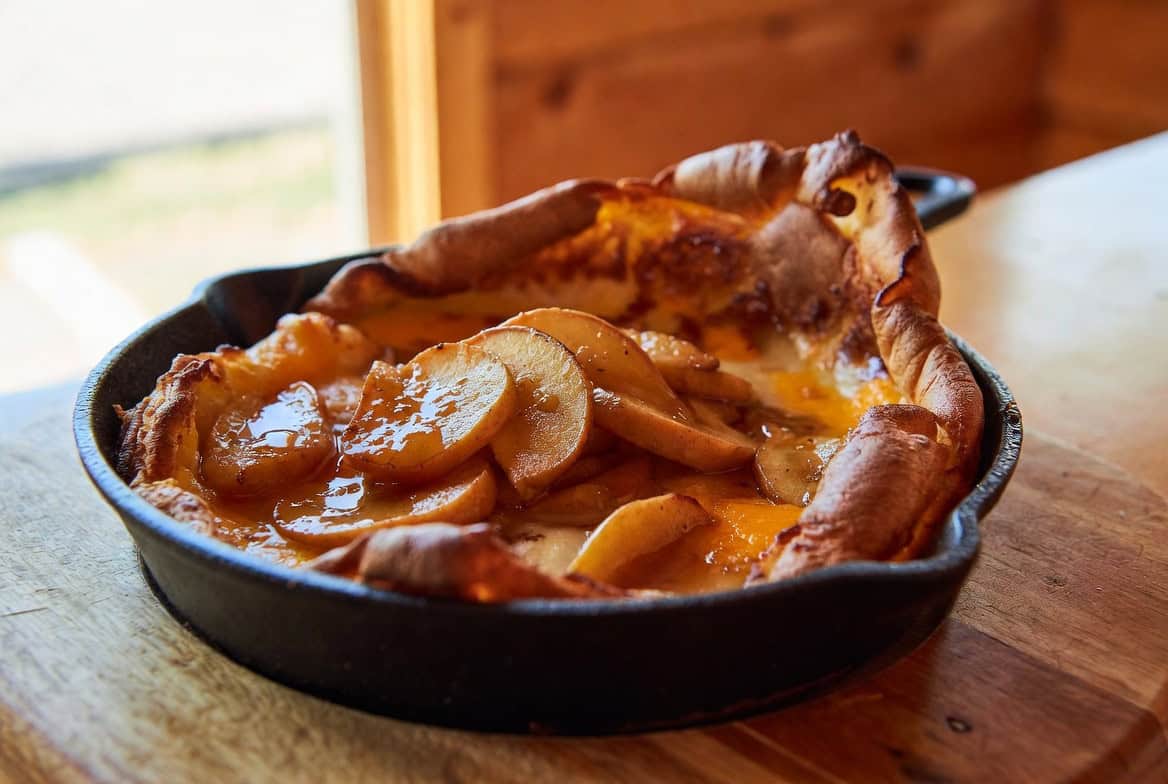
The edges should be deeply browned and crisp, the center tender and custardy rather than raw, and the apples soft without becoming sauce. The cheddar should create savory browned pockets rather than a heavy melted layer.
Straight from the pan
Serve directly in the skillet with the puffed edge fully visible. Arrange apple slices so some remain exposed beneath the cheddar. Use maple sparingly. This should still read as a savory apple-cheddar breakfast with caramelized fruit, not pancake syrup occupying a cast-iron crater.
Make-ahead and cabin strategy
One day ahead: Blend the batter and refrigerate it in a sealed bottle. Bring it toward room temperature for 20 to 30 minutes and shake thoroughly before baking.
Morning of service: Slice the apple while the oven preheats. Grate the cheddar in advance and keep it cold.
For two skillets: Mix a double batch but bake one at a time unless the oven has verified even heat and enough circulation around both pans.
Substitutions that work
- Pears: Replace apples and reduce the preliminary roasting to 3 minutes if very ripe.
- Gruyère or aged Gouda: Replace cheddar for a nuttier finish.
- Smoked cheddar: Adds stronger cabin-fire character; use slightly less.
- Cinnamon version: Omit thyme and Dijon, add 1/2 teaspoon cinnamon, and reduce cheese to 1/4 cup or omit it.
- Gluten-free flour: Use a dependable cup-for-cup blend and expect slightly less rise.
- Scallions: Add 2 sliced scallions with the cheese for a fully savory version.
Likely failure points
The Dutch baby does not rise: The skillet or oven was not hot enough, the batter was cold, or the oven door opened early.
The center is gummy: The batter was too thick, apples released excess moisture, or the bake ended before the center set. Bake several minutes longer at 375°F.
The apples burn: They were sliced too thinly or the skillet remained on a hot burner. Use 1/4-inch slices and move directly between counter and oven.
The cheese makes the center heavy: Too much cheddar was used or it was concentrated in one area. Scatter it evenly and keep the quantity restrained.
The edges stick: The skillet was insufficiently buttered or not well seasoned. Swirl butter around the sides before adding batter.
The pancake collapses: Some collapse is expected within minutes. Serve immediately rather than treating physics as an editorial failure.
Storage and reheating
The dramatic rise is temporary, but leftovers keep refrigerated for up to two days. Reheat uncovered in a 350°F oven for 8 to 10 minutes. Keep raw egg batter at 40°F or colder and do not leave it at room temperature longer than two hours.
Kitchen Kit
Goods: Eggs, milk, flour, salt, optional Dijon, butter, crisp apple, thyme, sharp cheddar, black pepper, maple syrup, and optional flaky salt.
Gear: 10-inch cast-iron or ovenproof skillet, oven, blender or whisk, mixing bowl or sealed batter bottle, oven mitts, apple corer, knife, cutting board, and serving spatula.
Before: Bring eggs and milk toward room temperature, preheat the skillet for at least 15 minutes, blend and rest the batter, slice the apple, and grate the cheese.
Magic: Use a genuinely hot skillet, keep batter loose and near room temperature, roast apples briefly, do not open the oven early, and serve before the puff retires.
The finished Dutch baby should be crisp, custardy, savory, and just sweet enough to make a cabin morning feel more capable than it probably is.
Part of Recipes & Technique.
Recipe provenance: Salty & Clever editorial formulation, built from established culinary technique and the traditions identified in the article. No chef, restaurant, family, or firsthand cultural provenance is claimed unless it is explicitly named and sourced. How we write and check recipes


