Dockside Corn Fritters with Jalapeño-Lime Yogurt
Corn fritters built at a ratio that makes them barely hold together, which is the point, with a cold jalapeño-lime yogurt to cut the oil.
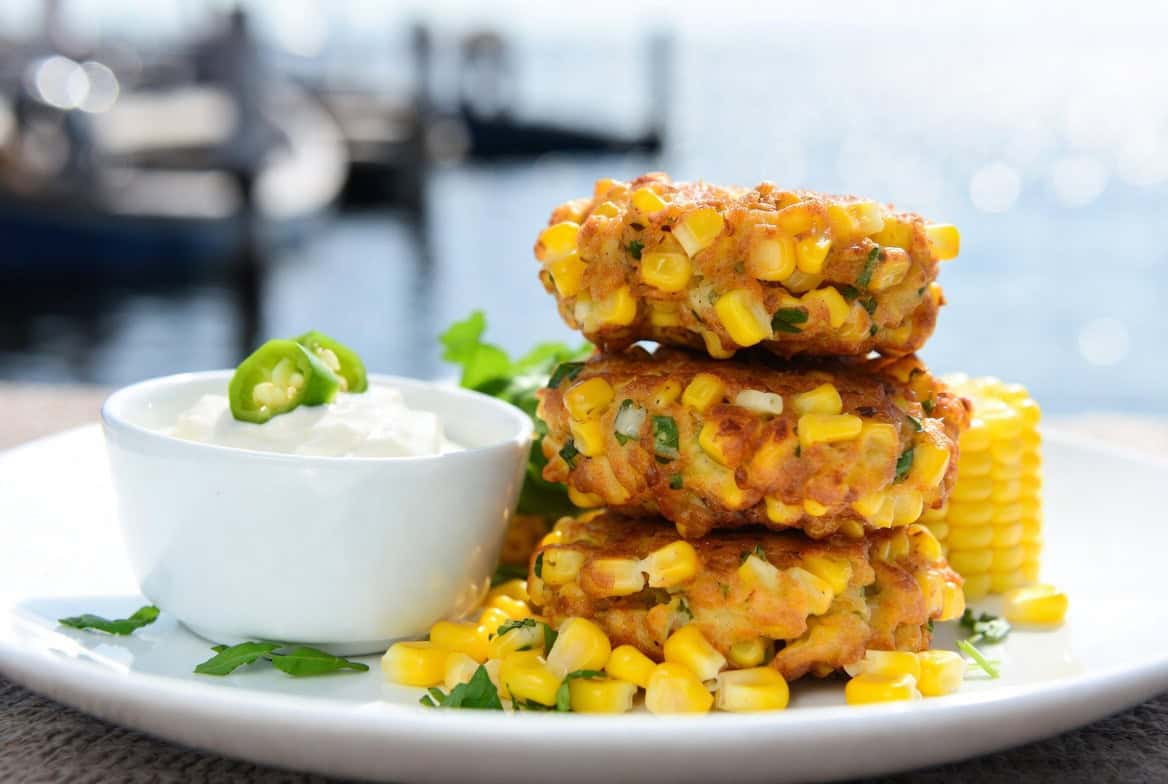
The parts that change whether this works tonight.
- Yield
- 16 fritters
- Time
- 35 minutes
- Equipment
- A wide skillet, a slotted spatula, and a cooling rack set over a sheet pan
- Dietary
- Vegetarian
- The method
- 13 ingredients · 5 steps
From this recipe’s own recipe card. Nothing here is a guess.
Pairing
Wine — Mexican lager or Albariño. Mixed drink — Ranch water with extra lime. Tequila and soda stay out of the way of the yogurt. Teetotaler — Lime-jalapeño soda with salt. Fried corn wants something cold and salted.
Tools
A wide skillet, a slotted spatula, and a cooling rack set over a sheet pan. Not a plate lined with paper towels — that is a steam chamber with good intentions.
Ingredients · swaps in parentheses
Corn kernels (frozen, thawed and patted very dry), scallions, flour, baking powder, cumin, kosher salt, eggs, milk, neutral oil, Greek yogurt (sour cream), jalapeño (serrano), lime juice and zest
Magic
Before the first fritter goes in, drop a small bundle of bruised cilantro stems into the hot oil for about thirty seconds, then lift them out with tongs. The oil takes on a green, faintly citrusy back note and hands it to all sixteen fritters, which is a completely different result from scattering chopped herbs into the batter, where they scorch against the pan and taste of nothing. Not feeling brave? Use half the stems and pull them the moment they stop sizzling hard.
Gotcha
Wet corn is the enemy. Kernels straight off a boiled cob or thawed from frozen carry enough surface water to thin the batter into a puddle, and no amount of extra flour fixes it properly — dry them on a towel first.
Three cups of corn against half a cup of flour is the whole argument. Most fritter recipes invert that ratio and produce small thick pancakes with corn suspended inside, which is a fine thing to eat and is not this. Here the flour is a minimum-viable binder, present in the quantity required to keep the kernels attached to one another and no more. The batter looks wrong in the bowl. It should.
Makes: 16 fritters
Time: 35 minutes
Ingredients
- 3 cups corn kernels
- 3 scallions, sliced
- 1/2 cup flour
- 1 teaspoon baking powder
- 1/2 teaspoon cumin
- 1/2 teaspoon kosher salt
- 2 eggs
- 1/3 cup milk
- Neutral oil for frying
- 3/4 cup Greek yogurt
- 1 jalapeño, finely chopped
- 1 tablespoon lime juice
- 1 teaspoon lime zest
Method
- Coat the corn in dry. Mix the corn, scallions, flour, baking powder, cumin, and salt. Doing it in this order coats every kernel in flour before any liquid arrives, which is what stops the batter from separating in the pan.
- Bring in the wet. Whisk the eggs and milk, then fold into the corn mixture. Fold, do not beat, and stop the moment there is no dry flour left.
- Mix the yogurt. Mix the yogurt, jalapeño, lime juice, zest, and a pinch of salt. Make it now so the raw chile has twenty minutes to bleed into the dairy.
- Fry. Fry heaped tablespoons of batter in a thin layer of oil over medium-high heat until browned, about 2 minutes per side. Flatten each mound gently with the back of the spoon as it goes in. For the magic version, run the cilantro stems through the oil here, before the first batch.
- Drain and serve. Drain on a rack and serve hot with the yogurt.
Troubleshooting: If the first fritter spreads, add a spoonful of flour. If it is dense, loosen the batter with milk. The first fritter is a negotiation, not a verdict.
Why the batter looks under-built
A half cup of flour and two eggs across three cups of corn gives you barely enough gluten and protein to bridge the gaps between kernels. That is deliberate. When it fries, the batter sets into a thin lattice and the kernels themselves are what you bite through, popping and releasing their own liquid. Add another half cup of flour and you get structural integrity, uniformity, and a corn pancake.
The baking powder is doing less than you would expect. In something this shallow it is not lifting anything meaningfully; it produces a small amount of gas that keeps the interior from compacting into a dense disc during the two minutes it spends in contact with hot oil. It is a texture insurance policy, not leavening in the cake sense.
The kernels decide everything
Fresh corn cut off the cob is best and it is not close. The kernels are structurally intact, the sugars have not converted, and the milky liquid inside each one is still contained rather than sitting on the outside. Cut them off standing the cob in a wide bowl so the kernels do not go across the room, and then scrape the bare cob with the back of the knife to get the last of the starchy liquid, which is free thickener.
Frozen corn works, but it must be dried aggressively. Thaw it fully, spread it on a clean towel, and pat until the towel comes away barely damp. Corn holds surface water in the crevice at the base of each kernel and releases it into the batter over about ten minutes, which is why a batter that looked correct when you mixed it can be soup by the fourth batch. If that happens, another spoonful of flour is the fix, and it is a fix, not a failure.
Oil depth and the first fritter
A thin layer means enough to move when you tilt the pan and to come up the sides of a fritter by a third, no more. Deeper and the fritters float and cook evenly but pale; shallower and they stick and tear when you turn them. Medium-high heat should give you an immediate steady sizzle, not a violent one.
Cook one first, alone, and eat it standing at the stove. This is not indulgence, it is calibration: the first fritter tells you whether the batter is too loose, whether the oil is hot enough, and whether the salt is right, and all three are fixable in the bowl before you commit fifteen more. Then work in batches of four or five with space between them. Crowd the pan and the temperature crashes, the fritters absorb oil instead of sealing, and you get something greasy and heavy.
The yogurt is a counterweight
Fried food needs cold acid nearby or it becomes monotonous quickly, and the yogurt is doing that job structurally, not decoratively. Greek yogurt over regular because it is thick enough to sit on a fritter rather than run off it, and thick enough that the lime juice does not make it watery.
Both parts of the lime matter and they are not interchangeable. The juice brings acid, which cuts the oil. The zest brings the aromatic oils from the peel, which is the part you smell before you taste anything, and it is what makes the sauce read as bright rather than merely sour. Mix the sauce before frying so the raw jalapeño has time to release into the dairy; twenty minutes turns scattered hot spots into an even, gentle burn across the whole bowl.
Part of Recipes & Technique.
Recipe provenance: Salty & Clever editorial formulation, built from established culinary technique and the traditions identified in the article. No chef, restaurant, family, or firsthand cultural provenance is claimed unless it is explicitly named and sourced. How we write and check recipes
Where this goes next

