Gluten Is Not an Ingredient. It Is Something You Do to Flour.
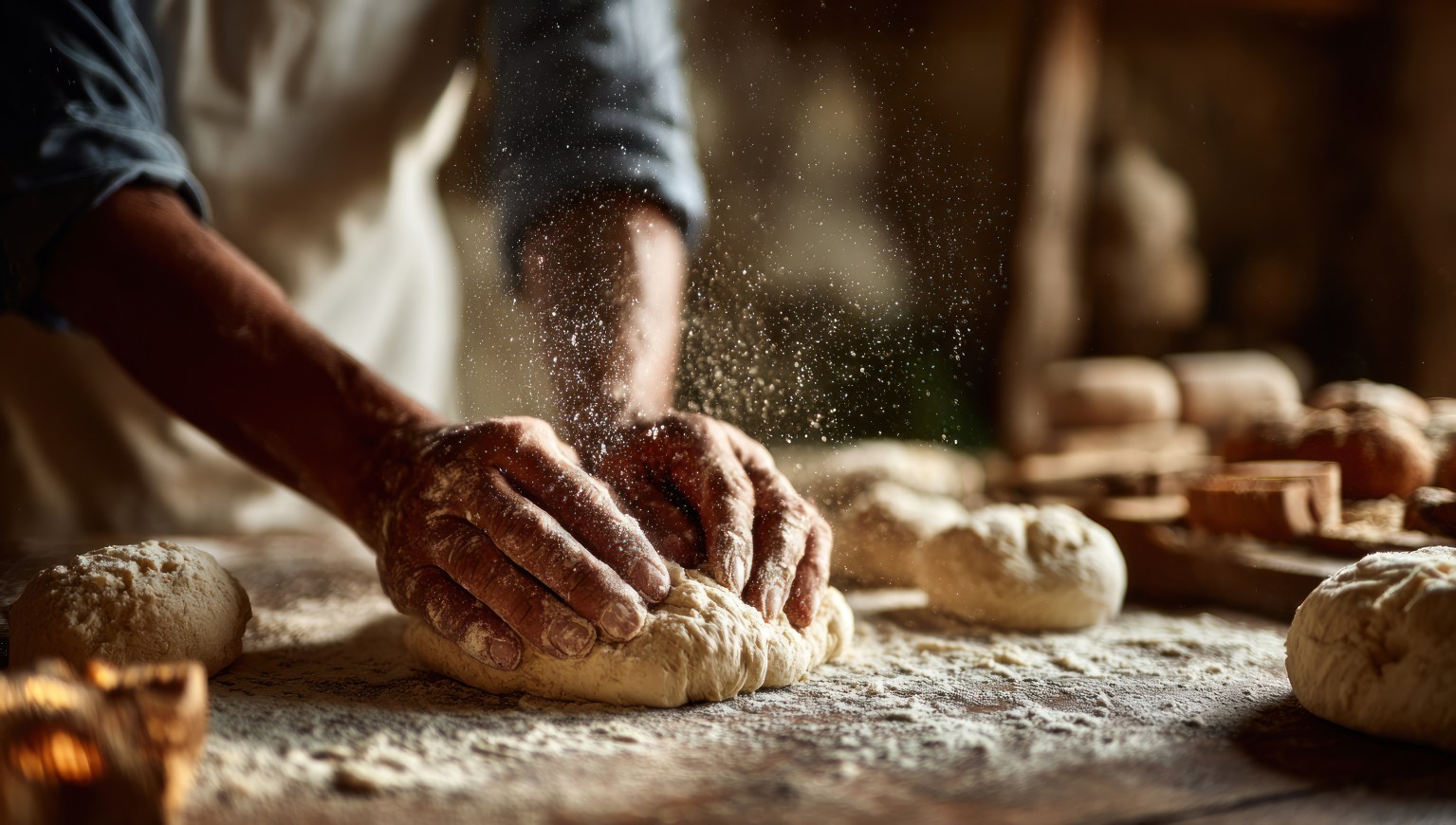
The same bag of flour, the same water, the same pair of hands. One bowl becomes a chewy, open loaf and the other becomes a tender crumb that falls apart on a fork.
Nothing in the bag decided that. Gluten is not a thing you buy, it is a structure you build or fail to build, and almost every instruction in a baking recipe that looks arbitrary is really an instruction about how much of it to allow.
There is no gluten in flour
What is in flour is two storage proteins, glutenin and gliadin, sitting in the endosperm in no particular arrangement and doing nothing at all.
Add water and they hydrate. Move them and they begin to link to each other, unfolding and bonding into a continuous elastic web through the dough. That web is gluten, and it did not exist five minutes earlier.
Which means three things you control make it: water, time and mechanical work. Every technique in bread baking is one of those three being turned up, and every technique in pastry is one of them being turned down.
The two proteins do opposite jobs
Glutenin provides strength and elasticity — the pull-back, the resistance, the reason a well-developed dough springs into a ball.
Gliadin provides extensibility — the flow, the willingness to stretch thin without tearing.
A dough with plenty of the first and not enough of the second fights you and snaps back. A dough with the reverse slumps and spreads and will not hold a shape. Almost everything anybody says about a dough — tight, slack, shaggy, silky — is a report on the balance between those two.
Water does more of the work than kneading does
Protein cannot link until it is hydrated, so water is the first lever and the largest.
A wetter dough has more molecular mobility, develops faster with less handling, and produces a more open, irregular crumb. A drier dough resists development, needs more work, and comes out tighter and more uniform. This is why the same recipe at sixty percent hydration and at eighty percent is two different breads, and why the wetter one is harder to handle and better to eat.
Time substitutes for effort almost completely. Flour and water left alone for twenty minutes — no salt, no yeast, no kneading — will have developed a noticeable amount of gluten on their own, because hydration and the flour’s own enzymes are doing the work while you are not in the room. A dough given that rest needs a fraction of the kneading it would otherwise want.
Twenty minutes of nothing is the cheapest thing in baking and the first thing to get skipped, because it does not look like work. A stand mixer buys the same development faster and costs a great deal more than twenty minutes.
Everything else in the bowl gets in the way, and that is the point
Fat coats the proteins and physically prevents them from linking. This is not a side effect; it is why the word shortening exists, because fat shortens gluten strands. Butter is doing this alongside its other two jobs, which is why a butter-rich dough is tender and a lean one is chewy.
Sugar competes for the available water, so a sweet dough hydrates more slowly and develops less, and it stays soft for longer afterward.
Salt tightens the network and makes a dough stronger and less sticky, which is why a salted dough handles better than the same dough unsalted, and why salt withheld at the start is added later rather than never.
Acid in quantity weakens the structure, which is part of why a very sour dough is slacker than a mild one, and why an acidic dairy in a batter produces tenderness rather than chew.
Protein percentage is a starting point, not a verdict
Bread flour runs around twelve to fourteen percent protein, all-purpose around ten to twelve, cake flour around seven to nine. More protein means more raw material for the network and a chewier result.
But the number is a ceiling, not an outcome. A high-protein flour barely mixed makes a tender thing, and a low-protein flour worked hard makes a tough one. Handling beats the bag more often than not.
It also means the number is adjustable. Replacing a couple of spoonfuls of all-purpose flour with cornstarch lowers the effective protein and gets most of the way to cake flour, because the starch is inert and dilutes what is available to link.
Resting is not rising, and dough that fights back is asking for it
A developed gluten network is under tension, and tension relaxes with time as the bonds rearrange. This is a physical process and it takes ten or fifteen minutes.
So a pizza base that keeps shrinking back toward the middle is not badly made; it is being asked to do something before it is ready. Cover it, walk away, come back, and it will roll out without argument.
It is the same reason pie dough rests before rolling and pasta dough rests before it goes through the machine. Resting means several unrelated things in a kitchen and this is the one that has nothing to do with juices or with yeast.
What development looks like from the outside
Stretch a piece of dough thin between your fingers. If it goes translucent without tearing, the network is continuous. If it tears at the first pull, it is not there yet.
Underdeveloped dough tears, spreads, and bakes into something dense with a tight crumb. Overdeveloped dough — which takes a machine, not hands — goes slack and sticky and grey as the network breaks down, and it does not recover.
In the tender direction the failure is easier to reach and more common. A muffin batter stirred until smooth makes tunnels and a rubbery texture, and a pancake batter beaten hard makes tough pancakes, both for the same reason. A cookie that spread flat and a cake that sank are usually about fat, leavening and temperature rather than gluten — but a cake that came out tough and chewy is gluten every time.
The tough muffin is the most common failure in home baking and the only one caused entirely by enthusiasm. Nobody overmixes a batter by accident. They do it because the lumps look like a mistake, and because stopping early feels like not finishing.
When you want less of it
Pastry, biscuits, scones, muffins, pancakes and most cakes are recipes for building as little structure as possible while still holding together.
Which gives a consistent method: keep the fat cold and in visible pieces so it stays as a barrier rather than dispersing, use the lowest-protein flour available, add the liquid all at once rather than gradually, and stop mixing while the batter still looks wrong. Lumpy is correct. A batter that looks smooth has been mixed past the point where it should have been.
And let it rest afterward for a different reason: the flour finishes hydrating, the visible lumps disappear on their own, and the result is more tender than the same batter mixed until it looked right.
Whole grain and rye are playing a different game
Bran is sharp at the microscopic scale and it physically cuts through developing strands, which is why a hundred percent whole wheat loaf is denser than a white one made identically. More water and a longer rest recover some of it, since softened bran does less damage.
Which means a recipe that swaps white flour for whole wheat one for one and changes nothing else has not been tested. The water is already wrong before the mixing starts, and no amount of kneading fixes a hydration that was set for a different flour.
Rye barely has the proteins at all. What holds a rye loaf together is a set of long-chain sugars that bind enormous amounts of water, which is why rye doughs are sticky rather than elastic, why kneading them accomplishes very little, and why rye breads are dense by nature rather than by failure.
All of which reframes the recipe. A list of ingredients and a mixing time is a specification for how much of this network to build, written in a code nobody explains. Read it that way and the instruction to mix until just combined stops being timidity and starts being a number.
Part of Recipes & Technique.


