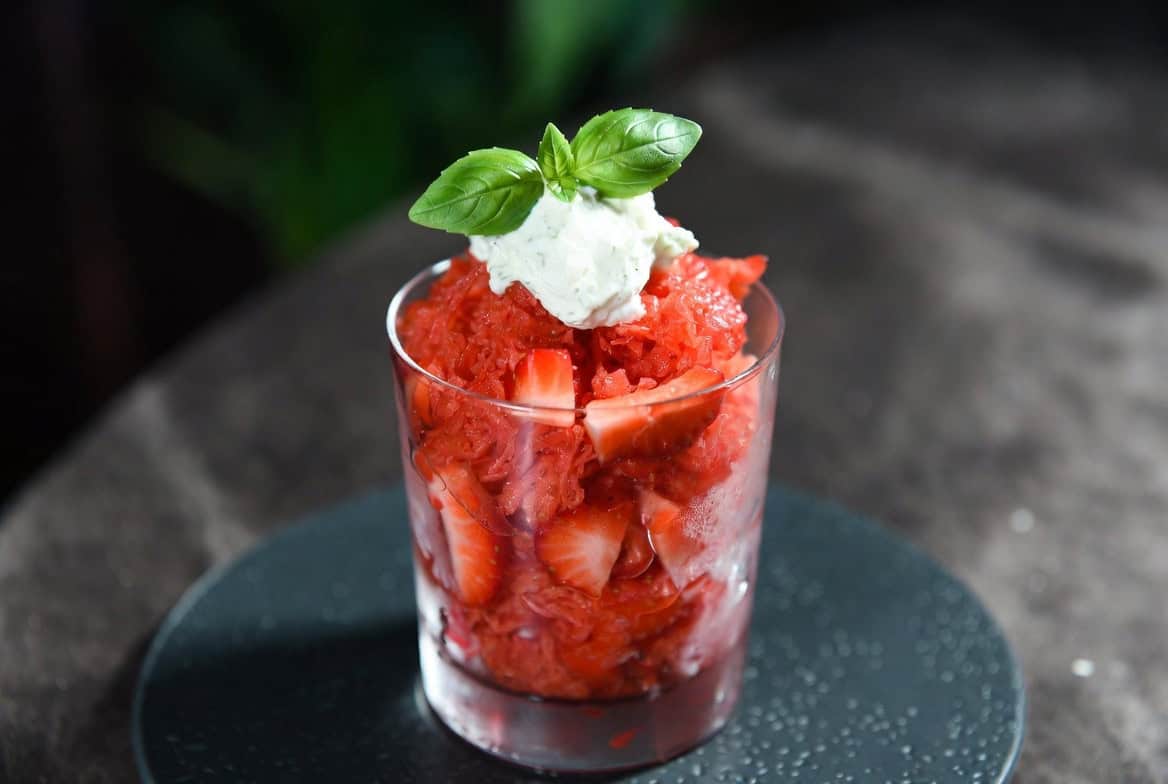
Red Herring Strawberry–Tomato Granita with Basil Cream
A scarlet ice that reads as pure strawberry on the spoon and turns into something longer and stranger by the finish. The tomato never announces itself, which is the entire point.
The parts that change whether this works tonight.
- Serves
- 6
- Time
- 20 minutes, plus freezing
- Equipment
- Blender, fine sieve, a shallow metal pan (metal, not glass or ceramic — it pulls heat out fast and gives you the crystal you…
- The method
- 9 ingredients · 6 steps
From this recipe’s own yield and timing lines and Kitchen Kit. Nothing here is a guess.
Pairing
Wine — A dry Provençal rosé, cold. This is a savory dessert whether or not it admits it, and rosé is the only wine that takes strawberry and tomato in the same mouthful without picking a side. Mixed drink — A negroni sbagliato. Bitter, red, and fizzing is the correct answer to a granita with black pepper in it, and the sweetness stays low enough not to double up. Teetotaler — Sparkling water with basil and a pinch of salt. The basil cream is the whole point of the dish; putting the herb in the glass too keeps it from looking like a garnish.
Tools
Blender, fine sieve, a shallow metal pan (metal, not glass or ceramic — it pulls heat out fast and gives you the crystal you want), a sturdy dinner fork, six glasses that will fit in your freezer.
Ingredients · swaps in parentheses
Ripe strawberries, ripe tomatoes, sugar, lemon juice, kosher salt, black pepper, heavy cream, powdered sugar, basil.
Magic
Pour 1 cup of the strained base into a small pan and cook it down to about 3 tablespoons of dark syrup, cool it, and stir it back into the rest before the pan goes near the freezer. One eighth of the batch has been somewhere hot and turned savory and faintly jammy; the other seven eighths is still raw and sharp. The two of them together give every spoonful a shadow behind the fruit, which is what a gazpacho gets from sitting overnight and this gets in ten minutes. Not feeling brave? Reduce half a cup instead, and stop while it is still pourable.
Gotcha
Miss two scrapes in a row and the pan sets into one pink slab that a fork will not touch. It is recoverable: chisel it into chunks, pulse them in a food processor, and refreeze for 20 minutes. Set a timer instead.
Everything here rides on the tomato, and the tomato is the one thing you cannot fake. You want the kind that feels heavy for its size and smells green and sharp where the stem was. A pale supermarket tomato in a plastic clamshell contributes water and a faint metallic hum, which is the opposite of the job. If you cannot get a good one this week, make something else this week.
Serves: 6
Time: 20 minutes, plus freezing
Ingredients
- 1 pound ripe strawberries, hulled
- 8 ounces ripe tomatoes, cored
- 1/2 cup sugar
- 2 tablespoons lemon juice
- 1/4 teaspoon kosher salt
- Several grinds black pepper
- 3/4 cup heavy cream
- 1 tablespoon powdered sugar
- 6 basil leaves, plus more for serving
Method
Where the time goes
- Blend the base
- 45 minStart the clock
- 30 minKeep scraping
- Infuse the cream
- Whip it soft
- Serve fast
- Blend the base. Strawberries, tomatoes, sugar, lemon juice, salt, and black pepper into the blender, run until completely smooth, then strain into a shallow metal pan. The sieve is not optional — tomato skin does not disappear in a blender, it just gets smaller and more annoying. For the magic version, lift 1 cup of the strained base into a small pan, simmer it down to about 3 tablespoons, cool it completely, and stir it back into the pan here.
- Start the clock. Freeze 45 minutes, until a firm rim has formed around the edges and the middle is slushy. Drag a fork through it, pulling the frozen edges into the center.
- Keep scraping. Return it to the freezer and repeat every 30 minutes until the whole pan is loose crystals rather than a wet slush, about 3 hours total. Four or five passes.
- Infuse the cream. Warm 1/4 cup of the cream with the basil leaves until it steams, then take it off the heat, let it cool to room temperature, strain the leaves out, and chill it thoroughly.
- Whip it soft. Add the remaining cream and the powdered sugar to the cold basil cream and whip only to the pourable-ribbon stage. Stiff peaks would sit on top of the ice like a hat.
- Serve fast. Fork the granita once more to break up anything that settled, pile it into cold glasses, and spoon the basil cream over. Tear a leaf on top.
What the tomato is actually doing
It is not there to taste like tomato. At a third of the weight of the strawberries, with sugar and lemon over the top, it disappears as a flavor and reappears as length. Ripe tomatoes carry free glutamate and a fair amount of citric and malic acid, which means they add savory depth and brightness at the same time — the two things a fruit ice usually lacks. Strawberry on its own goes flat about two seconds after it hits your tongue. This version keeps talking.
The black pepper is doing similar work from a different angle. Piperine is volatile and slightly warming, and on cold fruit it reads as complexity rather than heat. Grind it coarse and be less shy than you think you should be.
Granita is a schedule, not a recipe
There is no skill in a granita. There is only attendance. Every scrape is you interrupting the ice crystals before they can link up into a solid sheet, and the texture you end up with is a direct record of how many times you showed up. Miss the window and the crystals fuse; scrape too often and too early and you get pink snow that melts to juice on the spoon.
Metal pan, spread thin, about an inch deep at most. A glass dish insulates, which means the center stays liquid while the edges over-freeze, and you spend the whole afternoon fighting a gradient. A 9×13 metal pan is the right shape for this quantity.
Sugar is structural here, not decorative — it lowers the freezing point and keeps the mass from setting solid. Which is a long way of saying do not cut the 1/2 cup. If your fruit is exceptionally sweet, add another squeeze of lemon rather than pulling sugar out.
Basil cream, and how far ahead you can go
Basil bruises and browns the second it meets heat for too long, so the infusion is deliberately short and gentle: warm, not simmering, then off. Steeping it hot for twenty minutes gets you a grassy, slightly cooked flavor and a dull olive tint. The quarter cup is small on purpose, because you are extracting into a small volume and then diluting into the rest.
The infused cream holds two days in the fridge, covered. Whip it the hour you serve. Granita holds about three days in a covered pan before the crystals coarsen into something closer to shaved ice, which is still perfectly good, just less fine. Give a solid, older pan a vigorous forking straight from the freezer and it comes back most of the way.
Glasses in the freezer for at least fifteen minutes beforehand. This sounds fussy and it is the single thing that buys you the most time at the table.
Part of Recipes & Technique.
Recipe provenance: Salty & Clever editorial formulation, built from established culinary technique and the traditions identified in the article. No chef, restaurant, family, or firsthand cultural provenance is claimed unless it is explicitly named and sourced. How we write and check recipes
Where this goes next
The next thing you will need.

Pour alongside
 Drink