Sandbar Melon-Cucumber Salad with Feta and Mint
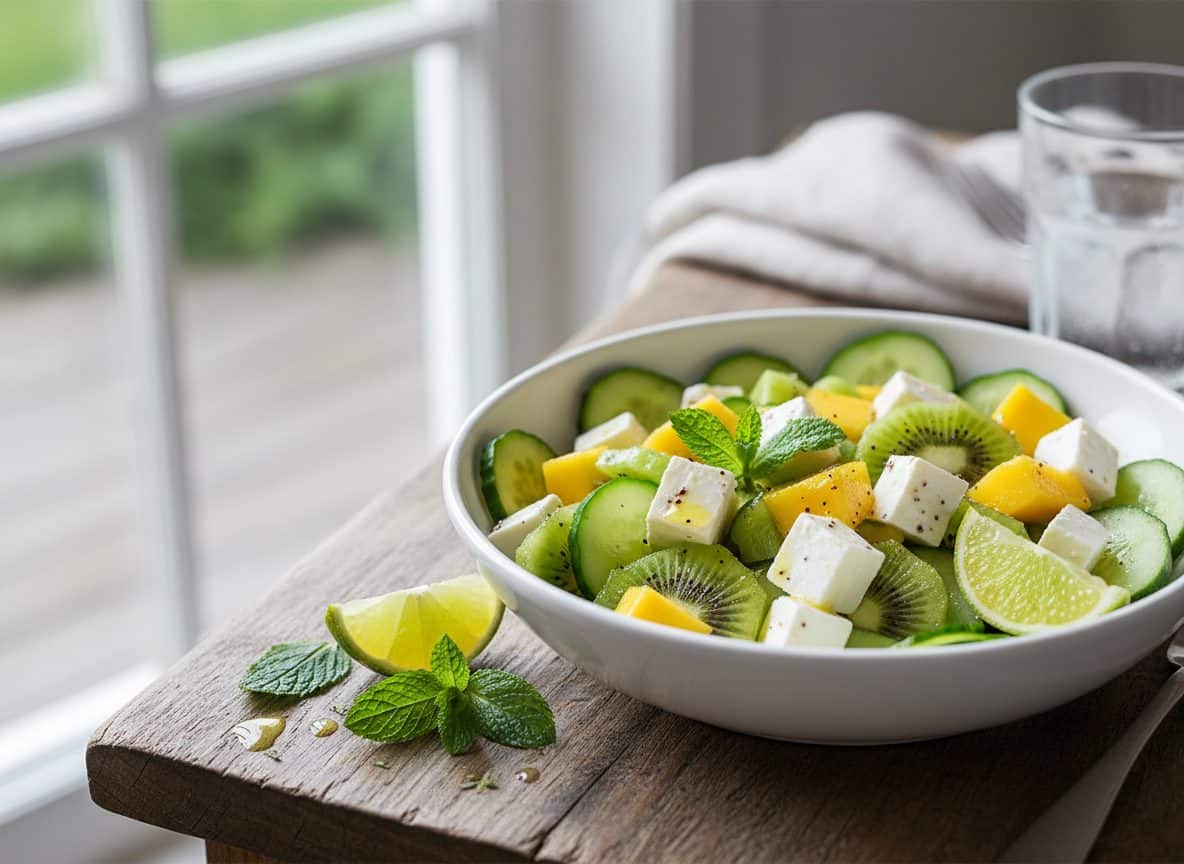
Cold melon and cucumber with feta, mint and lime, salted only at service so the platter stays crisp through its short service window.
Tools
Sharp knife or mandoline, platter, small whisk
Ingredients · swaps in parentheses
Melon, English cucumber, feta, mint, lime, olive oil, honey, flaky salt, Aleppo pepper
Magic
Chill produce well. Dress lightly. Add feta and mint last. Salt only at service.
Before you begin
Slice melon and cucumber several hours ahead. Assemble immediately before serving.
The parts that change whether this works tonight.
These fields come from the published recipe itself. If a recipe has not separately declared an operating fact, the gap stays visible instead of being filled with a guess.
- Servings
- 6 side servings; up to 8 when several salads share the table
- Timing
- About 1 hour 5 minutes, including the minimum chill
- Equipment
- Not separately declared
- Make-ahead
- Not separately declared
- Holding
- Not separately declared
- Leftovers
- Refrigerate leftovers promptly. The flavor remains good the next day, but the texture will be softer and more liquid will collect. Drain before serving and refresh with mint…
- Dietary notes
- Not separately declared
- Method map
- 10 ingredient lines · 3 method steps
Melon and cucumber share the same watery confidence, but they need salt, acid, and something creamy to become a proper salad. Feta, mint, and lime do the necessary work without burying the clean summer flavor.
This is a cold-platter recipe, not a mixing-bowl marathon. The produce should remain visibly distinct, the dressing should be restrained, and the salt should arrive late. Assemble it early and both melon and cucumber begin releasing water until the platter looks less like a salad and more like a shallow municipal feature.
Recipe brief
- Menu job: Cold, bright counterpoint for grilled, fried, smoky, or rich food.
- Yield: 6 side servings; up to 8 when several salads share the table.
- Host difficulty: Easy.
- Kitchen intensity: Very low.
- Make-ahead value: High for components, low after assembly.
- Service window: Best immediately to 20 minutes after dressing.
- Transport / buffet: Good only when cold and undressed; assemble at the destination when possible.
- Scaling: Double onto two platters rather than one deep mound.
- Likely failure: Water on the platter, disappearing cucumber, or feta everywhere. Salt late, keep the produce separate, and use larger feta crumbles.
- Leftovers: Drain, refresh with lime and mint, and accept that the texture will be softer the next day.
The useful place for this salad
Serve it when the rest of the menu is hot, fried, grilled, smoky, or rich. It works beside halloumi corn dogs, grilled shrimp, roast chicken, fish, lamb, spicy sausages, or a substantial grain dish. It can also anchor a light lunch with flatbread and beans.
The recipe serves six as a side. For a buffet with several salads, it can serve eight. It is best for home service or a short, reliably chilled transport. It is not designed to sit fully dressed in direct heat for an afternoon while everyone periodically admires it.
Host difficulty: Easy.
Make-ahead rating: High for preparation, low after assembly.
Kitchen intensity: Very low.
Yield and timing
- Yield: Serves 6
- Prep: 25 minutes
- Chill: At least 30 minutes for the produce
- Assembly: 10 minutes
- Total: About 1 hour 5 minutes, including the minimum chill
- Best service window: Immediately to 20 minutes after dressing
Ingredients
- 4 cups cantaloupe, honeydew, or a combination, cut into thin wedges or bite-size pieces
- 2 English cucumbers, thinly sliced
- 6 ounces feta, crumbled into varied pieces
- 1 cup loosely packed fresh mint leaves, torn only if large
- 2 tablespoons fresh lime juice
- 3 tablespoons extra-virgin olive oil
- 1 teaspoon honey
- Freshly ground black pepper
- Flaky salt for finishing
- Optional: Aleppo pepper, thinly sliced jalapeño, toasted pepitas, or a small amount of lime zest
Choose melon by fragrance and structure
The melon should smell distinctly sweet at the stem end and yield slightly when pressed, but it must still cut cleanly. Very soft melon releases too much juice and loses definition. Very firm melon keeps its shape while contributing almost no flavor, which leaves the feta and mint doing unpaid overtime.
Cantaloupe brings floral sweetness and color. Honeydew is cooler and more restrained. Watermelon can be used, but it releases more liquid and needs larger pieces, a wider platter, and an even later salt application.
Cut the melon into pieces that can be eaten with the cucumber in one bite. Huge wedges look generous until a guest must negotiate them with a salad fork.
Use cucumber for snap, not extra water
English cucumbers are useful because their skin is tender and their seed cavity is relatively small. Slice them thinly with a sharp knife or mandoline. If a cucumber has a very wet center, halve it lengthwise and scrape out some seeds before slicing.
Spread the slices on a clean towel and blot gently. Do not salt them in advance for this recipe; salting draws out water and softens the precise crispness the platter needs.
That instruction contradicts almost every other cucumber recipe, and the contradiction is the point. Salting cucumber is correct when you want it limp and pliant, folded into something pickled. It is wrong here, because the only job the cucumber has on this platter is to snap against soft fruit. Take the snap away and you are serving melon with cheese on it.
Chill the produce separately
Refrigerate the cut melon and cucumber in separate covered containers for at least 30 minutes. Keeping them separate prevents the melon juice from softening the cucumber before service and gives both ingredients the cold temperature that makes the salad feel genuinely refreshing.
Drain any collected melon juice before assembly. Save it for sparkling water, a drink, or tomorrow’s smoothie. It does not need to become salad dressing merely because it exists.
Whisk a dressing that knows when to stop
Whisk the lime juice, olive oil, and honey until lightly emulsified. Add several grinds of black pepper. Do not add salt yet.
Taste the dressing with melon and a small piece of feta. The feta supplies salinity and the melon supplies sweetness; tasting the dressing alone exaggerates the acid. The complete bite should feel bright, not pickled.
If the melon is exceptionally sweet, add another teaspoon of lime juice. If it is only moderately ripe, add honey a few drops at a time. The dressing should support the fruit, not create a second, syrupy personality.
Honey is the ingredient most likely to go in out of habit. A genuinely ripe melon does not need any, and a teaspoon of it on top of already-sweet fruit is how a side salad quietly becomes a fruit cup with cheese in it. Taste the bite first. Sweeten only if the fruit let you down.
Build the platter in visible layers
Use a wide chilled platter rather than a deep bowl. Arrange the melon and cucumber in overlapping sections so each remains identifiable. This reduces the amount of tossing and keeps the delicate pieces intact.
Drizzle about two-thirds of the dressing across the produce. Scatter the feta in uneven crumbles so some bites receive a creamy piece and others remain clean and bright. Add the mint, keeping a few leaves for the final pass.
Taste one complete bite. Add more dressing only if needed. Finish with black pepper, a restrained pinch of flaky salt, the remaining mint, and one optional accent such as Aleppo pepper or toasted pepitas.
The platter should look abundant but not buried. Feta is a counterpoint, not weather.
Why salt arrives at the end
Salt sharpens the melon and cucumber, but it also accelerates water release. Adding it during prep guarantees a wetter platter by service. Feta already seasons the salad unevenly in a useful way, so the finishing salt should be light and applied after the dressing.
For a buffet, place additional flaky salt nearby rather than aggressively pre-seasoning the entire dish. Guests can add more; nobody can return the water to the cucumber.
The make-ahead sequence
Up to one day ahead: Cut the melon and whisk the dressing. Keep both chilled separately.
Up to four hours ahead: Slice the cucumber and store it separately between clean towels so it stays crisp instead of becoming a day-old wet ribbon.
Several hours ahead: Crumble the feta, wash and dry the mint, and chill the platter.
Ten minutes before service: Drain the melon, blot the cucumber if needed, arrange the produce, and add dressing, feta, and mint.
At the table: Add flaky salt and any crunchy garnish.
If service is delayed, cover and refrigerate the undressed platter. Do not dress it and leave it on the counter under the optimistic theory that guests are nearly ready.
Scaling and serving vessels
For 12 people, double the produce and use two platters. One enormous mound compresses the lower layers and allows juice to collect invisibly at the bottom. Two platters also reduce table traffic and give both ends of a long table access.
For four people, use three cups of melon, one cucumber, and four ounces of feta. Make the full dressing amount only if another salad or grilled vegetable can use the remainder.
For individual service, arrange small portions on chilled plates and add dressing just before carrying them to the table. This is elegant but increases last-minute work, so use it only when the rest of the menu is already calm.
Substitutions and their consequences
- Watermelon: Sweeter and wetter. Use larger cubes, less honey, and more lime.
- Peaches or nectarines: Softer and more aromatic. Slice thickly and reduce the dressing slightly.
- Goat cheese: Creamier and tangier than feta, with less salty contrast. Use small pieces and add a little more finishing salt if needed.
- Ricotta salata: Firm, dry, and salty. Shave or crumble it and expect less creaminess.
- Basil for mint: Warmer and less cooling. It works especially well with peaches or tomatoes.
- No cheese: Add toasted pistachios or pepitas and increase the salt carefully.
- No honey: Omit it when the melon is fully ripe; the dressing may need no sweetener at all.
Common failures
The platter is watery: The produce was salted early, not drained, overripe, or assembled too far ahead.
The salad tastes bland: It may need lime or black pepper before it needs more salt.
The feta dominates: The pieces are too fine or the quantity is too high. Larger, less frequent crumbles create better contrast.
The cucumber disappears: It was sliced too thin or softened in melon juice. Keep the components separate until assembly.
The mint turns dark: It was cut too early, bruised, or placed against very wet fruit. Tear it at service.
The salad tastes like sweet fruit with cheese: Increase acid, pepper, or Aleppo pepper and reduce the honey.
Build the surrounding menu around contrast
This is the clean counterpoint, so let it do that job. Pair it with fried halloumi, grilled shrimp, lamb skewers, smoky chicken, spicy beans, or corn ribs. Add bread only if another element needs it. The salad does not need a sweet glaze, candied nuts, and a sweet drink arriving beside it.
A dry rosé, crisp white wine, or light lager can meet the feta and lime without amplifying the fruit. For the teetotaler pairing, use sparkling water with lime and mint, unsweetened iced green tea, or cucumber tonic with a small pinch of salt. Keep the drink dry and cold.
Kitchen Kit
Goods: Melon, cucumber, feta, mint, lime, olive oil, honey, black pepper, flaky salt, and an optional chile or seed garnish.
Gear: Sharp knife or mandoline, clean towels, small whisk, covered storage containers, and a wide chilled platter.
Magic: Chill the produce, keep it separate, dress lightly, and salt only at the end. Early salt summons the tide directly onto the platter.
Next decision
Check the full menu in Occasion OS, use Kitchen & Bar Intelligence for substitutions, and read A Salad Is a Structure for the late-dressing logic.
Storage and final judgment
Refrigerate leftovers promptly. The flavor remains good the next day, but the texture will be softer and more liquid will collect. Drain before serving and refresh with mint and lime rather than adding more oil.
The salad is simple because the decisions are disciplined, not because nothing is happening. Cold produce, late salt, enough acid, and one creamy counterweight are the entire system. That is plenty.
Part of Recipes & Technique.
Recipe provenance: Salty & Clever editorial formulation, built from established culinary technique and the traditions identified in the article. No chef, restaurant, family, or firsthand cultural provenance is claimed unless it is explicitly named and sourced. How we write and check recipes


