Tripling the Recipe Is Not Scaling the Dish
A dish built for four in a 10-inch skillet does not become a dish for twelve in the same pan, because only the ingredient list scales linearly.
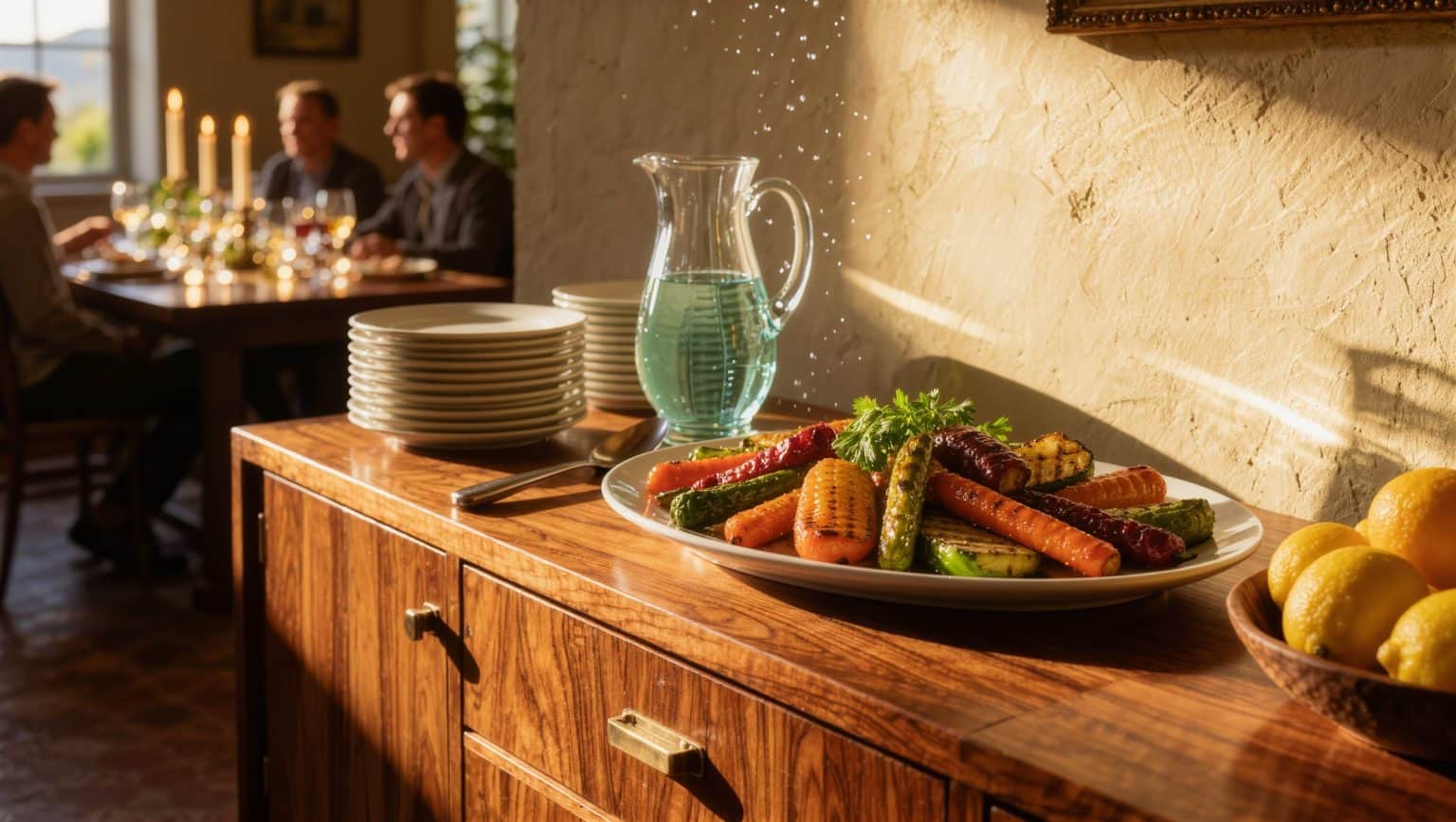
Tripling the ingredient list is the only part of scaling that is honest arithmetic. Everything that made the dish worth repeating is geometry, and geometry does not triple.
The scene of the failure
The version for four: six bone-in chicken thighs laid skin-down in a 10-inch skillet until the skin releases on its own, then braised with white beans, fennel and three cups of stock, lid off at the end so the liquid pulls back onto the beans. It reaches the table as crisp skin in a sauce thick enough to hold a spoon upright.
The version for twelve: eighteen thighs, six cups of beans, nine cups of stock, in the 12-inch skillet, because the 12-inch was the biggest pan in the house and 12 is bigger than 10. The thighs went in stacked, not laid. Nothing browned. The skin turned the color of wet paper at minute four and stayed there, because the pan filled with the water coming out of eighteen pieces of chicken and never got back above boiling. At 8:40 the host ladled pale chicken out of two and a half quarts of thin broth. The dish had not failed. It had been cooked in a pan that was making a different dish.
Ingredients scale. Area does not.
A 10-inch round pan gives about 79 square inches of floor. A 12-inch gives about 113. The diameter went up 20 percent and the area went up 44 percent, because area follows the square of the radius. Set that against what the recipe asked for, which was 200 percent more room: the 12-inch delivers 44 of those 200 points, a fifth of the way, and the rest goes on top of the first layer. Three times the food in one layer needs about 236 square inches, a round pan 17.3 inches across. A half-sheet pan gives about 190 square inches, 2.4 times the skillet and still short of three. The arithmetic keeps returning two pans. Pan area is the binding constraint on any scaled dish that browns, and it belongs with the numbers worth keeping in your head.
Crowding gets called a browning problem. It is a steam problem that presents as one. Browning needs contact with hot metal and an escape route for water vapor, and food two layers deep has neither. While free water is still leaving, the surface stays pinned near 212°F, and the reactions that make skin taste roasted are slow below 300°F. The pan cannot climb until the water is gone, and the water cannot leave until the pan climbs.
Reduction runs on surface, not volume
Reduction is evaporation, and evaporation happens only at the surface. Tripling the contents of a pot triples the water that has to leave without widening the door it leaves through. Three cups down to one across 79 square inches takes about 35 minutes at a bare simmer. Nine cups down to three across that same 79 takes roughly three times as long, near 105 minutes, and the chicken has come apart by minute 70. A 13-inch Dutch oven buys 132 square inches, 69 percent more surface, which brings reduction to about 1.8 times the original. That gap is why a tripled braise arrives loose.
Salt is the number I get wrong
Salt does scale with mass. About 1 percent of the weight of the solids is a defensible target for a braise. Six thighs and two cups of dried beans land near 3 pounds, so 1 percent is a scant half ounce, roughly four and a half teaspoons of Diamond Crystal kosher salt at about 3 grams per teaspoon. Tripled, the honest figure is near four and a half tablespoons, and almost nobody puts that into a pot, because the hand stops where the amount stops resembling the amount it remembers using. Salt scales with mass. It does not scale with memory, and it is the number I get wrong whenever I scale anything.
It also cannot be fixed late. Salt stirred in at 8:30 dissolves into the sauce in seconds but does not travel into the meat, where diffusion runs in hours. The guest gets seasoned sauce on bland chicken, and the fix at the table sits on the surface.
The ingredients that are not linear at all
Flour and cornstarch come closest to linear, because they track liquid volume: about a tablespoon of flour per cup for a light sauce, two for gravy. Their trap is indirect, since starch matched to the volume of an unreduced braise gives a pasty sauce carrying the same weak flavor.
Eggs do not set on ratio alone. One egg per half cup of dairy sets softly at any batch size, but the set happens between 170°F and 180°F. Pour a tripled custard into one dish three inches deep instead of three dishes an inch deep and the outer inch passes 185°F and weeps while the center is still 150°F. Depth decides a custard, not quantity. Leaveners fail through timing: a cup of all-purpose flour takes about a teaspoon of baking powder, or a quarter teaspoon of baking soda where acid meets it, but a tripled batter in one deep pan sets later, so more of the gas made in the first minutes escapes before the structure can trap it, and the crumb comes out coarse with a dip in the middle.
Aromatics compound rather than scale, because extraction depends on time and on how much fat is there to hold what comes out. Six cloves of garlic becoming eighteen in a pot running nearly twice as long reads hotter than three small pots do. Scale the pungent ones to about two and a half times, taste, and add the rest late.
Time is the trap that looks like the fix
Depth-limited dishes need more time. A braise three times as deep needs longer to come up, longer to tenderize at the center of the mass, longer to reduce. Time is the right lever there, and the number is not three.
Area-limited dishes need more area. A tripled sheet-pan roast in the same oven does not need more minutes, it needs a second pan. Added minutes give softer vegetables with the same pale surface, because that surface never dried and climbed. One oven takes two half sheets on separate racks, swapped at the halfway mark; a third pan means a second round, worth deciding early if you are running the whole dinner through one oven. Loading cold pans drops a 425°F oven by 50°F to 75°F with eight to twelve minutes of recovery, and convection narrows that without erasing it.
What to do instead
Scale by pan count, not pan size. Two 12-inch skillets rather than one enormous pan. The cost is two burners or racks, two browning shifts, and two pans that will not hit doneness on the same minute.
Hold the depth constant and add vessels. Keep the depth the original ran at and multiply the containers. The cost is that you may not own them, and the dish loses the single handsome presentation it was photographed with.
Convert every time into an endpoint before you start. Each clock number is a proxy for something visible, calibrated to the original pan, and scaling breaks the proxy. Thirty-five minutes of braising becomes “until a spoon dragged across the bottom leaves a track that holds two seconds,” and eight minutes of browning becomes “until the skin releases without being pried.” The cost is losing the comfort of a timer.
Re-season against a tasted reference. Cook one small portion alongside and season the big pot until it matches that, rather than by arithmetic. The cost is one extra pan and the discipline to salt earlier than feels comfortable.
Serve some dishes twice rather than doubling them once. Anything resting on a crust is better in two rounds, the second going into the pan during the first course. The cost is a table eating in two waves and a plan for holding the first round warm at 140°F or above.
The tell
If the scaled version uses the same pan as the original, the recipe has not been scaled. It has been overloaded, and the failure is set before the burner is on.
The 4 p.m. check is physical. Lay the raw food into the pans you intend to use, cold, in a single layer. If it does not fit in one layer at 4 p.m., it will not brown at 7. Then count the salt into a small bowl first, so you see the real quantity in one place instead of discovering it a shake at a time. The pans tell you whether you scaled the recipe. The bowl tells you whether you believed the arithmetic.
The mechanism here is established technique and the timings are reasoned from it rather than measured in a test kitchen; Salty & Clever’s standing note on how we write and check recipes applies. What ruins this one is a pan that quietly stopped browning and started steaming, and a sauce that is still liquid at the hour you have to serve it.
Part of Menus & Kitchen Systems.


