Whole Fish Baked on Potatoes
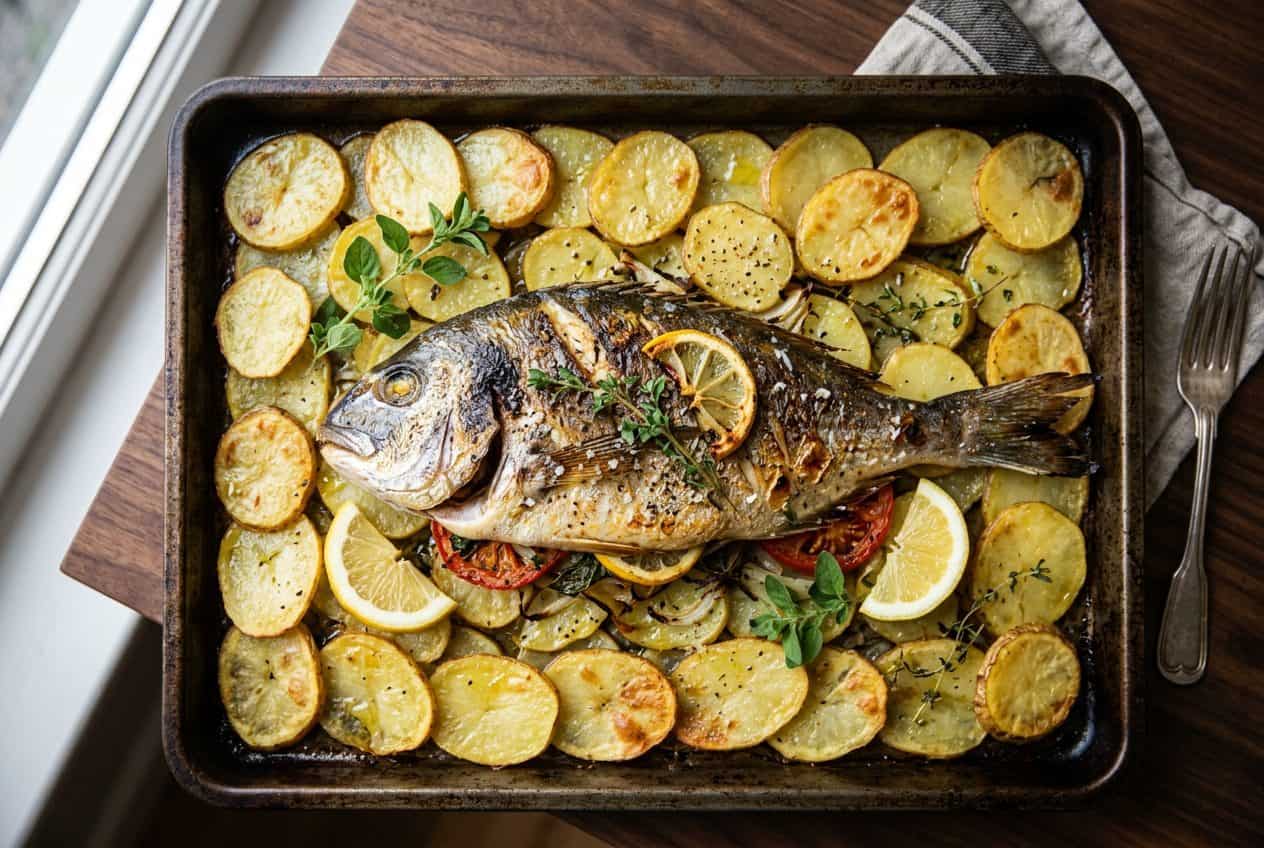
A whole fish roasted over sliced potatoes and tomato in one tray — the potatoes make up two-thirds of it on purpose, because the potato is what's actually in surplus.
Pairing
Wine — Vermentino di Gallura, from Sardinia. It has enough body for a tray of oily roast potatoes, a saline streak that suits baked fish, and a faintly bitter almond finish that stops the whole thing tasting soft. Mixed drink — An Americano — Campari, sweet vermouth, soda, a lot of ice, an orange slice. It is bitter enough to reset the palate between forkfuls of potato and weak enough that people can keep drinking it through a long communal course without anyone losing the thread. Teetotaler — Pink grapefruit juice over ice with a splash of thyme syrup made by steeping the thyme stems in warm honey and water, then straining. The bitterness of the grapefruit does the same job as the Campari, and the thyme ties it to the tray.
Tools
A large heavy roasting tray with a proper lip (the juices are the seasoning for the potatoes and a flat sheet loses them over the edge), sized so the potatoes lie in one barely overlapping layer — that single measurement decides whether they roast or steam — a mandoline or a very steady knife for ⅛ inch slices, since uneven slices give you raw potato next to collapsed potato in the same mouthful, a fish slice wide enough to lift a whole side, an oven thermometer if yours runs cool at 425°F, and an instant-read probe if you would rather not test doneness by poking at the bone
Ingredients · swaps in parentheses
Waxy potatoes (floury ones collapse into a wet mash under an hour of fish fat and tomato juice — the texture is the point, so this swap costs you the dish), olive oil in more quantity than feels sensible, one whole round fish such as bream or snapper, scaled and gutted (thick fillets work but go on for the last 15 minutes only, not the full roast), ripe tomatoes, fresh oregano and thyme, lemons, kosher or flaky salt, coarse black pepper
Magic
Mash two salted anchovy fillets to a paste with the flat of a knife and stir them into the olive oil you drizzle over the fish at step five. They dissolve completely in half an hour at 425°F — nothing on the tray tastes of anchovy — but as the oil runs off the fish and down between the slices it takes that savory depth into the potatoes, which are two-thirds of what you are actually eating and otherwise get seasoned only by accident. Anchovies not in the house or not in your fridge? Chop a tablespoon of capers and scatter them over the potatoes before the fish goes on less seamless, same job of making the bottom layer worth eating on its own.
Before you begin
The twenty-minute head start for the potatoes is not padding — skip it and the fish is dry by the time anything underneath is tender. Crowding is the other way this fails: one fish per tray, and a second fish means a second tray, because two on one tray steam each other and the potatoes end up pale and damp. If you sliced the potatoes a day ahead and held them in water, dry them properly wet potatoes will not color. Judge the fish at the thickest part by the bone, opaque all the way through rather than translucent, then rest five minutes and go straight to the table. It holds about twenty minutes covered and it does not reheat — a fish this size dries out completely the second time through an oven.
The parts that change whether this works tonight.
- Yield
- 6 servings per fish
- Time
- 1 hour 10 minutes
- Equipment
- A large heavy roasting tray with a proper lip (the juices are the seasoning for the potatoes and a flat sheet loses them over…
- Make-ahead
- Slice potatoes up to a day ahead and hold in water; do not assemble or cook ahead
- Holding
- This is the dish that sets the evening's timing, and it does not negotiate about it
- The method
- 8 ingredients · 7 steps
From this recipe’s own recipe card. Nothing here is a guess.
The main event, and it’s built the way this whole menu is built: from what’s actually in surplus. The potatoes make up two-thirds of the tray on purpose, because the potato is what’s genuinely left over, and the fish, tomato and oil are there to season a tray that could otherwise be mistaken for a side dish. Sliced potatoes go down first, the whole fish lays over the top, and the entire thing roasts hard in one pan until the fish is just cooked through and the potatoes underneath have taken on all its fat and juice.
Yield and time
- Yield: 6 servings per fish, written for a table of 6; add a second fish and tray per additional 6
- Active time: 25 minutes
- Total time: 1 hour 10 minutes
- Make-ahead window: Slice potatoes up to a day ahead and hold in water; do not assemble or cook ahead
Ingredients
- Waxy potatoes, sliced about ⅛ inch thick — 3¼ lb
- Olive oil, divided — ½ cup
- Kosher salt (Diamond Crystal), for the potatoes — 1½ tablespoons
- Ripe tomatoes, thinly sliced — 4 medium
- One whole fish (bream, snapper or similar), about 2½–3¼ lb, scaled and gutted
- Fresh oregano and thyme, roughly chopped — a generous handful
- Lemons, sliced — 2
- Black pepper, coarsely ground, to finish
Method
- Heat the oven to 425°F.
- Toss the sliced potatoes with half the olive oil and the kosher salt, and spread them in a single, slightly overlapping layer across a large roasting tray — they should cover roughly two-thirds of the tray’s surface.
- Roast the potatoes alone for 20 minutes, until they’ve started to soften and color at the edges but aren’t yet fully cooked — this head start is what stops the fish overcooking while it waits for the potatoes underneath.
- Scatter the sliced tomatoes over the potatoes, then lay the whole fish on top, stuffing the cavity with half the herbs and a couple of lemon slices.
- Drizzle the fish with the remaining olive oil, scatter the rest of the herbs and lemon slices over the top, and season everything with salt and black pepper.
- Return to the oven and roast for 25–30 minutes, until the fish flakes easily at the thickest part near the bone and the flesh has turned from translucent to fully opaque all the way through, and the potatoes underneath are tender and have taken on color from the fish fat and tomato juice.
- Rest for 5 minutes before bringing the whole tray to the table — this dish is meant to be seen and carved communally, not portioned in the kitchen.
Make-ahead
The day-ahead slicing window here was arrived at by reasoning from method rather than from a tested bench run, which is how most of what we publish begins; Salty & Clever’s standing note on how we write and check recipes applies to it. Slice the potatoes up to a day ahead and hold them submerged in cold water in the fridge to stop them browning, then drain and pat dry before using. Everything else — the fish, the tomatoes, the assembly — happens the same day, close to the meal, since this is a dish that’s genuinely better roasted fresh than reheated.
Holding and service
This is the dish that sets the evening’s timing, and it does not negotiate about it. If you are both cooking and answering the door, put the tray in when the first guest has a drink in hand, because the twenty minutes below is the entire margin you get. This holds covered for about 20 minutes before the fish starts to dry out and the potatoes cool past the point of being genuinely hot. It doesn’t reheat well — a fish this size dries out fast the second time through an oven — so time the roast to land close to when the table actually sits.
Scaling
The tray counts here follow a Tangled Thistle table rather than a home oven, which matters most at the point where the honest answer stops being a bigger tray and becomes a second one. One fish and one tray genuinely serves about 6; past that, add a second fish on a second tray rather than trying to fit two fish on one tray, since a crowded tray steams the fish instead of roasting it and the potatoes underneath end up soggy rather than crisp at the edges.
Substitutions
- Whole fish not available or a guest doesn’t eat fish — this is exactly what the braised beans are for; see the beans recipe for the vegan main built to arrive at the same size and the same moment.
- Only fillets available, not a whole fish — thick fillets work on the same bed of potatoes, laid over the tomatoes for the last 15 minutes of the potatoes’ roasting time rather than the full 25–30, since fillets cook much faster than a whole fish on the bone.
Why this dish, at Last Night of the Season
It belongs to Last Night of the Season, where the potato, not the fish, is the ingredient in surplus and the tray is built to say so honestly — two-thirds potato, by design.
Part of Recipes & Technique.
Recipe provenance: Salty & Clever editorial formulation, built from established culinary technique and the traditions identified in the article. No chef, restaurant, family, or firsthand cultural provenance is claimed unless it is explicitly named and sourced. How we write and check recipes
Where this goes next

