Roast Cabbage With Butter and Salt, and Nothing Else At All
The deliberately plain dish on a menu that has quite enough ideas in it already — and the one item on the table that dictates what time dinner is served.
Pairing
Wine — A very cold Muscadet sur lie — lean, faintly saline and completely unbothered by butter, it keeps the plate tasting of char rather than of dairy. Mixed drink — A mezcal paloma, salt on the rim or in the mix — smoke meeting smoke, with grapefruit doing the job the lemon squeeze does on the tray. Teetotaler — Burnt-honey lemonade: a spoonful of the syrup, a lot of lemon, cold water and a genuine pinch of salt — the bitterness in the honey stops it reading as sweet, which is the only way a soft drink survives next to butter and flaky salt.
Tools
Your heaviest baking trays, preheated in the oven rather than merely used — the hot tray is the entire dish, and a cold one under a wet cabbage is how you get the gray steamed version everybody thinks roast cabbage is — plus an oven that genuinely reaches 450°F convection or as close as it gets, a big knife for quartering straight through the root, a pastry brush, oven gloves you can trust at that temperature, and a wide low uncovered serving dish that holds one layer with no stacking. Past about 40 covers, add a griddle or a heavy dry pan for charring in advance
Ingredients · swaps in parentheses
Pointed or sweetheart cabbages, whose looser leaves and sweeter heart cook in half the time (a round white cabbage works with ten minutes longer and a splash of water in the tray, January King, savoy and sprout tops are all sturdier by five to eight minutes, and savoy chars magnificently on its crinkled leaf while wanting more butter, radicchio is a different dish rather than a swap — ten minutes total, and it needs a spoonful of burnt honey in the butter to keep the bitterness in check — and you do not do both, because two roasted brassica-shaped things on one table is a menu that has stopped paying attention), a neutral high-smoke-point oil such as rapeseed or peanut rather than olive, which smokes and turns bitter at this heat, unsalted butter (a good peppery olive oil added at the end instead, with more lemon, is close to equivalent here, since the butter is a finishing fat rather than a structural one), flaky sea salt crushed between the fingers rather than fine salt, a lemon, and coarse black pepper
Magic
When the wedges come off, do not pour the butter over them. Pour it into the empty tray while the tray is still screaming hot, and swirl it around with the back of a spoon so it lifts every blackened scrap welded to the metal — the burnt leaf tips, the caramelized juice, the whole dark deposit that normally goes down the sink with the dishes. Squeeze the lemon straight into that, let it hiss, and pour the lot over the cabbage. It adds nothing to the shopping list and takes fifteen seconds, and it is the difference between butter on cabbage and a sauce that tastes of the char you just made. It suits this plate in particular, which has refused to have an idea in it and should keep refusing. If wrangling a 450°F tray at the pass is one job too many, scrape the dark bits off with a spoon instead and swirl them into the melted butter in a small pan, lemon in last.
Before you begin
Heat decides everything here, and nearly every failure is a temperature failure. Trays preheated, cabbage dry, then oiled, then onto the tray in that order — you should hear them land — and then left alone, because moving them is how the crust never forms. Black at the edges is correct if nothing is black, it is not done, and a moderate oven gives you sweet wet gray cabbage instead. Two trays in a domestic oven is already a compromise, since opening the door drops it 35°F and it takes four minutes to recover, which is why the bottom shelf comes out pale. Then the clock: this holds for twenty minutes and afterwards it is a different vegetable, as steam inside the wedge migrates out and turns the char leathery by minute twenty-five and limp by minute forty. So it goes out last and fast, uncovered, unstacked, never in a chafing dish, and it is the dish the whole service clock is built backwards from. There is no roast-early-and-reheat version — reheated char is soft char, which is wet cabbage with a burnt taste — so if you cannot roast at service, put out more barley and lose only a texture. Leftovers are not a loss: chopped and fried hard in butter the next morning with an egg on top, they are arguably better.
The parts that change whether this works tonight.
- Yield
- Serves 10 as one of two sides with a braise — 16 wedges, which is generous…
- Equipment
- Your heaviest baking trays, preheated in the oven rather than merely used — the hot tray is the entire dish, and a cold one…
- Make-ahead
- The day before: nothing worth doing. The morning of: quarter the cabbages and keep them in a bag in the fridge; that is genuinely all, and it saves five minutes
- Holding
- Twenty minutes, and then it is a different vegetable. The residual steam inside the wedge migrates outward and softens the char, so at minute twenty-five the black edges have gone…
- The method
- 6 ingredients · 6 steps
From this recipe’s own recipe card. Nothing here is a guess.
There is no idea in this dish and there is not going to be one. Every menu I have ever seen with seven interpretations on it is exhausting to eat, and by the fourth clever thing nobody is noticing that any of them were clever. So one plate on the table does nothing at all except be extremely good, and this is it.
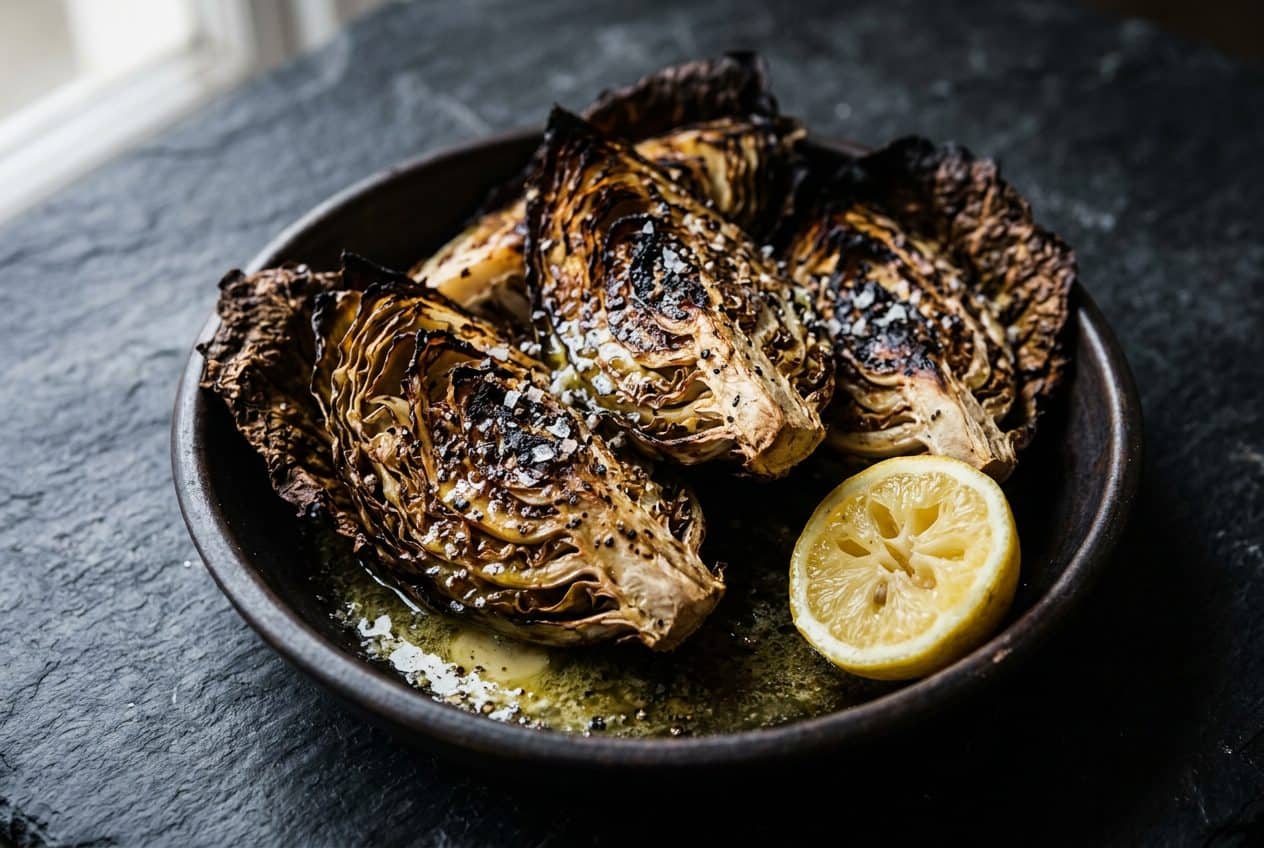
Heat is what decides this, and not much else. Cabbage roasted in a moderate oven steams itself gray and sweet and slightly wet, which is the version most people have eaten and the reason most people are unenthusiastic about roast cabbage. Cabbage roasted in a genuinely fierce oven, on a tray that was already hot, chars at the outer leaves while the heart is still holding, and turns into something with three textures in one wedge: black and papery at the edge, sweet and collapsed in the middle, and still faintly crisp at the root.
It is also, at this particular dinner, the dish that decides what time everybody eats. Everything else on the menu holds for an hour or more. This one holds for twenty minutes and then becomes a different vegetable. So the service clock is built backwards from the cabbage, and everything else falls into place around it.
Yield
Serves 10 as one of two sides with a braise — 16 wedges, which is generous, because people always take a second. Written for the 20-guest version of this evening as two trays.
Time
Active: 10 minutes. Total: 40 minutes. Make-ahead window: essentially none, and that is the honest answer rather than a difficult one — this is a 30-minute job you start when the braise is already reheating. Which means it lands in the worst half hour of your day, and you should agree to it knowing that.
Ingredients
- 4 pointed or sweetheart cabbages, about 1½ lb each. Pointed rather than round: the leaves are looser, the heart is sweeter and it takes half the time. A round white cabbage will work and wants ten minutes longer and a splash of water in the tray.
- ⅓ cup neutral oil with a high smoke point — rapeseed or peanut, not olive, which will smoke and go bitter at this temperature
- 1 stick unsalted butter, melted
- 4 teaspoons flaky sea salt (flaky, crushed between the fingers as it goes on, not fine salt, because half the pleasure here is the crunch of an undissolved flake)
- 1 lemon
- Coarsely cracked black pepper
Method
- Put your heaviest baking trays in the oven and set it to 450°F convection, or as hot as it goes. The trays must be preheated. A cold tray under a wet cabbage is how you get the steamed gray version.
- Strip off any loose or damaged outer leaves. Quarter each cabbage lengthways, straight through the root, and leave the root on — it is what holds the wedge together and it is also perfectly good to eat.
- Brush the cut faces with the oil and season them with about half the salt. Dry cabbage, oiled cabbage, hot tray, in that order.
- Lay the wedges cut-side down on the hot trays, spaced so they are not touching. You should hear them the moment they land. Roast for 14 to 16 minutes without moving them.
- Turn onto the second cut face and roast another 8 to 10 minutes. They are ready when the cut faces are deep brown with black edges, the outer leaves are papery and blistered, and a knife goes into the thickest part of the heart with only a little resistance. Black at the edges is correct. If nothing is black, it is not done.
- Move to a warm serving dish, pour the melted butter over while everything is still spitting, then the rest of the flaky salt, a hard squeeze of lemon and a lot of black pepper. Serve immediately.
Make-ahead
The day before: nothing worth doing. The morning of: quarter the cabbages and keep them in a bag in the fridge; that is genuinely all, and it saves five minutes.
What must not be done ahead: roasting them. There is no version of this dish that is roasted early and reheated. Reheated char is soft char, and soft char is just wet cabbage with a burnt taste. If you cannot roast it at service, do not put it on the menu — put out a second helping of the barley instead and lose nothing but a texture.
Holding and service
Twenty minutes, and then it is a different vegetable. The residual steam inside the wedge migrates outward and softens the char, so at minute twenty-five the black edges have gone leathery and at minute forty they are limp. It still tastes fine. It is no longer the dish.
Practically, that means it goes out last and it goes out fast. Do not put it in a chafing dish, do not cover it, and do not stack the wedges — stacked cabbage steams itself. A wide, low, uncovered dish, one layer deep, straight from the oven to the table.
It also has the useful property of being good at room temperature in an entirely different way, so the leftovers are not a loss: chop them, fry them hard in butter the next morning, and put an egg on it.
Scaling
Cabbage, butter, oil and salt all multiply exactly. Nothing about the seasoning changes.
What does not multiply is oven space, and here it is a hard ceiling rather than an inconvenience. This dish needs a fierce oven and an uncrowded tray, and both of those things disappear the moment you double the quantity. A domestic oven with two trays in it drops 35°F when you open the door and takes four minutes to recover, so the second tray is cooking at a lower temperature than the first — which is why the wedges on the bottom shelf come out pale.
That recovery figure, and the timings up in the method, are reasoned from how a domestic oven behaves rather than measured across a run of trays: this recipe was developed by reasoning from method rather than from a tested bench run, which is how most of what we publish begins, and Salty & Clever’s standing note on how we write and check recipes applies to it. Your oven is the authority on your oven. Cook to the black edge, not to my clock.
The method changes at about 40 covers. Above that, char the wedges in advance in a very hot dry pan or on a griddle — cut face down, 3 minutes, until properly black — hold them at room temperature, and finish them in the oven for 10 minutes at service. You lose a little of the papery outer leaf and you keep almost everything else. Above 150 covers, this dish needs either a commercial oven or a different vegetable, and there is no clever way around it.
Substitutions
January King, savoy or sprout tops. All good, all a little sturdier, all wanting five to eight minutes longer. Savoy in particular chars magnificently because of the crinkled leaf, though it is drier and wants more butter.
Radicchio or trevise. A genuinely different dish rather than a swap — bitter, faster (10 minutes total), and it needs a spoonful of the burnt honey stirred into the butter to hold the bitterness in check. Excellent next to the braise. Do not do both; two roasted brassica-shaped things on one table is a menu that has stopped paying attention.
Olive oil in place of the butter, for a vegan version. Use a good peppery one, added at the end rather than during roasting, and increase the lemon. This one is close to equivalent — the butter is a finishing fat here rather than a structural one, and the dish loses very little.
Why this is here
This is the plain plate on the menu for One Match, an evening on Tangled Thistle in which a room begins in total darkness and is lit over about eleven minutes by a single flame passed from guest to guest. Everything else on that table is doing something — a first course built around the way an eye adapts to darkness, a cocktail washed with beeswax, a tart that refuses a blowtorch on principle. This one is butter, salt and heat, and it is the plate everybody goes back to. The full food and drink design is Everything Is Already on the Table, and the working menu, with the service clock built backwards from exactly this dish, is here on Salty & Clever.
Part of Recipes & Technique.
Recipe provenance: Salty & Clever editorial formulation, built from established culinary technique and the traditions identified in the article. No chef, restaurant, family, or firsthand cultural provenance is claimed unless it is explicitly named and sourced. How we write and check recipes
Where this goes next

