Late Radicchio and Cedro
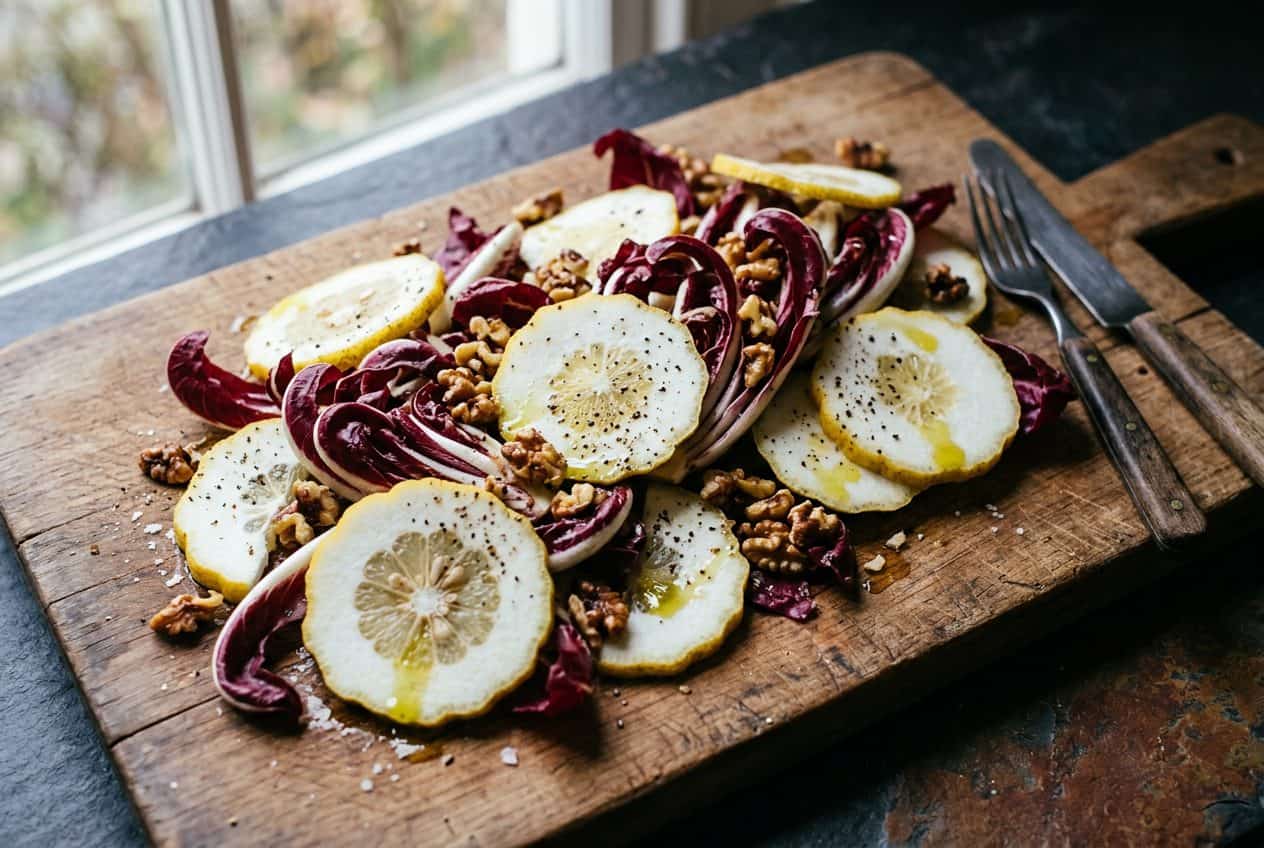
Tardivo radicchio torn and tossed with thinly sliced cedro, pith and all, toasted walnuts and a honeyed Garda oil dressing — the pith eats sweet and faintly bitter, like a firm melon.
Pairing
Wine — Schiava from the Alto Adige, served cool — pale, light and almond-bitter, one of the few reds that does not flatten a bitter winter leaf. Mixed drink — A fino sherry cobbler, heavy on the crushed ice. Nutty and bone dry, so it picks up the walnuts and stays out of the way of the honey. Teetotaler — Chinotto over plenty of ice with a pinch of salt and a squeezed strip of orange peel — bittersweet and faintly medicinal, which is precisely the register the plate is in.
Tools
A properly sharp thin-bladed knife and a stable board — the cedro's thick pith is the bottleneck of the whole dish and a dull blade tears it into wedges instead of slices (a mandoline sounds like the answer and is not, it drags on pith), a salad spinner or a clean dish towel to get the radicchio bone dry, a dry pan or a tray for toasting the walnuts, a small bowl and whisk for the dressing, and one wide board or platter big enough to keep the assembly loose
Ingredients · swaps in parentheses
Tardivo radicchio, the long forced winter kind rather than the round summer head (round radicchio works but is blunter and more aggressively bitter, so tear it smaller), a whole cedro (grapefruit segments plus a little candied lemon peel is the closest honest stand-in, and it is a different dish), walnuts (toasted pumpkin seeds for a nut-free table, scattered more heavily), a fruity green olive oil worth tasting on its own, honey, flaky and kosher salt, and coarse black pepper
Magic
Burn the honey before it meets the oil. Put the tablespoon of honey alone in the smallest pan you own over a medium heat and leave it until it foams, darkens to the color of strong tea and just starts to smell of smoke — about ninety seconds — then pull it off, let it stop bubbling, and whisk the oil and salt into it as usual. What you lose is the sugary top note that makes a honey dressing taste like breakfast what you gain is a caramel bitterness that runs alongside the radicchio and the pith instead of arguing with them, so the plate reads as one bitter thing in three textures rather than sweet stuff poured over bitter leaves. Prefer not to stand over a pan of scorching sugar? Warm the honey with a pinch of salt just until it loosens and goes a shade darker, and you get maybe half of it.
Before you begin
Taste a sliver of the pith raw before you commit the whole fruit — a true cedro is sweet and faintly bitter, near to firm melon, and if yours is harshly bitter you have been sold a large lemon and the dish will not work. Everything gets cut close to service: dressed radicchio has fifteen or twenty minutes before it slumps, and cut cedro dulls and browns at the edges within an hour or two, with no lemon-juice trick that fixes it without changing the fruit. Dry the leaves properly, since a wet leaf simply will not hold an oil dressing.
The parts that change whether this works tonight.
- Yield
- 6 servings
- Time
- 20 minutes
- Equipment
- A properly sharp thin-bladed knife and a stable board — the cedro's thick pith is the bottleneck of the whole dish and a dull…
- Make-ahead
- None — assemble cold, close to service
- Holding
- Both windows in this section were arrived at by reasoning from method rather than from a tested bench run, which is how most of what we publish begins; Salty &…
- The method
- 7 ingredients · 6 steps
From this recipe’s own recipe card. Nothing here is a guess.
Cold, assembled outside on boards close to service, and built entirely around the strangest ingredient on this whole menu: cedro pith. Tardivo radicchio — the long, winter-forced variety, not the round summer kind — is torn into pieces and tossed with thin slices of cedro flesh and pith, toasted walnuts, and a dressing that’s mostly Garda oil with a little honey. The pith is the whole surprise; sweet and faintly bitter, closer to a firm melon than a lemon in the mouth, and most guests have never eaten it before.
Yield and time
- Yield: 6 servings, written for a table of 6; multiplies by board
- Active time: 20 minutes
- Total time: 20 minutes
- Make-ahead window: None — assemble cold, close to service
Ingredients
- Tardivo (long, forced winter) radicchio, leaves separated and torn — 2 heads
- Cedro (citron), including the white pith, thinly sliced — 1 fruit
- Walnuts, toasted and roughly chopped — ⅔ cup
- New Garda olive oil, or another good fruity green oil — 6 tablespoons
- Honey — 1 tablespoon
- Kosher salt (Diamond Crystal) — 1½ teaspoons
- Black pepper, coarsely ground, to finish
Method
- Separate and tear the radicchio leaves into rough, hand-sized pieces, keeping the leaves’ natural shape rather than chopping them small.
- Slice the whole cedro thinly, including the white pith and the flesh — unlike a lemon, the pith here is meant to be eaten and tastes almost nothing like a lemon pith would; it should taste sweet, faintly bitter, and genuinely pleasant, closer to a firm melon than to citrus zest.
- Whisk the olive oil, honey and kosher salt together in a small bowl until the honey is fully incorporated.
- Toss the torn radicchio and sliced cedro together on a wide board or platter, keeping the arrangement loose rather than tightly composed — this dish is meant to look assembled outdoors, in the moment, not plated with tweezers.
- Scatter the toasted walnuts over the top.
- Drizzle with the dressing, finish with black pepper, and serve within a few minutes of dressing — the radicchio starts to wilt slightly once dressed, which is fine for a short window but not for a long one.
Make-ahead
This is written to a Tangled Thistle table, where the cutting is somebody’s scheduled afternoon rather than a thing squeezed in before the doorbell. The dressing can be made up to a day ahead and kept at room temperature; it doesn’t need refrigeration since it’s oil-based with no perishable component. The radicchio and cedro should be cut close to service — cut cedro flesh browns slightly at the edges within an hour or two, the same way an apple does, and there’s no lemon-juice trick that fully stops it without changing the flavor of the fruit itself.
Holding and service
Both windows in this section were arrived at by reasoning from method rather than from a tested bench run, which is how most of what we publish begins; Salty & Clever’s standing note on how we write and check recipes applies to them. Undressed and cut, this holds acceptably for about an hour, covered, before the cedro’s cut edges start to dull. Once dressed, serve within 15–20 minutes, before the radicchio softens past its intended crunch and the whole point of the dish’s cold, loose assembly is lost.
Scaling
The dressing scales cleanly in one batch; the cutting is the real bottleneck, since cedro’s thick pith takes real knife control to slice thinly and evenly — budget more time per fruit than a regular lemon would need — cedro pith is exactly the sort of ingredient I would normally throw in without thinking and then discover, halfway through, has a plan of its own — and split the cutting across more than one person for a larger table. The walnuts scale without any real thought required; toast a full batch at once rather than in stages, since a second batch toasted mid-service competes for oven or pan space with everything else that afternoon.
Substitutions
- No cedro available — this is a genuinely hard one to substitute honestly, since the pith is the point; a mix of thin grapefruit segments and a little candied lemon peel gets closer to the sweet-bitter effect than lemon alone, but it is not the same dish and shouldn’t be presented as though it were.
- No walnuts, or a nut allergy at the table — toasted pumpkin seeds keep the crunch without the tree nut; scatter a slightly heavier hand of them, since they’re smaller than walnut pieces.
Why this dish, at The Limonaia in February
It belongs to The Limonaia in February, built around the one part of the citron most people throw away. A limonaia exists to keep the whole tree alive through winter, pith included, and this dish is the argument for why that’s worth doing — the tree isn’t decoration for the room, it’s most of the menu.
Part of Recipes & Technique.
Recipe provenance: Salty & Clever editorial formulation, built from established culinary technique and the traditions identified in the article. No chef, restaurant, family, or firsthand cultural provenance is claimed unless it is explicitly named and sourced. How we write and check recipes
Where this goes next

