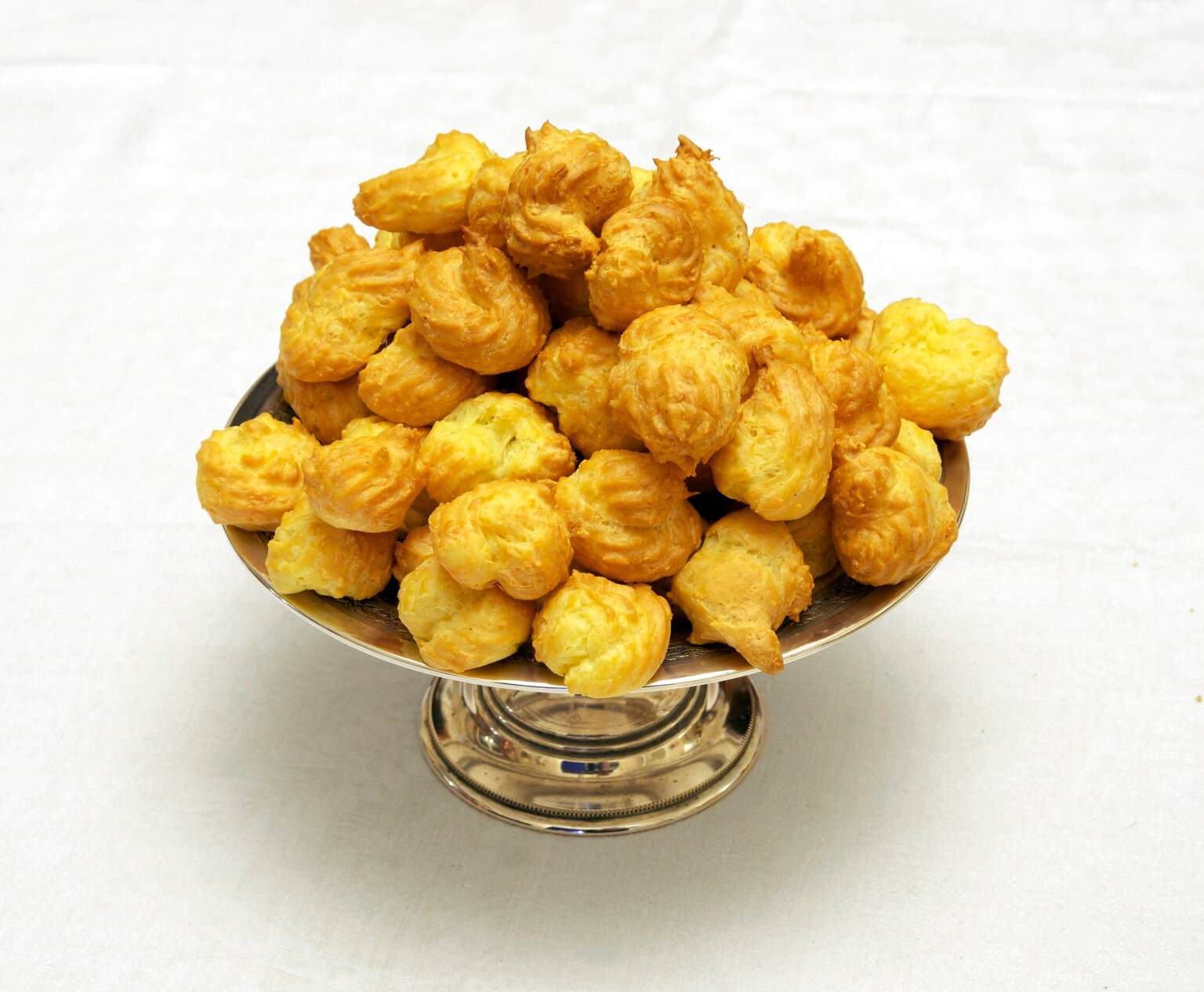
Black pepper gougères, off a props table
One bite, no plate, no sauce, no drip and almost no crumb — the only canapé that passes every constraint a working stage imposes.
Pairing
Wine — A Jura Savagnin, ouillé rather than sous voile if you can find it — it grew up next door to Comté, and the nutty edge sits on the cheese while the acid scrubs the butter off your palate. Chablis does the same job with less explaining. Mixed drink — A cold dry Martini with a lemon twist. The oil off the peel resets your mouth between puffs, and it is one of the few drinks you can hold in the same hand as a napkin while standing on a stage deck. Teetotaler — Verjus lengthened with cold soda over a lot of ice, with a wide strip of grapefruit peel twisted over the surface and dropped in. Sour and grape-y with no sugar in it, which is exactly what something this buttery needs.
Tools
A digital scale (the 5 oz of flour is the one weight that cannot be eyeballed), a heavy-based pan you can beat in over direct heat, a sturdy wooden spoon — the same one props the oven door later — two heavy flat trays, a piping bag with a ½ inch plain nozzle, and an oven you actually trust at 400°F convection, since the ten-minute dry-out in the switched-off oven is what decides whether these survive the tray walk, plus a stand mixer with the paddle if you go past a double batch
Ingredients · swaps in parentheses
Water, whole milk, unsalted butter, fine sea salt, strong white flour (a good gluten-free bread flour blend genuinely transfers here, but hold back about ¾ oz of egg and accept a slightly lower rise), large eggs, a mature hard cheese — Comté, Gruyère or a strong Cheddar — coarsely cracked black pepper, and mustard powder (smoked paprika and a little cayenne instead for a different bite, for a no-cheese version, finely chopped black olive and capers with the pepper doubled, which is darker and actually holds longer)
Magic
Comté and Gruyère both arrive with a rind most people bin. Drop a ¾ oz piece of natural rind — not a waxed or plastic-coated one — into the water, milk and butter as it comes to the boil, and fish it out before the flour goes in. Ninety seconds is enough to pull the broth-like, almost bacony edge of the rind into the liquid, and that ends up in every single puff rather than only the ones that caught a good scatter of cheese on top. It reads as more cheese without adding fat, which matters at puff number five. Short of a rind? A teaspoon of dried porcini ground to dust and beaten in with the pepper gets you a fair way there.
Before you begin
Both of the things that ruin these happen after the puffs look finished. Egg beaten into paste that is still hot scrambles, so give it a full five minutes off the heat, and stop adding the moment a spoonful holds a V for two seconds — the last of the four eggs is optional, and paste that has taken too much spreads flat instead of rising. Then bake to deep gold and do the ten minutes in the switched-off oven with the door propped a puff pulled early looks perfect coming out and goes damp on the tray within four minutes. Never cover them and never seal them warm in a box, because a cloth over a hot gougère steams it flat in ten.
The parts that change whether this works tonight.
- Yield
- about 60 gougères of ½ oz
- Time
- 1 hour 10 minutes
- Equipment
- A digital scale (the 5 oz of flour is the one weight that cannot be eyeballed), a heavy-based pan you can beat in over…
- Make-ahead
- Piped and frozen 1 month; baked 6 hours
- Holding
- Refreshed and out of the oven, they are at their best for 20 minutes and good for an hour
- The method
- 9 ingredients · 8 steps
From this recipe’s own recipe card. Nothing here is a guess.
Editor’s note: these are the first bite of Strike at Midnight, the rebuilt version of The Set Comes Down at Midnight, which makes them with aged Cheddar. The recipe is otherwise unchanged.
The arrival food at this evening has to satisfy a list of conditions that has nothing to do with taste and everything to do with the floor. It is eaten standing on a stage deck. There are no plates. It cannot drip, because other people are working on that surface. And it must not crumb, because a deck is swept between uses and a crumb on a taped carry route is somebody else’s problem at two in the morning. A choux puff is the only thing on the standard canapé list that passes all four.
The thing that decides whether it works is the drying. Choux fails when it is underbaked: it looks correct, comes out of the oven puffed, and then collapses into a damp shell within four minutes on a tray. The fix is to bake it until it is genuinely deep gold and then leave it in a turned-off oven with the door ajar for ten minutes, which drives the last of the steam out. A properly dried gougère holds for an hour.
Yield and timing
- Yield: about 60 gougères of ½ oz. Written for 100 guests at two each — make three and a half batches.
- Active: 40 minutes
- Total: 1 hour 10 minutes
- Make-ahead: Piped and frozen 1 month; baked 6 hours
Ingredients
- ½ cup water
- ½ cup whole milk
- 7 tablespoons unsalted butter, diced
- 1 teaspoon fine sea salt
- 5 oz strong white flour (about 1 cup — weigh it, this one matters most)
- 4 large eggs, beaten, about 7 oz
- 1¼ cups mature hard cheese — a good Comté, Gruyère or a strong Cheddar — finely grated
- 1 teaspoon coarsely cracked black pepper, plus more for the tops
- ½ teaspoon mustard powder
Method
- Heat the oven to 400°F convection. Line two heavy trays.
- Put the water, milk, butter and salt in a pan and bring to a full rolling boil, so the butter is completely melted before the liquid boils rather than after.
- Tip in all the flour at once and beat hard with a wooden spoon over a medium heat. It will come together into a lumpy mass and then, after 60 to 90 seconds of beating, into a smooth ball that leaves a thin film on the base of the pan and pulls cleanly away from the sides. That film is the cue. Keep going another 30 seconds to dry it further.
- Tip the paste into a bowl and let it cool for 5 minutes, stirring occasionally, until it is warm rather than hot. Egg added to hot paste scrambles.
- Beat in the egg a third at a time. It will look curdled and wrong after each addition and then come back. Stop when the paste falls from the spoon in a thick ribbon that holds a V shape for two seconds before dropping. You may not need all the egg; flour varies and this is the judgment in the recipe. I should say plainly that I am not a baker; that end of this kitchen is my husband’s and I have never pretended otherwise. Choux earns its place here anyway, because none of it happens out of sight. There is a pan, a spoon and this one call, and if you get this one right nothing later can quietly betray you.
- Beat in 1 cup of the cheese, the pepper and the mustard powder.
- Pipe walnut-sized mounds, about ½ oz, spaced 1½ inches apart. Flatten the peaks with a wet fingertip. Scatter the remaining cheese and a little more cracked pepper over the tops.
- Bake 22 to 25 minutes without opening the door for the first 18. They should be deep gold and feel light and hollow. Then turn the oven off, prop the door ajar with a wooden spoon, and leave them in there for 10 minutes. This is the step that decides whether they survive the tray walk.
Make-ahead
Pipe onto a lined tray and freeze solid, then bag. They keep a month and bake straight from frozen with 4 minutes added. This is by far the best way to do them for a large count.
Baked, they hold 6 hours at room temperature in an open container — not sealed, which softens them — and refresh completely in a 350°F oven for 4 minutes.
The paste itself can be made 24 hours ahead and refrigerated, but it pipes badly cold. Freezing piped is better in every way.
Holding and service
Refreshed and out of the oven, they are at their best for 20 minutes and good for an hour. On a tray in a warm room they soften slowly rather than collapsing, which is exactly the failure curve you want for arrival food.
Do not cover them on the tray. A cloth over a warm gougère steams it flat in 10 minutes.
At hour three they are a different, chewier object. If arrival runs long, bake a second tray at the hour rather than holding the first.
Scaling
Scales cleanly, and the freezer makes it trivial: pipe everything a fortnight out in batches of 60 and bake in relays on the night.
The paste does not scale in one pan past about a double batch, because beating four eggs’ worth of paste by hand is one thing and beating twelve is another. Use a stand mixer with the paddle for the egg stage above a double batch.
Oven space is the real constraint: two trays of 30 at a time, 25 minutes, so 60 an hour from a domestic oven. For 200 gougères you need three hours or two ovens, and in a theater green room you will have one oven. Plan accordingly, and by plan I mean decide now who is standing at that oven for three hours, because it will be somebody and it should not be a surprise to them.
Substitutions that keep the idea
- Gluten-free: choux works with a good gluten-free bread flour blend, though it needs about 1½ tablespoons less egg and rises slightly less. It is one of the few pastry techniques that genuinely transfers.
- Without cheese: 3 oz of finely chopped black olive and 2 tablespoons of capers in place of the cheese in the paste, with the pepper doubled. Savory, dark and it holds better than the cheese version.
- Smoked paprika and a little cayenne instead of the mustard powder, with a sheep’s cheese. A different bite, same architecture.
Where this belongs
These are the arrival food at The Set Comes Down at Midnight, served off a props table — a trestle with the outline of every item taped onto it in white so that anything missing is visible in the dark. The dish sits inside its own taped rectangle. Nobody explains it and everybody understands it. The taped rectangle is Tangled Thistle’s doing; my part was the narrow one of finding a canapé that does not drip on a floor other people are still working on.
This recipe was developed by reasoning from method rather than from a tested bench run, which is how most of what we publish begins; Salty & Clever’s standing note on how we write and check recipes applies to it. The tell is the sheen on the dough, not a minute count. If yours collapse, they came out early; go by color and by the weight in your hand.
Part of Recipes & Technique.
Recipe provenance: Salty & Clever editorial formulation, built from established culinary technique and the traditions identified in the article. No chef, restaurant, family, or firsthand cultural provenance is claimed unless it is explicitly named and sourced.
Where this goes next

