Whipping Is Controlled Damage, Which Is Why One Foam Can Be Rescued and the Other Cannot
Over-whip cream and you get butter, which is fixable. Over-whip egg whites and you get a weeping curd that nothing brings back. They were both foams a minute earlier, and they were never the same kind of foam.
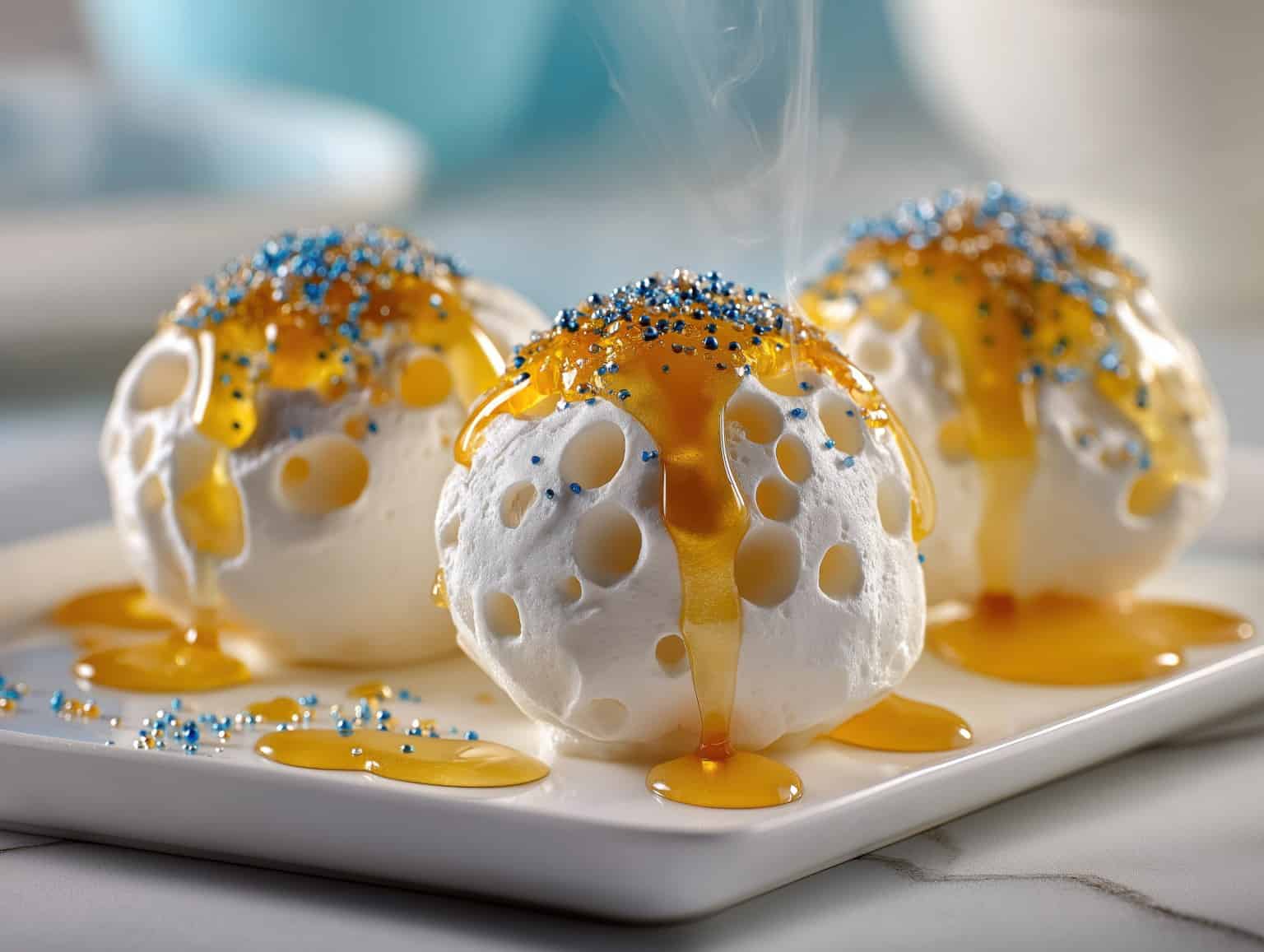
Whip cream too far and you get butter, which is annoying and completely fixable. Whip egg whites too far and you get a grainy, weeping mass that no amount of further beating will bring back. Both were foams a minute earlier. The reason one is recoverable and the other is not has nothing to do with technique and everything to do with the fact that they were never the same kind of foam.
A foam is air held in a liquid by something that surrounds the bubbles and refuses to let them merge. In a meringue that something is protein. In whipped cream it is fat. The two behave under stress in opposite ways, and once you know which material is doing the holding, every rule about bowls and acid and sugar and temperature stops being a list to memorize.
Egg white is a protein film, built by damage
An egg white is mostly water with proteins folded up in it, each one curled into a shape that keeps its water-hating parts tucked inside. When you whisk, you drag air into the liquid and create an enormous amount of surface between air and water.
The proteins cannot stay folded at that boundary. Their water-hating regions want to face the air, so they unravel — denature — and once unraveled they bond to their neighbors. That linked sheet of unfolded protein is the wall of the bubble. The whisking is not mixing air in so much as it is tearing proteins open against the air.
Which explains the failure. Keep whisking past the point where the film is complete and the proteins keep bonding to each other, tighter and tighter, until the network squeezes out the water it was holding. That is the grainy curd with a puddle under it. The bonds are made. There is nothing to undo them with, which is why the only honest advice for an over-whipped white is to start again.
It also explains the famous prohibition. A trace of yolk, or a film of oil left in a plastic bowl, parks itself at the air-water boundary the proteins were trying to occupy. The fat gets there first and the film never forms. This is not fussiness. It is two materials competing for the same surface, and fat wins.
Acid and copper widen the window
Cream of tartar, a squeeze of lemon, or the traditional copper bowl all do the same job from different directions: they slow the over-bonding so the useful stage lasts longer.
Acid lowers the pH, which makes the unfolded proteins less eager to link to one another. Copper ions bind to one of the egg proteins and hold it back from bonding too readily. In both cases the foam takes slightly longer to reach soft peaks and is considerably harder to ruin after it gets there.
If you have wrecked meringues before, this is the single change worth making. An eighth of a teaspoon of cream of tartar per white turns a narrow window into a wide one.
Sugar is a stabilizer that works by getting in the way
Sugar binds water and raises the viscosity of the liquid between the bubbles, which slows drainage and holds the foam up. It is the difference between a foam that collapses in ten minutes and a meringue that holds its shape on a tray.
It also interferes with the protein film while that film is forming. Add sugar at the start and the whites take much longer to climb, and may never reach the same volume. Add it in a stream after soft peaks and you get the stabilization without the penalty.
Undissolved sugar is its own failure, and a visible one: those amber beads that weep out of a baked meringue are sugar that never went into solution, drawing moisture as the meringue cools. The fix is to add it slowly, keep whisking a minute past the point you think you are finished, and rub a little between your fingers to check for grit before it goes anywhere near the oven.
Whipped cream is not protein. It is a fat scaffold, and it has to be cold.
Cream is fat globules suspended in water. When you whip it, the beating damages the membranes around those globules, and the partly crystallized fat inside begins to stick to the fat in neighboring globules. The clumps gather around the air bubbles and build a network that holds them.
The whole mechanism depends on some of that fat being solid. Warm cream has fat too fluid to build a scaffold, which is why cream that will not whip is almost always cream that is not cold enough. Chill the bowl and the whisk along with it; they are in contact with the cream and they are the part of the system most likely to be warm.
It also explains the fat floor. Below roughly 30 percent fat there is not enough material to build the network, which is why half-and-half will not whip regardless of how cold it is or how long you persist.
Over-whipping is the same process continuing past the point of use. The fat network keeps consolidating until it separates from the water entirely, which is butter and buttermilk. Up to the grainy stage it is recoverable precisely because nothing was denatured: fold a little fresh unwhipped cream into the grainy mass by hand and the fat re-suspends. One splash, gently, and it comes back.
Aquafaba behaves like egg white and fails differently
The liquid from a can of chickpeas foams because it contains proteins and saponins leached out of the beans, and saponins are surfactants — they lower the surface tension at the air-water boundary and make bubbles easy to form.
In practice it whips more forgivingly than egg white. It tolerates a little fat, it is nearly impossible to over-whip into curd, and it takes sugar well. What it does not have is egg white’s behavior under heat: a baked aquafaba meringue is more fragile and more moisture-sensitive, and a hot application will find the difference faster than a cold one.
Reduce the liquid by a third before whipping and the protein concentration rises along with the stability. It is the single adjustment that moves aquafaba from workable to reliable.
Every foam is on a clock, and the clock is not the same
The service question is the practical one, and each material answers it differently.
Whipped cream holds soft peaks for perhaps twenty minutes before it starts to weep, and holds for hours if you give it something to hold with — a spoonful of mascarpone or creme fraiche, a little confectioners sugar for the cornstarch in it, or a small amount of bloomed gelatin folded in. For a dinner where dessert arrives whenever it arrives, stabilize.
A raw meringue folded into a batter begins deflating the moment it is folded, and everything after that point is a race. This is why the instruction is always to fold a third in first to slacken the base and the rest in two additions with a light hand — not for elegance, but because the batter is heavy and every stroke costs bubbles.
A cooked meringue, where the whites meet hot sugar syrup or are warmed over a water bath, is dramatically more stable than a raw one, because the heat sets part of the protein network before it ever leaves the mixer. If a foam has to sit, cook it.
The same physics is behind the drink in your hand
The head on a shaken sour is an egg white or aquafaba foam built by mechanical energy, held by protein, and killed by fat and by time. Everything above applies: shake hard without ice first to build the film, then again with ice to chill and dilute, and serve it in the next minute because nothing is stabilizing it.
Mousse is a foam folded into something heavy. A souffle is a foam that gets set by heat before it can collapse. The head on a beer is protein, and it dies when it meets a greasy glass, which is why a lipstick mark flattens a pour.
What to look at instead of the timer
Foams do not have a whipping time any more than eggs have a cooking time, and the visual cues are more reliable than any number of minutes at any speed.
For whites: soft peaks flop over entirely when you lift the whisk; stiff peaks stand up and hold a point; a beat past that the surface loses its gloss and starts to look dry and separated, and that is the warning. Glossy is fine. Matte is trouble.
For cream: the whisk starts leaving tracks, then the cream holds a soft fold, then it holds a firm one. The moment it looks faintly grainy at the edges you have gone one turn too far, and that is the moment the splash of fresh cream is for.
Both are asking the same question in different languages. How much damage have you done, and is the structure you built out of it still holding water.
Part of Kitchen Systems.
Where this goes next

