Your Oven at 350 and Your Oil at 350 Are Not Doing the Same Thing
You can hold your hand in a 350-degree oven and you cannot put a finger in 350-degree oil. Same number, completely different event, and the reason explains most of what a pan does that an oven cannot.
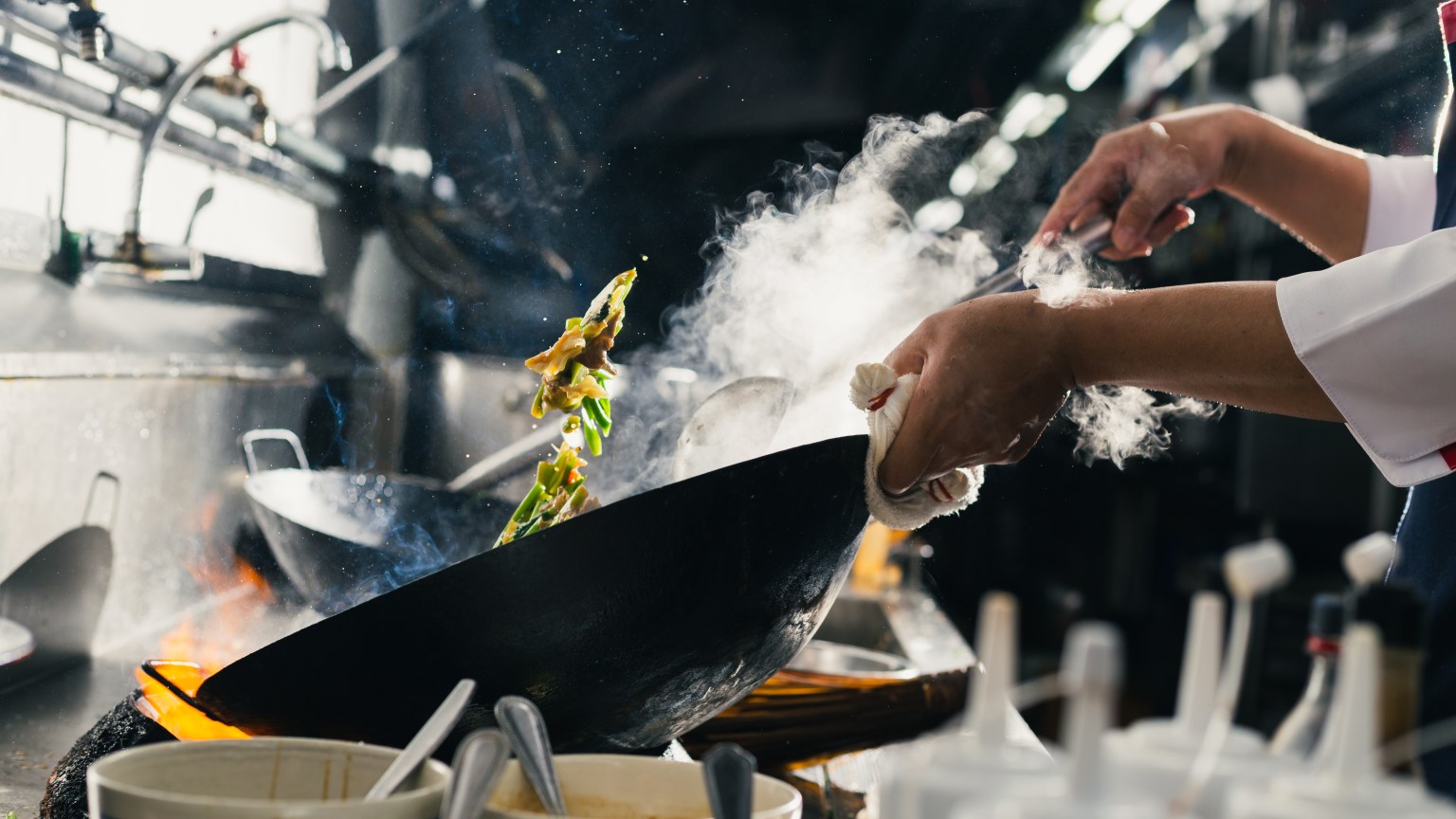
Open a 350°F oven and put your hand inside for a few seconds and nothing happens. Put a finger into 350°F oil and you will be in an emergency room. The temperature is identical. The outcome is not remotely comparable, and nearly everything confusing about heat in a kitchen follows from that gap.
Temperature tells you how hot something is. It tells you almost nothing about how fast that heat will move into your food, and speed is the thing you are actually cooking with. Once those two come apart in your head, a pan and an oven stop being interchangeable boxes that get hot and become genuinely different tools.
Heat arrives three ways and they behave nothing alike
Conduction is direct contact. A pan touching a steak, a pot touching water. It is the fastest and most aggressive route, concentrated on whatever surface is in contact and nowhere else.
Convection is a fluid moving past the food, carrying heat with it. That fluid can be air, as in an oven, or water, as in a pot, or oil in a fryer. How well it works depends enormously on which fluid.
Radiation is energy crossing open space, no contact required. A broiler, glowing coals, the hot walls of an oven. It travels in straight lines, which means it only reaches surfaces that can see it.
Every cooking method is some mixture. What changes is the proportions, and the proportions are what you are choosing between.
Air is a spectacularly bad conductor, and that is the whole answer
The reason you can reach into a hot oven is that air carries very little energy and gives it up slowly. Water moves heat roughly twenty-five times more readily than air at the same temperature. Oil is somewhere in between and closer to water.
That single fact reorganizes a lot of kitchen intuition.
Boiling water at 212°F cooks a potato faster than a 350°F oven does, despite being 140 degrees cooler, because water delivers its heat so much more efficiently. Steam at 212 does the same. A deep fryer at 350°F cooks in minutes what an oven at 350°F takes half an hour to do.
It also explains why an oven is forgiving and a pan is not. In an oven you have a large margin between the air temperature and the food temperature, and the heat arrives slowly enough that a few minutes rarely ruins anything. In a pan, contact heat arrives fast and the margin is measured in seconds.
And it explains why a convection oven cooks faster at a lower setting. Moving air strips away the thin layer of cooler, still air that clings to the surface of food and insulates it. Same temperature, better delivery, which is why the standard adjustment is to drop the dial by about 25 degrees.
Thermal mass is why cast iron forgives what thin steel does not
Forget the pan’s temperature for a second. What matters is its stored energy, and that quantity is what gets transferred into cold food in the first thirty seconds.
Put four cold chicken thighs into a thin nonstick pan and the pan temperature collapses, because there was not much energy in it to begin with. The food sits there releasing moisture into a pan that is no longer hot enough to drive it off, and you get the gray, steamed result the water ceiling predicts.
Put the same thighs into preheated cast iron and the pan barely notices. It is holding far more energy, it gives it up steadily, and it recovers quickly.
So crowding is not a single rule. It is a rule that scales with what your pan is made of. A heavy pan lets you get away with more food at once; a light pan demands smaller batches and a real preheat. This is also why a small quantity in a big heavy pan overshoots so easily, and why halving a recipe removes your margin for error along with the food.
Preheating is the practical consequence. A pan is ready when the metal has reached temperature all the way through, not when the burner has been on for two minutes. Thin pans get there fast and lose it fast. Cast iron takes several minutes and then stays.
Radiation is the one people forget they are using
A broiler is nearly pure radiation, which has two implications that matter.
It only reaches what it can see. Anything in shadow is not being cooked by it, which is why broiling works beautifully for a flat surface and badly for anything with geometry.
And it acts on the surface almost exclusively, with very little penetration. That makes it the right tool for finishing, browning, blistering and glazing, and the wrong tool for cooking anything through. A thick chop under a broiler will be black on top and raw in the middle, every time, and a thick chop directly over a fire fails in exactly the same way for exactly the same reason.
Radiation is also why dark pans bake differently from shiny ones. Dark surfaces absorb radiant energy better, so a dark metal tin browns crusts and bottoms more aggressively. Glass and ceramic are slower to heat and hold that heat longer, which is why a glass dish keeps bubbling long after it leaves the oven.
A lid changes which mode you are in
Putting a lid on a pan does not simply keep heat in. It converts the environment.
Trapped steam means the food is now surrounded by water vapor, and water vapor caps the surface temperature at the boiling point. Whatever browning was happening stops. In exchange you get very efficient heat transfer and a moist environment, which is exactly right for cooking something through and exactly wrong for a crust.
This is the whole architecture of a braise: sear uncovered for the surface, then cover to cook through gently. Two modes, in sequence, chosen on purpose. Leaving the lid on for the sear or off for the braise are both errors, and they are the same error in opposite directions.
It is also why reheating crisp food under cover fails and reheating a stew under cover succeeds. The lid is not a convenience, it is a setting.
Heat keeps arriving after you stop supplying it
Because heat moves through food gradually, the outside of anything sizeable is much hotter than the middle at the moment you take it off the heat. That gradient does not care that you are finished. It keeps equalizing, and the center keeps climbing.
The bigger the piece, the more stored energy, the larger the climb. This is carryover, it is the reason a rest is a cooking period rather than a pause, and it is why the number you pull at is more important than the number you were aiming for.
The same principle runs backward. Food straight from the refrigerator has a cold core that will take time to catch up, which is why a thick steak cooked from cold ends up with a wide band of overcooked meat around a cool center.
Choosing the tool by the mode you want
Stated as a decision rather than a physics lesson, it comes out short.
If you want a hard surface change and nothing else, you want conduction or radiation: a heavy preheated pan, a grill, a broiler. Fast, intense, one side at a time.
If you want something to cook through evenly without much surface change, you want air: an oven, moderate, slow, gentle, reaching all sides at once.
If you want speed and evenness together and do not need a crust, you want water or steam, which is why poaching and steaming are so reliable and so unglamorous.
And if you want both a crust and a cooked interior, you almost always want two phases rather than one compromise, because no single setting does both well. Low oven then hot pan. Or hot pan then low oven. The order is a separate argument, but the two-phase structure is not optional, and trying to get there with one aggressive heat is the most common way a good piece of meat is spoiled.
The oven and the oil were never the same temperature in the way that matters. They were the same number.
Part of Recipes & Technique.


