A Stockpot of Chili Takes Most of the Night to Cool, and the Refrigerator Does Not Help
Reheating gets written down and containers get photographed. The hours between the stove and the cold are treated as a gap where nothing happens, and they are the only part of the process with any real risk in it.
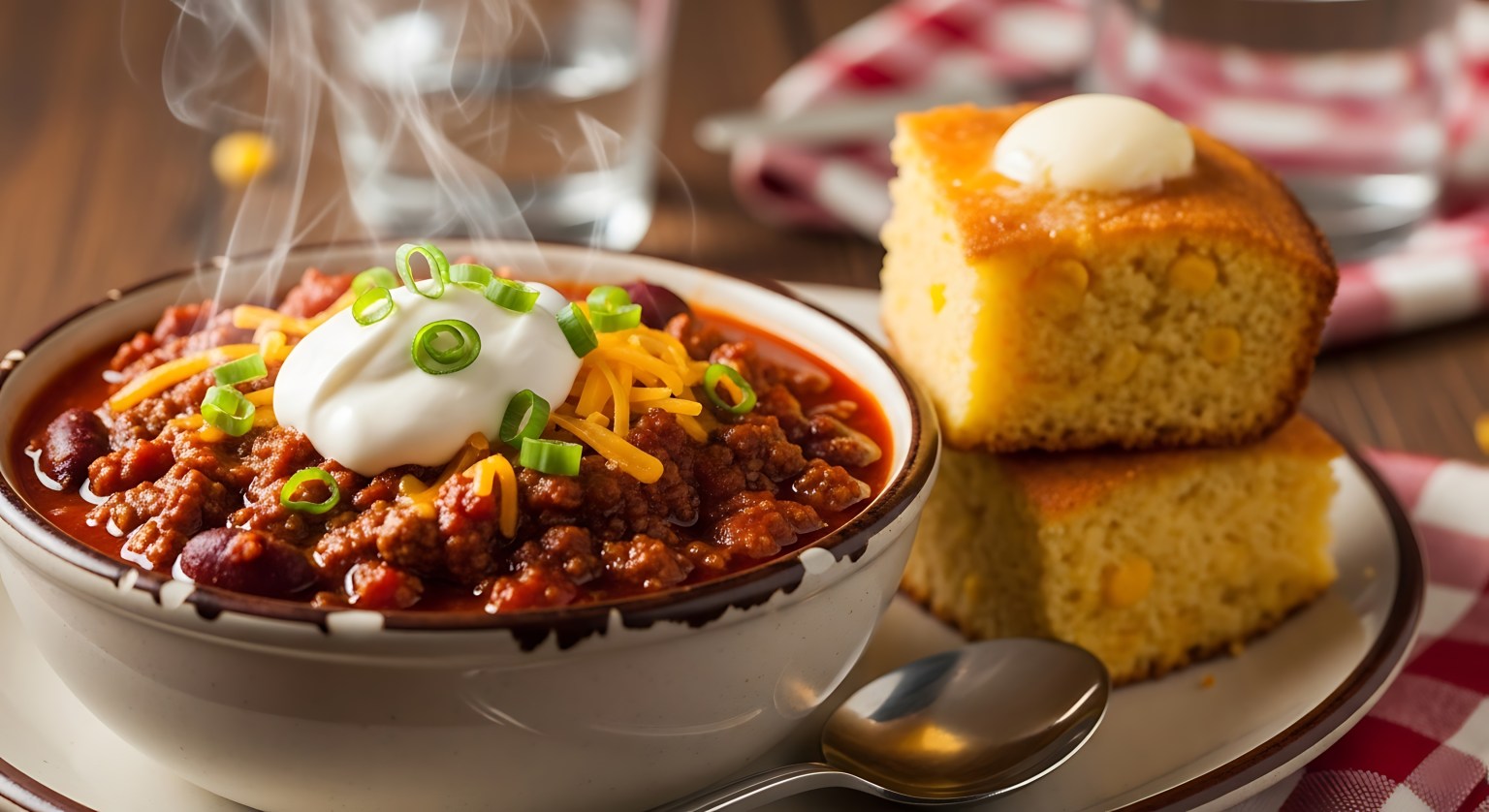
Put a full stockpot of chili in the refrigerator at eight in the evening and the middle of it can still be warm at two in the morning. Not cool. Warm. The pot has been in a cold box for six hours and the geometric center of the food has barely moved, because a refrigerator is built to hold cold things cold, not to pull heat out of a deep mass of something hot.
This is the part of leftovers nobody writes down. The reheating gets written down. The containers get photographed. The hours between the stove and the cold are treated as a gap where nothing happens, and they are the only part of the process with any real risk in it.
Heat leaves through the surface, which a stockpot barely has
Food cools the way it cooks, from the outside in, and the rate depends on how much surface the mass has relative to its volume. A quarter-inch of sauce on a plate is almost all surface. A gallon of chili five inches deep is almost all interior, insulated by the chili around it.
The center of that pot is not being cooled by the refrigerator. It is being cooled by the layer of chili next to it, which is being cooled by the layer next to that, and conduction through a thick wet mass is slow. The same geometry that makes a braise take four hours to come up to temperature makes it take most of a night to come back down.
Cut the depth in half and you do not halve the cooling time. You cut it by roughly three quarters, because conduction time scales with the square of the distance heat has to travel. That single fact is the whole of the practical advice, and it is the reason every commercial kitchen owns a stack of shallow pans.
The window that matters is roughly 40 to 140
Between about 40°F and 140°F, the bacteria that survived cooking multiply. Below that range they are stalled. Above it they die. The whole question of cooling is how many hours the food spends inside those two numbers.
Food service rules put it in two stages: down from 135°F to 70°F within two hours, and the rest of the way to 41°F within four more. Home guidance compresses it into one line — perishable food should not sit out longer than two hours, or one hour if the kitchen is above 90°F — which is a fine rule for a plate and a bad one for a pot, because the pot is still above 70°F long after it has left the counter.
The useful reframe: the clock does not stop when the lid goes on and the pot goes in the refrigerator. It stops when the food is cold.
The organisms that matter are the ones cooking does not kill
This is the piece that makes the rest make sense. Boiling a stew for two hours does not sterilize it. It kills the vegetative bacteria and leaves behind spores, which are dormant, heat-resistant, and waiting for exactly the conditions a slowly cooling pot provides.
Clostridium perfringens is the one that lives in large batches of meat, poultry, gravy and stew. Its spores routinely survive cooking, and it multiplies fast in the middle of the cooling range. It is one of the most common causes of foodborne illness in this country, and its profile is almost entirely large quantities of food cooled slowly — catering, holiday roasts, the church-supper pot. Nobody gets it from a single chicken breast.
Bacillus cereus is the rice one, and it is the reason rice has a reputation. Its spores survive boiling easily and germinate happily in a warm pot of cooked rice left on the stove. The problem it creates is worse than the others, because one of its toxins is heat-stable: it is still there after you reheat the rice to steaming.
Which sets up the thing worth knowing over everything else on this page.
Reheating is not a rescue
Reheating to 165°F kills bacteria. It does not remove toxins that bacteria already made, and several of the relevant ones — the B. cereus emetic toxin, the Staphylococcus aureus enterotoxin — are stable at temperatures well past boiling.
So a badly cooled pot cannot be fixed at the far end. Everything the cooling did is already done by the time the food goes back on the heat. The reheat is the last step in a chain, not a reset, and the decision that determined whether the food is fine was made in the hour after dinner while everyone was clearing plates.
Divide, then cool, then cover
Every practical move is some version of increasing surface area before the food starts its descent.
Split the pot before it leaves the stove. Not after. Four quart containers, filled no deeper than about two inches, cool in a fraction of the time the pot would. This is the single highest-return habit in leftover cooking and it costs nothing but a shelf.
Give an ice bath a chance to work. A pot set in a sink of ice water, stirred every few minutes, drops temperature fast — but only if you stir. Unstirred, you are cooling the outer inch and insulating the middle with it. Two parts ice to one part water beats ice alone, because water contacts the pot and air does not.
Use frozen water bottles as paddles. A sealed bottle of ice stood in a pot of stock or chili pulls heat from the center rather than the edge, which is the part that needs it. Commercial kitchens buy these as cooling wands; a clean bottle of frozen water does the same job.
Spread the things that pack tightly. Rice, grains and anything pilaf-shaped hold heat in a way soup does not, because they trap steam. Spread on a sheet pan, an inch deep, they are cold in twenty minutes. Left in the cooker, they are a textbook case.
Cut the roast. A whole braised shoulder sitting in its liquid is the worst geometry on the table. Pull it apart, or at least halve it, before it goes in.
Leave the lid off until the steaming stops, then cover. A sealed lid traps heat and does not let evaporation help. Once the food is no longer visibly steaming, cover it, because now you want it to stop drying out.
The old advice about hot food and refrigerators has the reason backwards
The instruction you grew up with — never put hot food in the refrigerator — was framed as a mercy to the appliance. Modern refrigerators are not endangered by a warm container.
The real reason to hesitate is the other food. A hot pot raises the internal temperature of the whole compartment, and everything on the shelves around it spends an hour in exactly the window you were trying to get your chili out of. You have not solved one problem; you have spread it across the milk.
The instruction that actually works is not wait and it is not straight in. It is divide first, cool the divided containers fast on the counter or in an ice bath, and put them in already most of the way down.
Most leftovers do not need any of this
A plate of dinner scraped into a small container is two inches of food with a lot of surface. It is cold in fifteen minutes and none of the above applies. Half a roast chicken, a bowl of greens, the last of a gratin — all fine.
The rule is about mass and depth, not about leftovers in general. If you can put a hand on the outside of the container and feel warmth at the center within a minute, the geometry is on your side. If you are carrying it with two hands, it is not.
This belongs in the plan, not after it
If you are cooking Sunday for the week, cooling is a step in the recipe with a time cost attached, and it is the step people discover at ten at night while looking for lids. Set the containers out before you serve. Decide then how the pot is getting divided. It takes ninety seconds at a point when you are not tired and no seconds at all at the point when you are.
The freezer has its own version of this problem and a different answer — there, speed protects texture rather than safety, and the same shallow containers happen to do both jobs.
None of this is a reason to be nervous about leftovers. It is the opposite. A pot that was divided and cold within two hours can be reheated with confidence three days later, and a pot that sat deep and warm until midnight is a coin toss no amount of careful reheating can call. The difference between those two outcomes is a stack of shallow containers and the decision to use them while the food is still on the stove.
Part of Kitchen Systems.


