Cooking for One or Two Is an Equipment Problem, and It Is the Kind You Solve Once
The recipe halves fine. The twelve-inch skillet does not. Almost everything that goes wrong when you scale a dinner down is a piece of equipment that is the wrong size for the food in it.
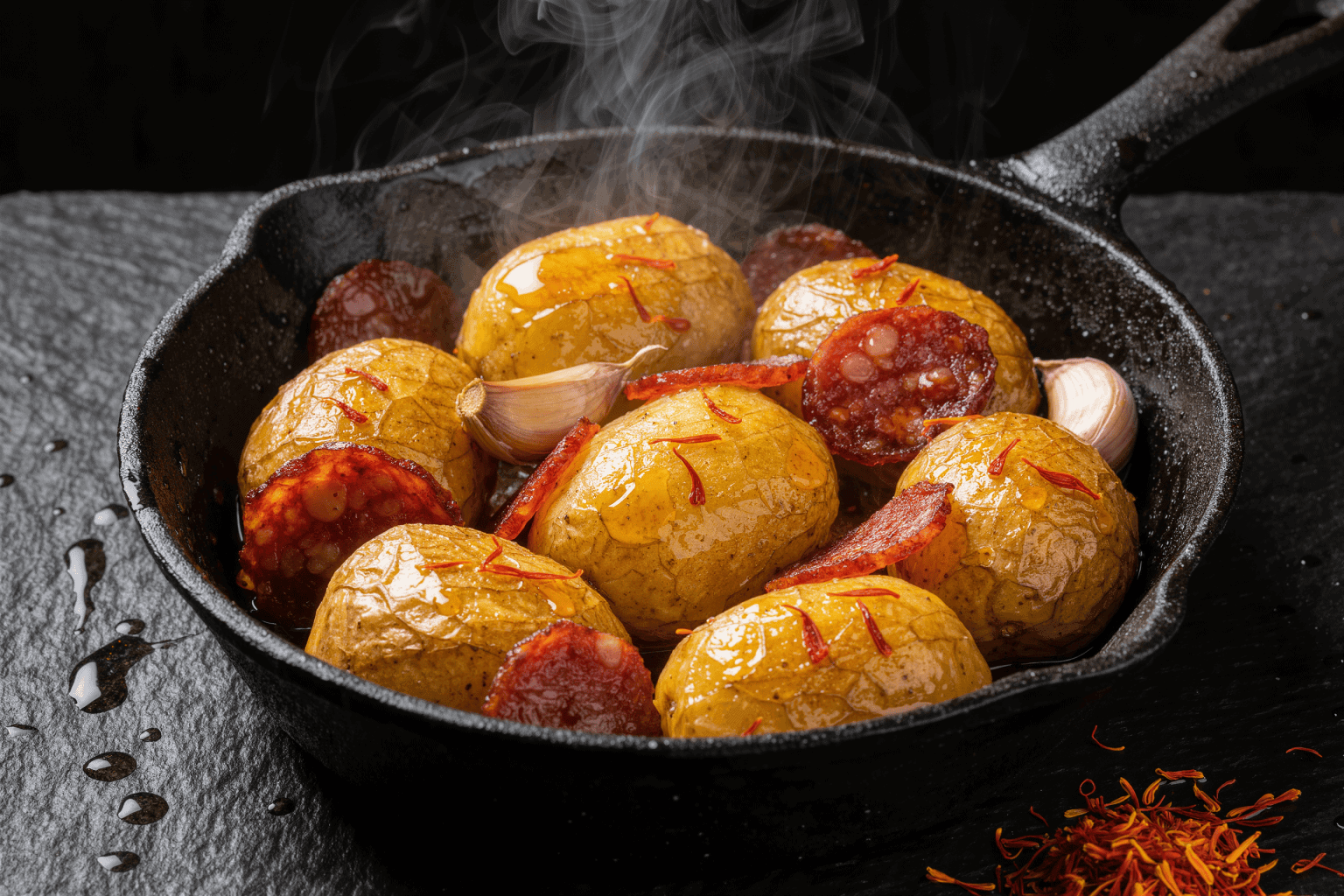
The recipe halves fine. The twelve-inch skillet does not.
Two chicken thighs in a pan built for six is a pan that is mostly empty, and the empty part behaves completely differently from the part with food on it. The fat there smokes, the fond there burns, and the sauce you were going to build is bitter before you have poured anything into it. Meanwhile everyone concludes that cooking for one is intrinsically unsatisfying, when what actually happened is a piece of equipment was the wrong size.
This is the good news buried in the fact that halving a recipe does not work. Most of what goes wrong is geometric, geometry is a property of the pan, and pans can be bought.
Food is a heat sink and bare metal is not
A pan over a burner is receiving heat continuously. The food sitting on it absorbs a large share of that heat and holds the metal underneath near a working temperature. Bare metal absorbs the same energy with nothing to give it to, so it climbs.
That is why an under-filled pan misbehaves. The exposed ring runs hotter than the part under the food, the oil there passes its smoke point, and any browned residue that lands there goes from brown to black while the meat in the middle is still cooking correctly.
The opposite failure is the famous one. Too much food in too small a pan cannot get rid of its own water fast enough, the pan temperature crashes, and everything steams instead of browning.
So there is a band, not a maximum. Food wants to cover somewhere between two thirds and three quarters of the pan floor in a single layer. Both edges of that band are real, and the person cooking for one lives on the wrong side of the one nobody warns them about.
A wide pan reduces fast, which is why halved braises dry out
Evaporation happens at the surface of the liquid, so the rate depends on how wide the liquid is, not how much of it there is.
Halve a braise and cook it in the same Dutch oven and you have halved the volume without changing the surface at all. The liquid is now shallow and wide, it reduces roughly twice as fast relative to its volume, and the meat that was supposed to be half-submerged for three hours is sitting in a dry pot at ninety minutes.
A smaller, taller pot fixes this without a single change to the recipe. Same liquid-to-meat ratio, same depth, same reduction rate, same dish. This is the single largest return on any piece of small-batch equipment, and a three-quart braiser or small Dutch oven is the thing to buy first.
The same logic runs in reverse when you want reduction. A sauce for one reduced in a small saucepan takes forever; poured into an eight-inch skillet it is done in three minutes.
Appliances have minimum volumes and nobody prints them
A countertop blender works by circulating the contents through the blade. Below a certain volume the vortex never forms, the ingredients ride up the sides, and the blades spin in air. A soup for one simply will not blend in a large jar, and no amount of scraping down fixes it.
An immersion blender has no minimum, which makes it the correct blender for a small household and a better one than the expensive machine sitting beside it.
A stand mixer whisk cannot reach one egg white in a five-quart bowl. A food processor cannot process anything that does not reach the blade. A hand mixer and a bowl the right size for the job will out-perform both every time you are working with one or two of something, which is a slightly humiliating thing to discover after buying the large machine.
The oven is the least efficient thing you own for two portions
A full-size oven has substantial thermal mass and it takes fifteen or twenty minutes to charge it. For a half sheet pan of food that is a fair trade. For two pieces of fish it is a poor one.
A countertop oven preheats in a few minutes because there is far less metal and air to bring up. The trade is the other side of the same fact: it holds less heat, so it recovers slowly when the door opens and it cannot deliver a sustained blast. It is excellent for roasting a quarter sheet of vegetables and poor at anything that wants a hot, stable, high-mass environment.
The tray matters as much as the oven. Two portions on a half sheet pan is the under-filled skillet problem again in a different shape: the exposed pan runs hot, the food sits isolated in the middle of it, and there is nothing to create the humid pocket that keeps the surfaces from drying into leather. A quarter sheet pan costs almost nothing and fixes it.
The list, with the reason attached
An eight-inch skillet. The workhorse for one, and the pan that makes two eggs, one piece of fish or a single chop behave. Stainless or carbon steel if you want a sauce out of it, since nonstick leaves you no fond.
A ten-inch skillet. The same thing for two.
A three-quart Dutch oven or braiser. The reduction fix above, and the single most useful purchase on this list.
A one-quart and a two-quart saucepan. Grains, one portion of sauce, a single egg.
A quarter sheet pan, and a second one. Roasting, par-baking, and a place to spread things out to cool fast.
An immersion blender. For the minimum-volume reason, and because it cleans in ten seconds.
A small whisk. A balloon whisk in a small bowl is doing almost nothing.
A scale. Volume measurement is least accurate at small quantities, and a quarter teaspoon of salt is a much bigger fraction of a dinner for one than a teaspoon is of a dinner for four.
Single-portion storage. Not because it is tidier, but because the real tax on cooking for one is spoilage, and a container that holds exactly one meal is the mechanism that turns a batch into four dinners instead of one dinner and a slow decision.
What not to buy
The stockpot. The second large sheet pan. The twelve-cup food processor. The rice cooker sized for a family. The enormous Dutch oven that everybody photographs.
The principle is that a small household needs smaller versions of what it already owns rather than more kinds of thing. The failure mode of a small kitchen is not a missing capability. It is the same three capabilities available only at the wrong scale.
What this actually costs
A small skillet, a small pot, two quarter sheet pans, an immersion blender and a scale is a modest and mostly unglamorous amount of money, and it changes every dinner for the rest of the time you cook this way. A specialized gadget costs about the same and changes one dish.
It is also the rare kitchen problem with a clean answer. Most of what makes cooking hard is judgment, and judgment takes years. This particular difficulty — the reason the food for one person never looks like the picture — is a shelf of the wrong-sized objects, and it can be fixed on a Saturday.
Part of Recipes & Technique.


