The Dinner That Washes Up by Hand
The working menu for a long table served on repaired ceramics: eleven recipes, a prep clock counted backwards from an eight o'clock main, quantities at three guest counts, and an honest account of which two dishes are the real work.
A note before you shop: this menu belongs to an earlier draft of the World. Gold in the Cracks has since been rebuilt, and its menu with it, so the dishes below are not the ones the current evening serves. Cook from the current World if that is the night you are planning.
This is the executable version of a menu Tangled Thistle designed for The Gold Is in the Cracks, Occasion Study No. 26 — a dinner served on ceramics that genuinely broke in ordinary use and were repaired, in a credited homage to kintsugi. The creative direction is Nothing Here Soaks Overnight. This is the shopping, the clock and the arithmetic.
One thing shapes everything below and it is worth stating before the first ingredient. Every vessel on this table is hand-washed at the end of the night by a named person, in about ninety minutes, with no dishwasher and no soaking. I want that person named on the plan rather than discovered at midnight; ninety minutes at a sink is a real cost and it belongs in the menu, not in the goodwill of whoever is still standing. So nothing on this menu bakes onto a surface. There is no gratin, no melted cheese, no caramel, no glaze reduced to a lacquer. Every dish here comes off a repaired bowl with warm water and a cloth in under twenty seconds. That constraint wrote the menu, and it happens to have written a good one.
The sequence
- On arrival, standing, plain crockery only — broken buckwheat crackers and a butter made twice, with persimmon milk punch and roasted barley and quince, poured cold from bottles, no ice.
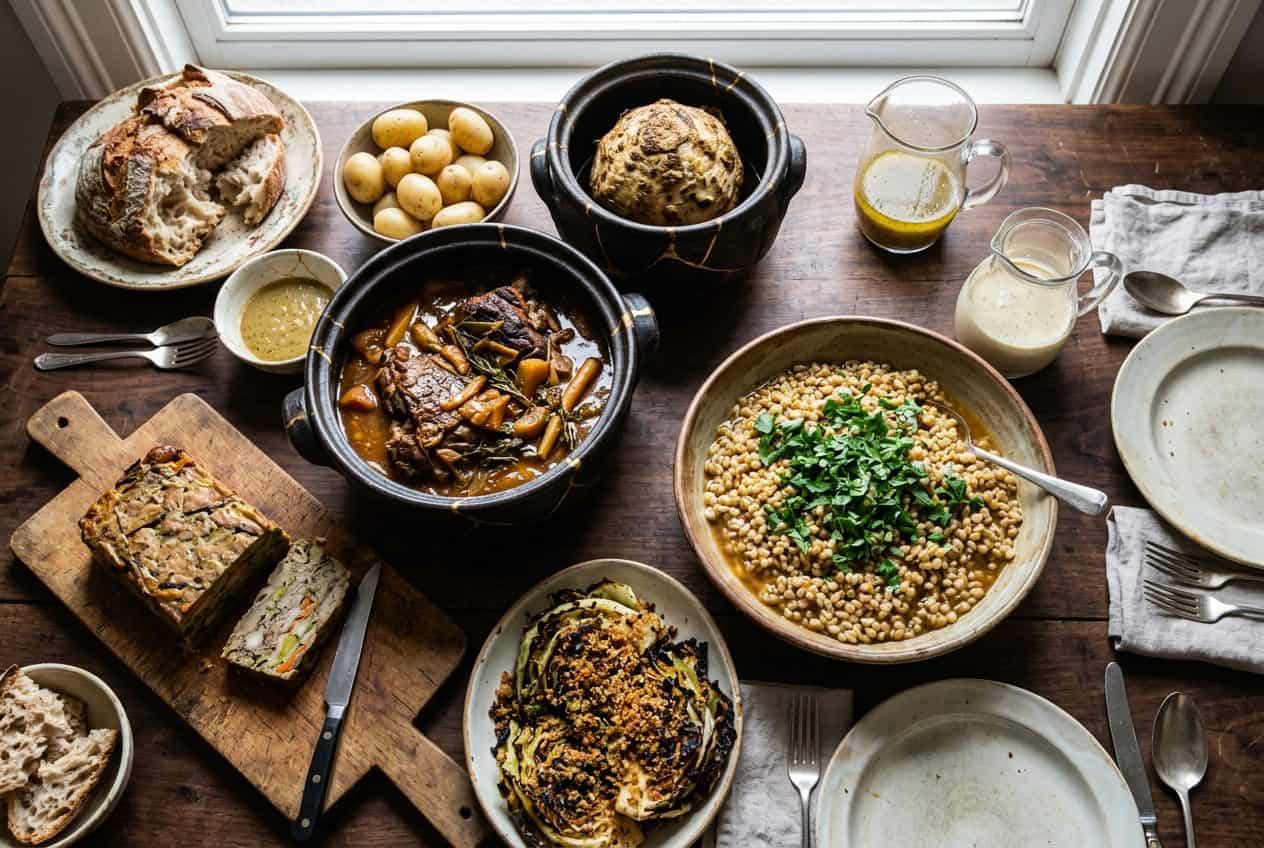
- Seated, bread — the barley loaf, whole and warm, torn by hand.
- First — pressed vegetable terrine set in its own stock, with a mustard and cider vinegar dressing in a plain glass pitcher.
- Main, family service, everything at once — lamb shoulder in cider with a bread-thickened sauce and, at the same minute in the same kind of pot, whole celeriac baked six hours.
- Alongside — barley and roasted onion cooked in the skins, warm cabbage with a brown-butter crumb, and new potatoes boiled and salted, which need no recipe and are on the table for a reason.
- Dessert — quince baked in honey until it turns red, with thick unsweetened cream in a pitcher.
- Late, standing, on a board — the last of the shoulder in the ends of the loaf, with cornichons in their jar. Then warm hojicha and one bottle of something brown left on the table.
The two dishes that are the workload
Not the ones you would guess. The lamb takes five hours and needs you for forty minutes of them. The quince takes six and needs you for twenty. The punch takes three days and needs you for an hour spread across them.
The terrine is the first real job. Five vegetables, roasted on five separate trays because they finish at wildly different times, then cooled, then packed, then set, then pressed for twelve hours under weights in a fridge you probably also need for other things. It is two hours of active work and a shelf you have to plan for. Plan the shelf before you plan anything else: of everything here, this is the dish I am least willing to improvise. It is also the best-looking thing on the table and the only dish that cannot be rescued on the day if you skip it.
The bread is the second. Two loaves, one oven, a pot that has to preheat for forty-five minutes between bakes, and a dough that wants a four-hour bulk. That is an afternoon. Baking is not my end of the kitchen and I am not going to pretend otherwise here; this loaf is on the list because it is forgiving. It is also unavoidable at the point where you want more than four loaves, and at that scale the honest answer is in the substitutions below.
If you have one afternoon rather than three, do the terrine and buy the bread. If you have one afternoon and no fridge space, do the bread and serve the crackers and butter as the first course instead of the arrival, which works and shortens the evening by one act.
The prep clock, counted backwards from an 8:40 main
Five days out
Order the lamb from a butcher — whole shoulders on the bone are not always on a shelf. Buy quinces, which need to be found rather than bought, and buy them hard. Buy the persimmons now too, because they have to get properly, alarmingly ripe and that takes days.
Three days out
Steep the punch overnight. Roast the terrine vegetables and refrigerate them. Fry the brown-butter crumb and put it in a jar.
Two days out
Split, filter and bottle the punch — start early, it drains for six hours. Build and press the terrine. Make the twice-made butter. Bake the crackers as whole sheets and tin them. Make the onion-skin stock for the barley and refrigerate it.
The day before
Morning: mix, bulk and bake the loaves. Salt the lamb shoulders and leave them uncovered on a rack in the fridge. Early evening: braise the lamb and the celeriac, cool them fast, refrigerate in their liquor. Last thing at night: quinces into the oven at 275°F, sealed under paper and foil, and go to bed.
The day itself
- 08:00 — quinces out, cooling in their syrup. Roast and cold-infuse the barley for the zero-proof drink; it needs six hours.
- 11:00 — cut the quinces, reduce and strain the syrup. Half goes back to the fruit, half goes to the drink.
- 15:00 — build and bottle the zero-proof drink. Both drinks into the cold box.
- 16:00 — lamb and celeriac into the oven at 300°F, covered, to reheat for 90 minutes. Cook the barley to two-thirds and spread it on a tray.
- 17:30 — cut the cabbage. Scrub the potatoes. Whisk both pitchers of dressing. Butter out of the fridge.
- 18:20 — terrine out of the fridge to come up to 57°F. Turn it out and slice at 19:45, not before.
- 18:45 — lay the repaired pieces out on the choosing table. Check the tape marks underneath: food-safe repairs take food, decorative ones take salt, flowers and candles. Brief whoever is serving, once.
- 19:00 — doors. Break the cracker sheets by hand as people arrive. Pour, do not build.
- 19:20 — the choosing.
- 19:30 — seated. The forty words about the practice. Loaves into a 400°F oven, whole, for 8 minutes.
- 19:35 — bread out, whole, on boards.
- 20:00 — terrine and its pitcher.
- 20:10 — oven to 475°F with trays inside. Cabbage in at 20:15.
- 20:20 — potatoes on. Finish the barley with the last of the stock. Make the bread sauce: soak, blitz, vinegar, salt.
- 20:40 — everything out together. Lamb and celeriac in matching pots, at the same moment, pulled apart at the table.
- 21:45 — clear the main. Hold back 1¾ lb of the shoulder and the same of celeriac in a low oven for later. Salt the red onion for the late board now.
- 22:00 — quince wedges warmed in syrup, cream in a pitcher.
- 23:00 — hojicha, warm not hot. The brown bottle goes on the table and stays there.
- 23:15 — press and cut the late sandwiches. Board and jar to the far end.
- 23:30 — the wash starts. Hand-wash, dry immediately, repack into the crates. Ninety minutes with a named person on it.
Quantities at three counts
All recipes above are written for 24. Here is what the main components come to at the counts this concept actually runs at. Twenty-four is where the sourcing of genuinely repaired vessels starts to hit a wall, and above about thirty the honest version is mended serving ware among plain individual settings.
| Item | 12 guests | 24 guests | 60 guests |
|---|---|---|---|
| Lamb shoulder, on the bone | 1 × 5 lb | 2 × 5 lb | 5 × 5 lb |
| Celeriac, whole (per 8–10 non-meat eaters) | 1 | 2 | 4 |
| Dry cider | 3½ cups | 1½ quarts | 3½ quarts |
| Pearl barley, for the side | 10 oz | 1 lb 5 oz | 3 lb |
| Onions, total across all dishes | 9 | 18 | 44 |
| Cabbage | 2 | 4 | 9 |
| New potatoes | 2½ lb | 5¼ lb | 12 lb |
| Quinces | 4 | 8 | 18 |
| Loaves | 1 | 2 | 5 |
| Punch, finished | 1¼ quarts | 2¼ quarts | 5½ quarts |
| Zero-proof, finished | 1 quart | 2¼ quarts | 5½ quarts |
| Hands needed in the kitchen | 1 | 2 | 4 plus one on drinks |
| Hands needed at the sink from 23:30 | 1 | 1 | 2 |
On drinks: count 2.5 servings per person across the first ninety minutes and 4 across the evening, split roughly 70/30 between the punch and the zero-proof unless you know your table. Make the zero-proof at parity if you are not sure. Running out of it while the punch is still flowing is the one supply failure that says something you do not want said.
What holds and what collapses
| Dish | How long it survives on the table | What goes first |
|---|---|---|
| Crackers and butter | 90 minutes | The butter weeps at hour two in a warm room. Take it away when the bread lands. |
| Both drinks | All evening in a cool box; 20 minutes in a glass | Warmth. Never leave bottles standing on a bar. |
| The loaf | All evening, and it is meant to dry | Nothing. The dry ends are wanted at 23:15. |
| Terrine | 2 hours (agar holds shape to about 140°F) | Cut faces darken at hour two. Clear it at three. |
| Lamb and celeriac | 1 hour covered, easily | Exposed surfaces dry at hour two. Spoon liquor over. |
| Barley | 40 minutes good, 1 hour acceptable | It sets into a block. Send half, hold half warm. |
| Cabbage | 2 hours, and it is fine cold | The crumb softens within 20 minutes. Scatter it late. |
| Potatoes | 45 minutes | They go waxy and cold. Nobody minds. |
| Quince | All evening, warm or cold | The cream, in a warm room. Small pitcher, refilled. |
| Late board | 40 minutes | The cut faces dry. Anything left is breakfast. |
Hot holding: keep the braises and the barley at 145°F or above in the kitchen — a margin above the usual 140°F hot-holding line, and worth confirming against your own food authority rather than us — and let them come down to serving temperature only as they go out. Serving temperature here is around 140°F, which is warm rather than scalding, because these are repaired ceramics and heat is what a mended surface likes least.
The shopping order
- Butcher, ordered five days out: lamb shoulders on the bone, whole, not boned and rolled — the bone is doing work in a five-hour braise.
- Greengrocer, five days out: quinces (hard), persimmons (to ripen at home), celeriac, cabbage, leeks, carrots, onions by the sack, mushrooms, new potatoes, lemons, parsley, thyme, bay.
- Dry goods, any time: pearl barley × 2 (drink and side), buckwheat flour, bread flour, rye, agar, honey, oolong, seeds, hazelnuts, caraway, cornichons, hojicha.
- Dairy, two days out: whole milk for the punch, cultured salted butter, unsalted butter, heavy cream or crème fraîche.
- Drink: aged rum, dry cider (cooking and drinking are different bottles), verjus, cider vinegar, light red wine, a textured white, one bottle of aged rum or calvados for the table.
- Not food, and on the list anyway: coffee filters or cheesecloth for the punch, baking paper, foil, a roll of masking tape for marking the food-safe repairs underneath, and two clean dish towels per twelve guests for the wash.
If the kitchen is a tent with two burners
The bread and the lamb fail first, and for the same reason: both want a real oven at overlapping times. Buy good bread and warm it whole in foil on a burner — you lose the two-day crumb and keep the tearing, which was the part that mattered. Braise the lamb at home the day before and reheat it slowly, covered, on one burner for ninety minutes; braises are the most transport-tolerant food there is and this one is better on day two anyway.
The terrine is the third casualty, because it needs twelve hours of cold pressing. Set it at home, transport it in the mold under its weight in a cool box, and turn it out ten minutes before service.
The cabbage is the one that cannot be faked at high volume without changing method: blanch two minutes in heavily salted water, dry thoroughly, then finish in batches at the highest heat you have. And the quince does not care about any of this. It bakes overnight in whatever oven you can find and it will be the best thing on the table regardless.
Vegetarian, vegan and gluten-free, by name
The vegetarian and vegan main is the whole baked celeriac, in the same pot, at the same minute, torn apart in the same gesture and announced by its own name. It is not a substitute and it is not carried in separately ninety seconds later. The terrine, the loaf and the crackers are already vegan or trivially so. Vegans lose the butter on the potatoes and the cream with the quince: swap to a light syrup and a thick oat or coconut cream, and say so out loud rather than leaving somebody to find out.
Gluten-free costs the bread-thickened sauce, which is the one real loss on this menu. Rebuild it with 4 oz of buckwheat groats toasted until nutty, simmered in the liquor and blitzed. The crackers already have a rice-and-cornstarch version, the terrine and quince are naturally fine, and the barley becomes buckwheat groats at 15 minutes instead of 35. Do not attempt a gluten-free version of the loaf. There are potatoes on the table.
Ask on the invitation, decide the versions in advance, brief whoever is carrying each pot, and keep the whole conversation off the table. Nobody should be asked what they can eat while eleven people listen. The responsibility sits with the kitchen and the host, and it is not discharged by a card.
The creative direction behind all of this is Nothing Here Soaks Overnight, and the evening it belongs to — the light, the vessels, the way the practice is named once and then left alone — is Occasion Study No. 26 on Tangled Thistle.
Every recipe here was developed on paper against established technique rather than cooked repeatedly in a test kitchen. Salty & Clever’s standing note on method and AI applies.
Part of Kitchen Systems.
Where this goes next

