A Dull Knife Is Usually Not Worn Out. It Is Bent.
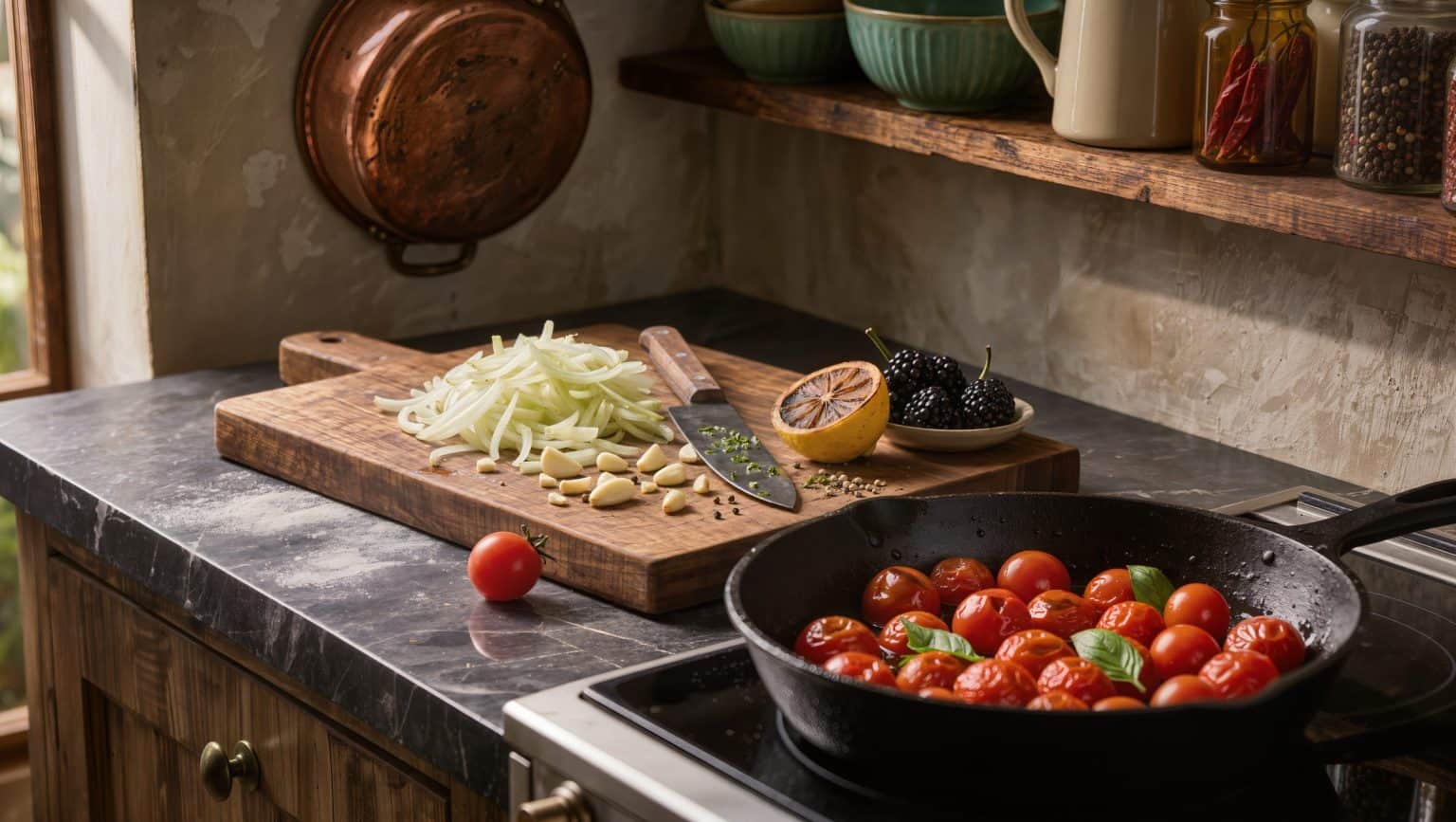
The knife slides off the tomato skin instead of going through it, and the conclusion is that it needs sharpening. Sometimes it does. Far more often the metal is all still there, arranged slightly wrong, and thirty seconds of the right motion puts it back.
The distinction between the two matters because they are different operations with different tools, done at different intervals, and doing one when you needed the other is why a lot of household knives are simultaneously over-sharpened and permanently dull.
The edge is thinner than the problem looks
The cutting edge of a knife is a microscopically thin ridge where two ground faces meet. It is extraordinarily thin and correspondingly fragile.
Under use, that apex does not usually wear away. It bends. Contact with a board, a bone, a plate, the side of a pan rolls the apex over to one side, and once it is lying down rather than standing up, the knife presents a curved surface to the food instead of a point. That is what a dull knife usually is: a sharp edge, folded.
It is also why a knife can go from cutting well to cutting badly in the middle of one job. Nothing wore out in ten minutes. Something bent.
Honing stands it back up. Sharpening makes a new one.
A honing rod — the long steel or ceramic wand that came with the block and that most households have never used — pushes the rolled apex back into alignment. A smooth steel removes essentially no metal. It is a straightening tool, not a cutting tool, and the name knife sharpener on the box is simply wrong.
Sharpening is abrasive. A whetstone, a guided system or a pull-through grinds metal away from both faces until they meet again at a fresh apex. It is a real material loss and a knife has a finite number of them in it.
The intervals follow. Hone often — before or after each substantial use, a handful of light passes per side. Sharpen rarely, two or three times a year for a knife in regular home use, and only when honing has stopped restoring it.
Somebody who hones weekly and sharpens twice a year has a knife that is sharp every day and lasts decades. Somebody who never hones and drags it through a pull-through every month has a knife that is briefly sharp, mostly dull, and visibly shorter after five years.
How to tell which one you need
Hold a sheet of paper by one corner and slice down through it. A properly sharp knife parts it cleanly with no pressure. A blunt knife snags and tears.
If the paper test fails, hone it and try again. If honing fixes it, that was all it needed. If honing changes nothing, the apex is genuinely gone and it wants a stone.
The tomato is the everyday version of the same test, because the skin is tough and the flesh underneath offers no resistance to push against. A tomato is an honest test surface and it will tell you before the paper does.
Which makes the diagnosis free, and the excuse thin. Thirty seconds with the rod either fixes it or proves it was not the problem, and both answers are worth having before you take abrasive to something you intend to keep for twenty years.
The angle is the thing a pull-through decides for you
European knives are typically ground at around twenty degrees per side; Japanese ones at fifteen or less. Shallower is sharper and more fragile; steeper is more durable and less keen.
A pull-through sharpener has one fixed angle built into it, usually a Western one. Run a Japanese knife through it and it will grind away the shallow edge the knife was designed around and replace it with a blunter one, permanently. That is the real objection to them — not that they do not work, but that they decide something about your knife that you did not.
And the decision does not reverse. Taking a fifteen-degree edge out to twenty removes metal across the whole bevel, and putting it back means removing a good deal more. One pass through the wrong slot is a permanent change to a knife you paid for once.
A whetstone lets you hold whatever angle the knife was made for. It also takes practice, which is the honest trade-off, and a two-sided stone plus fifteen minutes of attention twice a year is a reasonable amount of both.
What is actually destroying the edge is probably the board
Glass, stone, ceramic, marble and steel are all harder than knife steel. Every stroke on one of them rolls or chips the apex, and no amount of honing keeps up.
Wood and plastic are softer than the blade and let the edge sink slightly rather than deflecting it. End-grain wood is the gentlest, because the fibers part and close around the edge rather than being cut across.
A glass board is a knife-destroying machine that happens to wipe clean, and nothing you do at the stone outruns it. There is no technique here, only a swap: keep the glass for rolling pastry, and cut on wood.
The dishwasher is the other culprit: heat, harsh detergent and knives knocking against other things, all at once. And a drawer full of loose knives is a drawer where every edge meets every other piece of metal. A magnetic strip, a block or an individual sheath costs nothing and does more for sharpness than any sharpener.
A sharp knife is the safer one, and this is not a paradox
A dull knife needs force, and force is what turns a slip into an injury. It also skids off curved surfaces — onion skin, tomato, chicken skin, butternut squash — precisely because it is not biting.
A sharp knife goes where it is pointed with very little pressure, which means the hand holding it is doing less work and has more control. Almost every kitchen cut happens with a knife that was not cutting.
Sharpness changes the food, not only the effort
A blunt blade crushes as much as it cuts, rupturing cells well beyond the line of the cut. That is visible within minutes on anything delicate: basil bruised rather than cut goes dark, salad leaves wilt at the edges, and onions release more of their sulfur compounds and taste harsher.
It also makes precision impossible, and the size of a cut is a decision about cooking time rather than about neatness. Pieces that were meant to be uniform are not, so half of them are done before the rest.
Three knives, and only two of them need any of this
A chef’s knife does most of the work and deserves the honing rod and the stone. A paring knife does the small jobs and wants the same treatment less often.
A serrated bread knife is a different animal: the points do the cutting, they stay clear of the board, and they stay sharp for years. It cannot be honed on a rod and it is fiddly to sharpen at home, which is fine, because it rarely needs it.
Everything else in the block is optional. The tools worth owning are few and the difference between them is behavior rather than price, and a mid-priced knife that is honed weekly outperforms an expensive one that lives in a drawer.
The thirty seconds
Take the rod, hold it point down on a board, and draw the knife down and across it at the angle the edge already has, alternating sides, six or eight light passes each. No force; the weight of the blade is enough.
Then wipe it, because honing leaves a little metal dust, and cut the tomato.
That is the entire maintenance routine for the most-used tool in the kitchen, and the reason most knives are dull is not neglect of sharpening. It is that nobody was ever told what the steel in the block was for.
Part of Kitchen Systems.
Where this goes next

