Chile Heat Is Not a Taste, Which Is Why You Cannot Season It Out or Drink It Away
There is no receptor for capsaicin anywhere in the taste system. It binds to the sensor that reports burns, which is why the dish is not too spicy in the way a dish is too salty, and why water makes it worse.
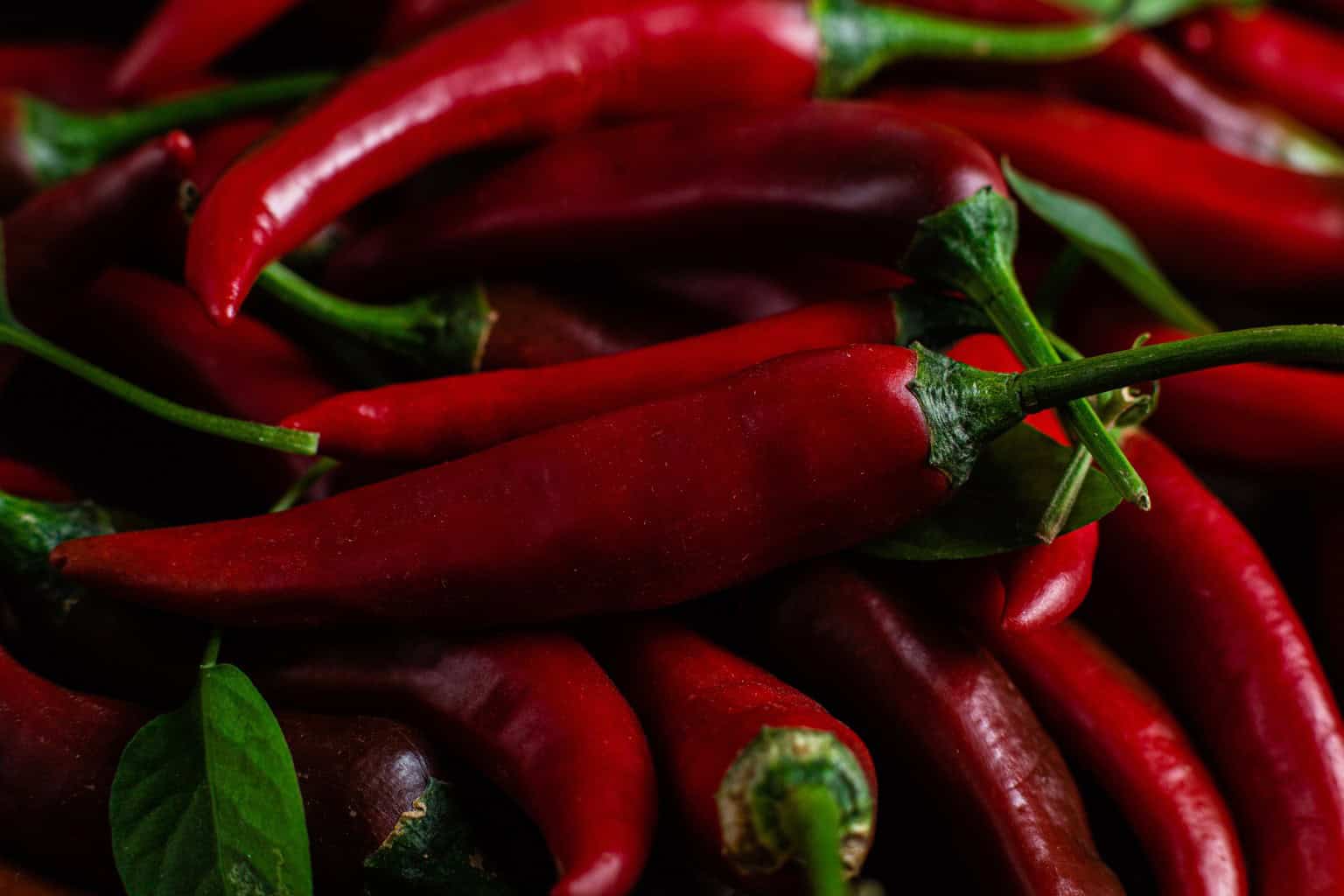
You are not tasting the chile. There is no bitter receptor, no sour receptor, no receptor of any kind in the taste system that responds to capsaicin.
What it binds to instead is a sensor in the nerve endings that reports tissue temperatures above roughly 109°F — the one that exists to tell you that you are being burned. Capsaicin opens it chemically. The signal that reaches the brain is not a flavor with an unusual character. It is a genuine report of heat damage, arriving from food that is at room temperature.
Almost everything confusing about cooking with chiles follows from that one fact.
It does not balance, because it is not on the same scale as anything else
Salt and acid and sugar and bitterness argue with each other. They occupy the same system and adding one changes the perception of the others.
Heat does not join that conversation. Adding salt to an over-spicy dish makes it a salty over-spicy dish. Adding acid makes it a sharper over-spicy dish. Adding sugar helps a little, but only by distraction, not by cancellation.
So the usual ladder for fixing a dish does not have a rung for this. There are only two real moves: dilute the dish with more of everything else, or add something that physically removes capsaicin from the tissue it is sitting on.
Capsaicin is oil-soluble, and water spreads it around
Reaching for water is the universal instinct and it is close to the worst available option. Water does not dissolve capsaicin. It moves it around the mouth, distributing it across tissue that was not previously affected.
Fat dissolves it and carries it away. This is why full-fat dairy works and skim milk works less well, why a spoonful of yogurt or sour cream or coconut milk is an actual intervention, and why the traditional accompaniment to hot food in nearly every cuisine that cooks hot food is something fatty.
Dairy has a second mechanism on top of the fat. Casein, the main milk protein, binds capsaicin and strips it off the receptor. Milk, yogurt, lassi, raita, crema and paneer are all doing two jobs at once, which is why they outperform an equally fatty non-dairy option.
Starch helps mechanically — rice, bread, tortilla, potato absorb and physically remove. Rice next to a hot curry is not a neutral filler. It is part of the system.
Which is worth deciding before anybody sits down. The pitcher of ice water goes on the table by reflex and the yogurt stays in the refrigerator, because nobody thought of it as part of dinner. A tub of plain yogurt and a pot of rice will do more for a hot curry than anything you can say about it.
Alcohol makes it worse before it makes it better
Ethanol does dissolve capsaicin, which is the usual argument for a drink. But ethanol also acts on the same receptor, lowering the threshold at which it fires. A strong drink alongside hot food sensitizes the tissue you were trying to calm.
Which gives a clean pairing rule that is not a matter of taste. With genuinely hot food: low in alcohol, cold, and a little sweet. Lager, off-dry riesling, lambrusco, a lightly sweet cider, lassi, anything on ice.
And the things to avoid: high-proof spirits, and big tannic reds, because tannin and capsaicin amplify each other into something genuinely unpleasant. That pairing is not a matter of opinion; it is two astringent signals stacking.
Cold helps on its own, separately from what is in the glass. The receptor reports temperature, so lowering the temperature of the tissue lowers the signal. Ice cream after something hot is not a dessert decision.
So a cold lager and a shot of mezcal are not interchangeable beside the same plate, whatever the drinks tray implies. One cools the tissue and dilutes. The other lowers the threshold at which the receptor fires. Same table, opposite jobs.
You cannot cook the heat out
Capsaicin is stable at cooking temperatures. It does not break down in a long braise, it does not evaporate, and a pot that is too hot at thirty minutes will be exactly as hot at three hours, only more reduced.
Which means the extra hour you were going to give it is not a fix. It is a concentration step. Taste at thirty minutes and make the decision there, while a can of coconut milk is still an option and not a rescue.
Where the heat lives is the other half of this, and most people have it wrong. It is concentrated in the pale pithy tissue the seeds are attached to, not in the seeds themselves. The seeds are hot because they have been sitting against the hot part. Scraping out the pith is a real reduction; picking out the seeds and leaving the ribs is mostly ceremony.
Blooming chile in fat does something worth understanding too. It pulls the capsaicin out of the solid and into the oil, where it distributes through the whole dish evenly. The same solubility that carries the flavor carries the burn, which is why chile oil is uniformly hot and a dish with chopped fresh chile in it is a series of small ambushes.
Heat accumulates across a meal, which is a hosting problem
The burn does not reset between bites. It builds. A dish that seems pleasantly warm at the first bite is noticeably hotter at the twelfth, because the receptor has been firing continuously and the capsaicin has not gone anywhere.
Two consequences at a table. Seasoning for heat while tasting from a spoon underestimates what a full plate will do. And people vary enormously — regular exposure genuinely reduces the response over time, so your calibration is not theirs.
Which makes heat the one seasoning that cannot be corrected at the table by the person who wants less of it. Salt can be added by whoever wants it. Heat cannot be removed.
So build the dish at the level the least tolerant person can eat, and put the heat in a bowl on the table — chile oil, a hot sauce, sliced fresh chiles, a spoonful of the paste you held back. Everyone gets the dish they wanted and nobody negotiates.
Not all burns are the same burn
Different chiles produce noticeably different shapes of heat, and they are worth choosing between rather than substituting.
Fresh green chiles tend to hit fast and at the front of the mouth, and fade. Dried red chiles come on slower, sit further back, and last. Habaneros and their relatives arrive late and stay a long time. A dish built on one of these does not taste like the same dish built on another, whatever the arithmetic of heat units says, which is roughly the argument that a chile is a word rather than a heat setting.
And capsaicin is only one of several pungent compounds, each with its own behavior. The pungency in black pepper is a different molecule with a softer, warmer profile. The one in mustard, wasabi and horseradish is volatile — it goes up the nose rather than onto the tongue, it is water-soluble, and it disappears within a minute, which is why wasabi is intense and brief where a habanero is neither.
Ginger is a third. Sichuan pepper is not a burn at all but a numbing tingle, a completely separate nerve effect, which is why it stacks with chile instead of competing with it.
What to do with a pot that is already too hot
Add fat — cream, coconut milk, butter, yogurt off the heat. It does the most, both by dissolving and by coating.
Add bulk — more of the base, more starch, more vegetable. Dilution is the blunt instrument but it is the only one that reduces the concentration.
Add acid and a little sugar, which will not remove anything but will give the palate something else to report.
Serve it with rice and something cold and creamy on the side, and stop apologizing. Adding water to the pot, or to the person, is the one move that reliably makes it worse.
Part of Kitchen Systems.
Where this goes next

