Food Sticks for Three Reasons and Only One of Them Is the Pan
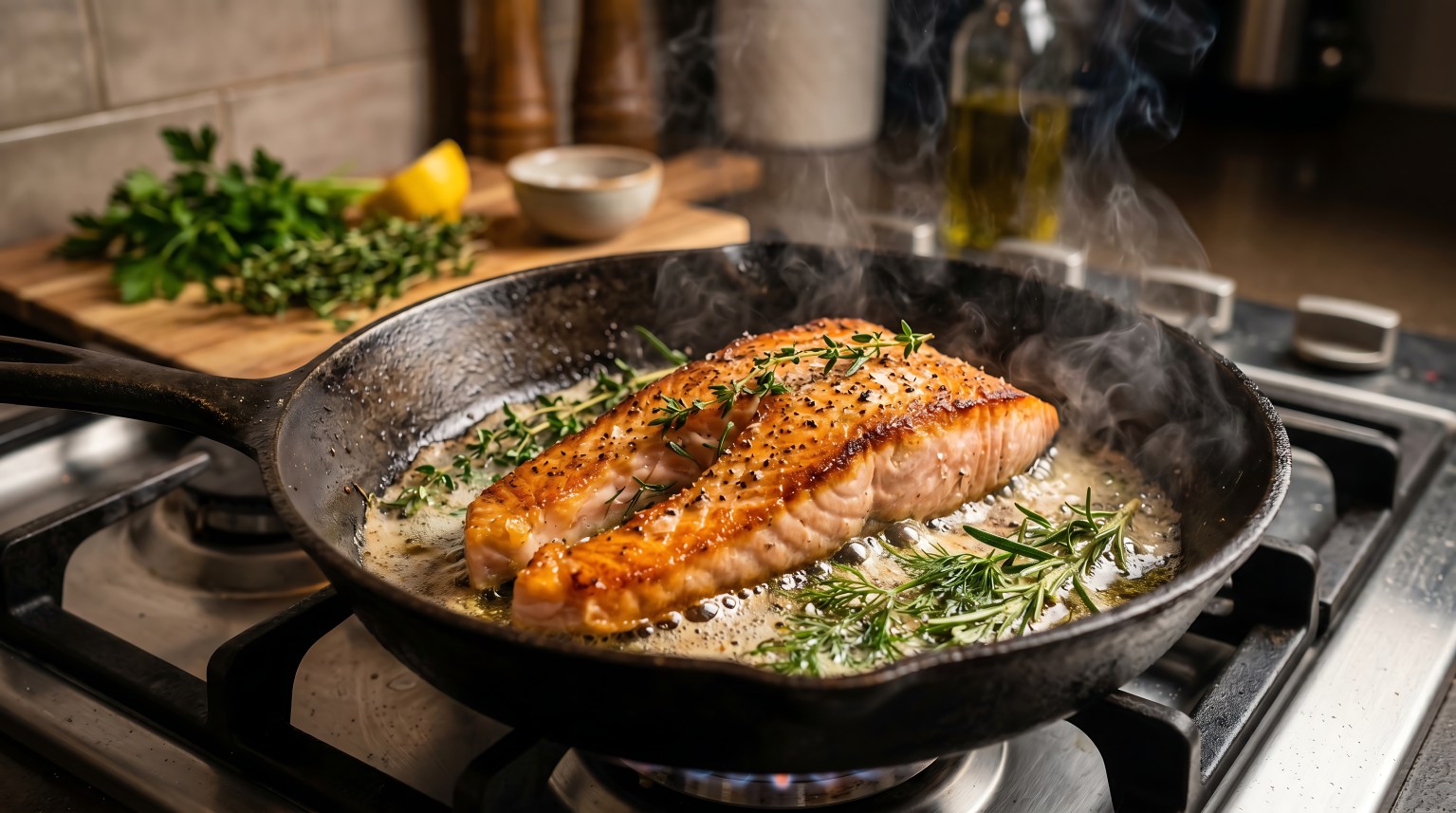
The fish goes in, and thirty seconds later half of it is welded to the metal and the other half is coming away in shreds. The usual conclusion is that the pan is bad, or that the cook needed a better one.
Sticking is a chemical bond between protein and metal, it forms under specific and predictable conditions, and it releases under equally predictable ones. Two of the three causes have nothing to do with which pan is on the stove.
What sticking actually is
Proteins in meat, fish and egg are chemically reactive, and bare metal is a surface they will bond to directly. Not glue, not dryness — an actual bond between the food and the pan.
The useful part is what happens next. As the protein continues to cook it coagulates and contracts, and those bonds break on their own. Which is why a piece of fish that is welded down at thirty seconds lifts cleanly at two minutes, with no intervention at all.
That single fact converts most sticking problems into patience problems. If it resists, it is not ready. If it is ready, it releases.
Reason one: the pan was not hot enough when the food went in
Metal expands as it heats, and a hot surface is microscopically smoother and more uniform than a cold one. Food landing on cold metal settles into that texture and bonds before any crust has formed.
There is also the water problem. A cool pan spends its time boiling moisture off the surface, so the food sits in its own steam, no crust forms, and the protein has every opportunity to bond to the metal instead.
The test for stainless is a bead of water: it should skitter across the surface as an intact ball rather than spreading and hissing. That is the point at which food can go in.
And it has to be hot again for each round. The pan drops sharply the moment the first batch lands, which is why the second batch sticks when the first did not.
Reason two: there was not enough fat, or it was not hot
Fat fills whatever texture remains in the surface and forms a physical layer between protein and metal. Too little and the food is touching the pan in places.
It also needs to be up to temperature. Oil poured into a hot pan shimmers within seconds and is ready; oil poured into a cold pan and heated with it spends several minutes degrading first and coats less well.
Hot pan, then oil, then food, in that order and with only seconds between them.
Reason three: it was moved too early
This is the most common of the three and the hardest to obey, because the instinct when something sticks is to work it free.
Put the food in, and leave it. Do not shake the pan, do not slide a spatula under it, do not check. Wait until it has had long enough to build a crust and for the proteins to contract, then try one edge. If it resists, it is not ready; wait another thirty seconds and try again.
A fillet of fish, skin down, left completely alone for three or four minutes, releases itself. The same fillet poked at forty seconds tears and then sticks worse, because the torn surface exposes fresh protein to bare metal.
Which pan you have changes how much margin you get
Bare stainless steel is the least forgiving and requires all three of the above to be right. It is also the best at building fond, which is the compensation.
Seasoned cast iron and carbon steel carry a hard polymer layer bonded to the metal that the proteins cannot reach, which is why a well-used pan releases eggs almost like a coated one.
Nonstick coatings have very low surface energy, so almost nothing bonds to them at all. That is genuinely useful for eggs, delicate fish and anything with sugar in it, and it is exactly wrong for a hard sear, because the coating cannot take the heat and there will be no fond. The four materials are four behaviors rather than four price points, and this is the behavior that separates them most visibly.
Sugar and starch stick by a completely different mechanism
Anything sweet — a glaze, a marinade with honey or soy in it, fruit — caramelizes onto the surface and then hardens. Anything starchy gelatinizes and glues itself down.
Heat and patience do not solve those, because nothing releases; it only gets darker. The answers there are parchment, a coated pan, lower heat, or adding the sweet element late rather than at the start.
Which is why a teriyaki-style dish should be seared plain and glazed in the last minute, and why a marinade with sugar in it is scraped off before the protein goes anywhere near a hot pan.
The two ingredients that need all of it
Eggs are almost pure protein with very little fat, so they bond eagerly and they overcook in seconds. They want a coated or well-seasoned pan, moderate heat and enough butter, and they are governed by a temperature rather than a duration.
Fish is the other. Its structure gives up at a far lower temperature than meat’s, so it tears easily once bonded. Dry the surface hard, salt it a few minutes ahead, get the pan properly hot, put it in skin-side down, press it flat for ten seconds, and then do not touch it.
And some of what is stuck was never the problem
Brown residue left after the food comes out is fond, not failure. It is concentrated protein and sugar, plain water lifts it, and it is the beginning of the sauce.
Black residue is different, and it is the one case where sticking is genuinely a loss. That happens when the pan was too hot for too long, or when loose crumbs and flour carbonized in the fat.
So the summary is short. Get the pan hot, give it enough fat, put the food in and leave it alone. Two of those are free and the third is the one nobody manages.
Part of Kitchen Systems.
Where this goes next

