The Honest Ceiling: When Your Kitchen Has to Say No
The guest ceiling is set by whichever capacity runs out first — heat, cold, surface, hands, holding, service, or cleanup — not by how many people fit in the room. Locating that limit before the doorbell is the part that protects the evening.
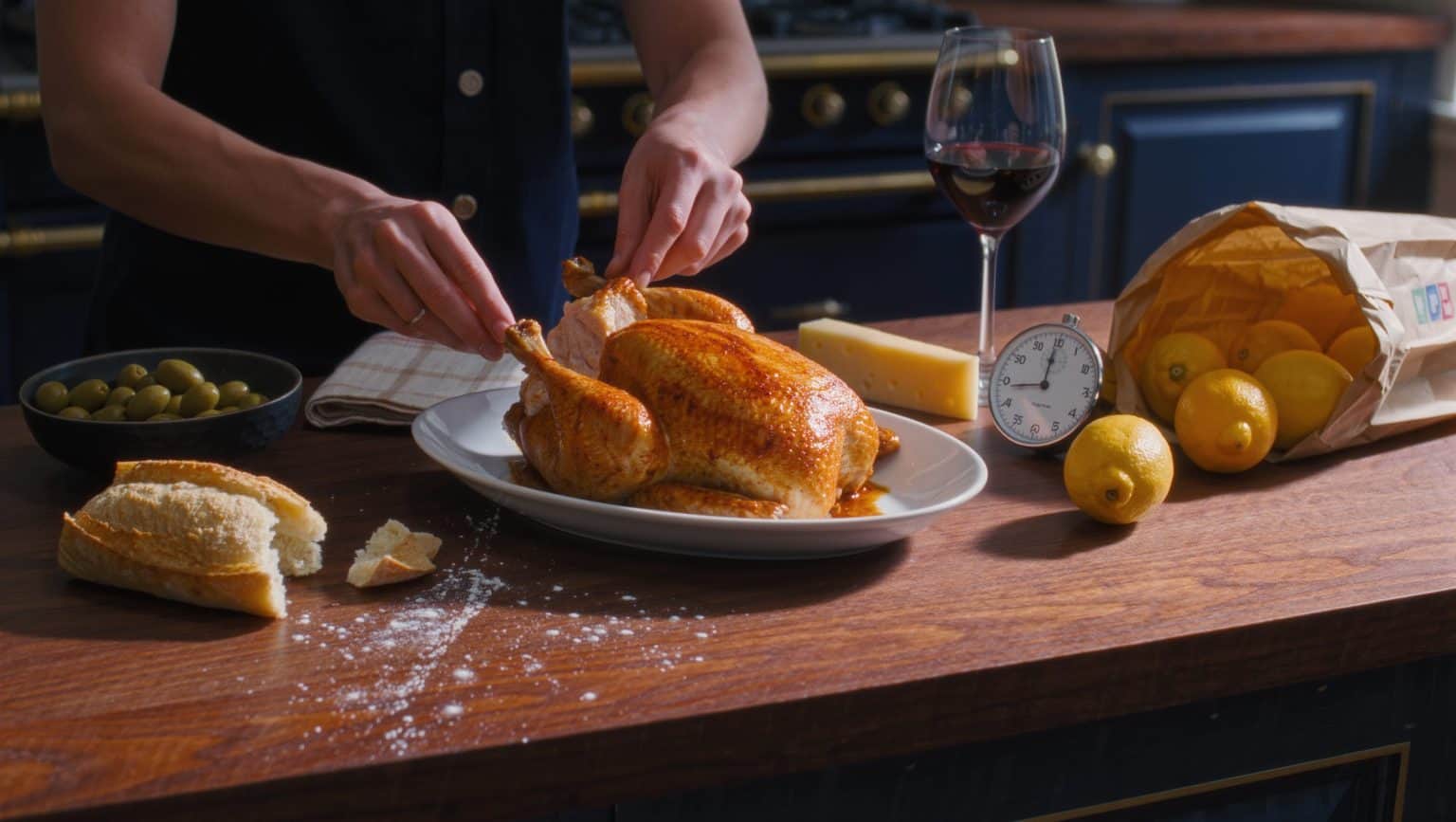
There is a point where “you can make it work” becomes bad advice.
I would like the kitchen to be allowed to say no.
Not because small kitchens are incapable. They are often extremely efficient. Not because twelve people cannot have dinner in an apartment. They absolutely can. The problem is the lazy leap from people can physically enter the room to this particular menu can be cooked, held, served, and cleaned up for them from this particular kitchen.
Those are different questions.
A useful hosting plan needs an honest ceiling: the largest guest count for which the food, equipment, room, service style, and actual human labor still agree with one another. Above that ceiling, something has to change. Maybe the menu changes. Maybe the service style changes. Maybe you borrow a table, plates, or another heat source. Maybe the number changes.
The refusal is not the failure. Finding it before the doorbell is the service.
The ceiling is not “how many people fit in my apartment?”
If twelve adults can stand in the living room, congratulations: you have established a fire-code-adjacent fact about bodies. You have not established dinner capacity.
Dinner capacity is the intersection of several smaller capacities:
| Ledger | The question that actually matters |
|---|---|
| Heat | How many oven racks, practical burners, grills, warmers, or other verified heat positions can be occupied at once? |
| Cold | What shapes can the refrigerator and freezer safely accept after normal household food is counted? |
| Surface | Where can chopping, assembly, carving, plating, and hot-pan landing happen without competing for the same square foot? |
| Hands | How many people can perform active finishing work without getting in each other’s way? |
| Holding | Which foods can wait safely and still be good, and by what tested method? |
| Service | How many plates, bowls, seats, serving vessels, and usable guest surfaces exist? |
| Cleanup | Can the sink, dishwasher, trash, and dirty-dish parking absorb the production load while the kitchen is still working? |
This is why a single “kitchen load: 78%” number is seductive and not especially helpful. You can have enormous unused refrigerator space and still be unable to finish dinner because one cook is supposed to sear fish, reduce sauce, drain potatoes, and plate twelve mains in six minutes.
The average is comfortable. The bottleneck is on fire.
Start with the thing that refuses to scale
Guest count does not multiply. It jumps.
If one tested pan of roasted vegetables serves six, then twelve requires two pans or two batches:
batch count = ceiling(guest count ÷ tested yield per batch)
At six guests, the vegetable occupies one pan and one oven slot. At seven, it may suddenly occupy two. Nothing about the seventh guest is extravagant. The equipment consequence is.
Do this for every dish whose yield is constrained by a pan, pot, fryer basket, skillet, blender, refrigerator tray, serving platter, or carving surface. Then ask what happens when the batch count rises.
Does another pan physically fit? Does it fit at the same time? Does the first batch still taste good when the second finishes? Does doubling a pot make it too heavy for the burner or too deep to reduce correctly? Do you own a serving vessel large enough, or have you quietly introduced another transfer step?
This is the arithmetic most “serves 12” labels skip. The ingredient math may scale perfectly while the kitchen does not.
The binding constraint is the answer
I do not want a planner to tell me a kitchen is “busy.” I want it to tell me why dinner stops working.
The useful output looks like this:
Eight works as written.
Ten works if the vegetables are cooked earlier and served intentionally warm rather than reheated.
Twelve works as buffet, but not as individually plated service.
Twelve seated works if you borrow four plates and four chairs and move the carving station out of the kitchen.
Fourteen does not work with this menu. The final twelve minutes require three active burners and you have two practical burner positions.
That final sentence is useful because it gives you something to repair. “High stress” gives you a mood.
There are five honest answers
A capacity system does not need forty shades of warning. It needs to make the consequence legible.
- Works. The menu fits the declared kitchen, guest count, service style, safety requirements, and labor without a meaningful collision.
- Works with sequencing. The resources are sufficient, but one or more dishes need to move earlier, later, or into a holding window.
- Works with a service change. The food can be produced, but plated, seated, family-style, buffet, or roaming service changes the workload enough to matter.
- Works if one resource changes. Borrow plates. Clear one refrigerator shelf. Add one appropriate folding work surface. Use a properly managed cooler for beverages. Add a capable helper. The fix should be named.
- Does not work. Not with this menu, this kitchen, this service promise, and this number of people.
The fifth answer needs to remain available. Otherwise the first four are theater.
The refusal should name the bottleneck
“No” without explanation is irritating. “No because the only oven rack is occupied for ninety minutes and the second hot side cannot hold through that window” is planning.
The common refusals are usually not mysterious.
Oven refusal: scaling creates more batches than the quality window can tolerate.
Burner refusal: the last few minutes require more active pans than can physically or safely operate at once.
Counter refusal: finished pans, carving, plating, and salad assembly all need the same landing zone.
Cold refusal: the menu is supposedly make-ahead, but the prepared food has nowhere to stay cold.
Attention refusal: one person has been assigned several tasks that all require judgment at once.
Service refusal: the kitchen can make the food, but the room, plates, seats, serving surfaces, or service method cannot deliver it as promised.
Holding refusal: the food can technically be cooked in waves, but there is no safe and quality-preserving way to keep the first wave while the second finishes.
Once the refusal has a name, you can decide whether it is worth fixing.
Changing the service style can raise the ceiling—and move the problem
Buffet is the most common example.
It can be an excellent solution. Removing twelve individual plates from the final service window can dramatically reduce counter use and host attention. It can also solve a seating problem when the room works better with places to perch and move.
But buffet does not make food stop having a temperature.
Hot food held for service needs an appropriate method to keep it safely hot; cold food needs to stay safely cold. FDA guidance advises keeping hot buffet food at 140°F or warmer and cold food at 40°F or colder, and recommends using smaller serving dishes and replacing them rather than endlessly adding fresh food to an existing platter. USDA likewise identifies 40°F to 140°F as the temperature “danger zone” in which bacteria can grow rapidly.
So the calculation is not:
plating problem + buffet = solved
It is:
plating problem − individual plates + holding requirement + serving surface + guest traffic
Sometimes that is a wonderful trade. Sometimes you have simply moved the traffic jam six feet to the left.
For buffet-specific quantity and service logic, use How to Build a Cocktail Buffet That Actually Counts as Dinner. For current safety guidance, see the FDA buffet guidance and USDA FSIS danger-zone guidance.
The same kitchen can have three different ceilings in one week
This is why I would not publish a rule such as “a galley kitchen can host eight.” It sounds crisp. It is also mostly nonsense.
On Friday, the menu is a braise, salad, bread, and cake. The braise is finished early, reheats well, and can be served from one large vessel. That kitchen may feed fourteen without becoming interesting.
On Saturday, the menu is seared fish, pan sauce, crisp potatoes, individually plated vegetables, and a warm dessert. The same kitchen may become unpleasant at eight.
On Sunday, lunch is cold roast beef, good bread, two salads, pickles, cheese, and cake. The oven is almost irrelevant. The dining room and refrigerator may become the binding constraints instead.
Guest ceiling belongs to the night, not permanently to the address.
Several things that look like fixes are only relocations
“Move it to the stovetop.” Fine, if the stovetop is not already full.
“Make it ahead.” Fine, if the refrigerator can hold it and the food has a real reheating or holding plan. The Small-Refrigerator Menu exists because “make ahead” can create a different kind of gridlock.
“Get a helper.” Helpful only if the kitchen has space for another body and the helper has a defined job. Two people both reaching across a narrow galley for the same knife is not labor capacity. It is choreography nobody rehearsed.
“Make it buffet.” Possibly. Then calculate holding and serving space.
“Use the dining table as prep space.” Possibly. Then decide when it stops being prep space and becomes the dining table.
“Use more serving dishes.” Fine, if there is somewhere to stage, wash, and store them. The Dishwashing Tax Nobody Budgets For handles the return trip.
A real fix reduces the binding constraint without creating a worse one somewhere else.
The small-kitchen ceiling worksheet
Before the invitations become a menu commitment, answer these ten questions:
- How many oven positions can actually hold the pans this menu needs?
- How many burners remain usable with the cookware at full size?
- How many clear landing zones exist for a board, hot pan, platter, or stack of plates?
- What prepared-food shapes fit in the refrigerator after ordinary household food remains?
- Does the sink have to stay available for any cooking or draining task during service?
- How many people can work in the kitchen without blocking one another?
- How many dinner plates, bowls, glasses, serving vessels, trivets, and utensils are actually available?
- Which foods have tested holding windows, and what method keeps them safe and good?
- What happens in the final fifteen minutes? Count active tasks, not elapsed time.
- What service promise are you making: plated, seated family-style, buffet, roaming, or something else?
Then scale the menu and look for the first ledger that fails.
That is the ceiling until something changes.
The tool should show its work
If Salty eventually calculates this automatically, I do not want the answer to be a green circle that says Kitchen Load 62%. A percentage can be useful as a summary, but it should never hide the actual conflict.
I want:
Feasibility: tight but workable.
Binding constraint: counter space from 6:52–7:08.
Oven: comfortable.
Burners: comfortable.
Cold storage: full.
Active attention: high at 7:02.
Recovery: twelve-minute buffer if the salad waits undressed.
Guest ceiling: eight seated as written; twelve if service changes to buffet and safe holding is added.
That is an answer a person can use.
It also makes the refusal defensible. The tool is not judging the host’s courage. It is describing a queue.
Refusal is hospitality too
There is a version of hosting culture that treats every constraint as a challenge to prove you care enough. Not enough chairs? Squeeze. Not enough oven? Wake up earlier. Not enough refrigerator? Stack harder. No counter? The bathtub is technically horizontal.
I am not interested in making inconvenience a character test.
A smaller guest list can be generous. A buffet can be beautiful. A room-temperature vegetable can be the best thing on the table. Borrowed plates do not reduce the dinner’s moral value. Buying dessert can be exactly the move that protects the rest of the meal.
And sometimes the correct sentence is: not this menu for twelve in this kitchen.
That is not less hospitable than optimism. It is more hospitable because the answer arrives while there is still time to change dinner.
Use The One-Oven Dinner Party when heat is the bottleneck, The Small-Refrigerator Menu when cold space is, and What Went Wrong at Dinner when the failure is concentrated in shared resources. The broader system lives in Hosting Systems, Hosting and Service, and Menus and Kitchen Systems.
Part of Hosting & Service.
Where this goes next

