What Went Wrong at Dinner: Five Menus That Collapsed at Service
Five composite dinner-party failures show how good dishes collapse when they compete for the same oven, hands, counter space, or service window.
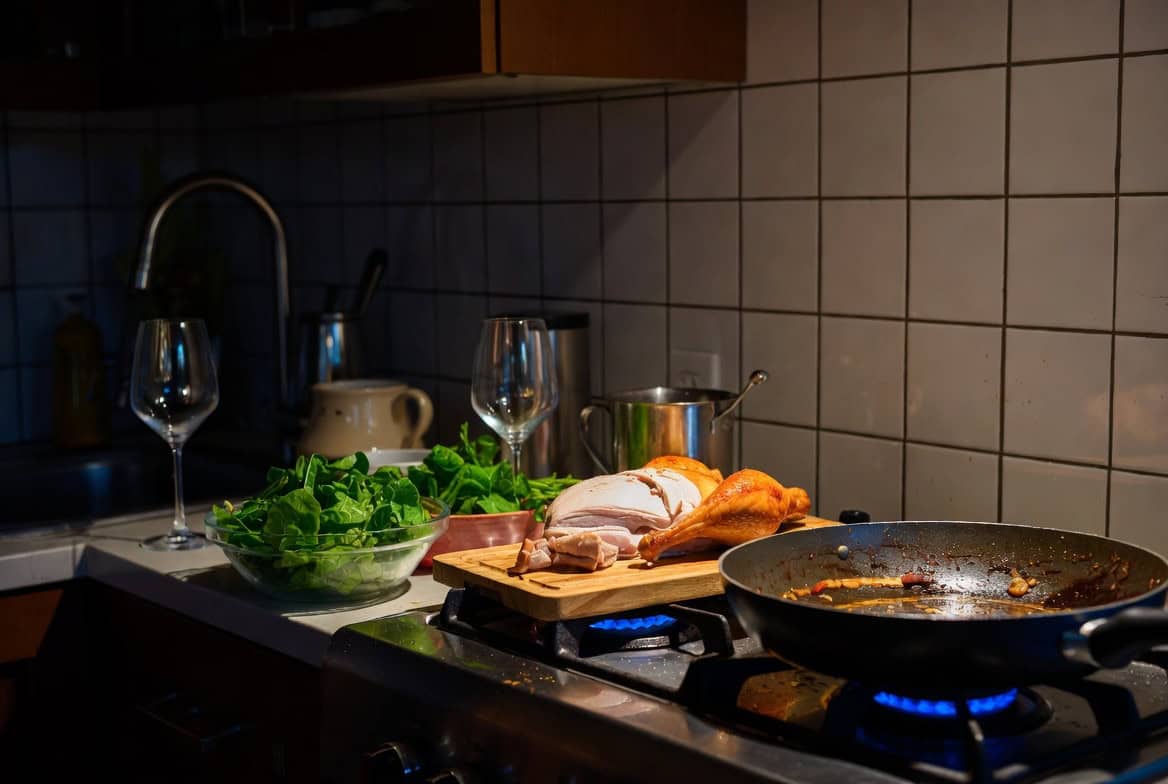
The collapse rarely starts with flavor. It starts when too many dishes need the same oven, the same hands, the same serving window, or the same square foot of counter. A dish does not earn immunity because it is excellent in isolation. If its timing collides with the rest of the night, the menu has to change.
These are composite failure patterns, not stories about incompetent hosts. Each one is a menu judged dish by dish instead of as one operating system.
Failure one: the oven hostage situation
The menu includes a baked main, roasted vegetables, gratin, warm bread, and a hot dessert. Nothing is individually unreasonable. Together they create one appliance with five owners. The repair is not imaginary equipment. Move one vegetable to room-temperature service, stop reheating bread, and choose a dessert that waits. If four things need 400°F in the same twenty minutes, three of them are lying about when they will be ready.
Failure two: the make-ahead mirage
Several dishes can be prepared early, but every one needs crisping, dressing, reheating, or final assembly at the same time. “Make ahead” is incomplete unless the recipe explains how the food holds and what work remains. A tart shell is make-ahead. Filling it, glazing it, and cutting it at 6:50 is not. Write the remaining work on the menu, or it will find you at the door.
Failure three: the plating trap
Individual plates multiply hands, surfaces, utensils, and delay. If the main is fragile, family-style sides and a self-serve first bite may be the difference between a composed meal and a kitchen traffic jam. Twelve plated salads is a restaurant. A bowl of greens with a vinaigrette that was mixed at 5 is a house that still has a host in it.
Failure four: the beverage ambush
The food is ready, but every guest wants a custom drink. One batched alcoholic option, one equally considered zero-proof option, water, and a clear refill plan usually offer more hospitality than a bar that requires the host to disappear. If you are shaking eight cocktails while the roast rests, the roast is resting. You are not.
Failure five: the invisible cleanup wall
By service, the sink is full and every usable bowl has already been used. Cleanup is part of production. Count vessel changes, protect one clean surface, and stage leftover containers before guests arrive. A kitchen that cannot receive a dirty pan cannot finish dinner.
Five collapses, read side by side
| The failure | What the menu looked like | The repair |
|---|---|---|
| The oven hostage situation | Baked main, roasted vegetables, gratin, warm bread, hot dessert | Move one vegetable to room temperature, stop reheating bread, pick a dessert that waits |
| The make-ahead mirage | Everything prepped early, everything needing crisping, dressing or assembly at 6:50 | Write the remaining work on the menu, not just the prep. It will find you at the door otherwise. |
| The plating trap | Twelve individual plates and a fragile main | Family-style sides and a self-serve first bite. Twelve plated salads is a restaurant. |
| The beverage ambush | A custom drink for everyone, while the roast rests | One batched alcoholic option, one equally considered zero-proof, water, and a refill plan |
| The invisible cleanup wall | Sink full and every usable bowl spent, by service | Count vessel changes, protect one clean surface, stage the containers before anybody arrives |
Run the service autopsy
- List every item requiring heat, chilling, assembly, carving, garnish, or last-minute attention.
- Identify the appliance, surface, person, or fifteen-minute window carrying too much work.
- Move one task earlier, change one service method, and remove one fragile flourish.
- Decide what can be omitted or served differently if timing slips.
If a dish cannot survive that autopsy, it does not belong on this night. Put it on a quieter one.
The menu fails at the shared resources
The useful way to read a dinner menu is not entrée, side, salad, dessert. Read it by shared resource: oven, burners, cold space, counter space, serving vessels, and human attention. Those are the things every recipe quietly assumes it owns.
A roast chicken and a gratin may be perfectly compatible on the plate and completely incompatible at 6:40 if both need the same oven at different temperatures. A composed salad and a pan sauce may taste beautiful together but still be a bad pairing if both require the same person during the final five minutes. Good cooks build bad menus this way. They judge flavor correctly and operations one dish at a time.
One diva is enough
I am not interested in solving this by making every dinner beige, slow-cooked, and safe. One fragile thing is often exactly what makes the meal worth having. The mistake is giving every course the same right to be fragile.
If the fish has a six-minute window, let it have the window. That means the potatoes are already holding, the vegetable is good warm or room temperature, the starter has been cleared, and dessert does not need a torch. If the soufflé is the point, dinner should not also contain à la minute risotto and a cocktail that needs to be shaken one at a time. A menu can support a star. It cannot support a cast full of actors demanding top billing at 7:02.
Repair the menu without making it smaller
Take an impossible menu: roast chicken, potato gratin, roasted carrots, dressed green salad, warm bread, pan gravy, and apple crisp. The answer is not necessarily to cut three dishes. Change the jobs. Roast the carrots earlier and serve them intentionally at room temperature with a sharp yogurt. Bake the crisp before dinner and serve it barely warm or room temperature. Skip reheating the bread. Make the gravy base before the chicken comes out so the pan only has to finish it. Dress the salad after the chicken is resting, not while it is being carved.
Same dinner. Much less collision. That is the distinction I care about: editing the operating system without sanding all the pleasure off the menu.
Give every fragile task a recovery move
Before service, write down what happens if each delicate thing misses its window. Salad is late? Hold the dressing. Sauce tightens? Loosen it with the liquid already staged beside the stove. Bread is not warm? Serve it at room temperature and stop apologizing. Garnish is not ready? It disappears. A recovery move should reduce work, not open a second project.
The best recovery moves are invisible. Guests do not need a production report. They need dinner that still makes sense.
The final test is the last twenty minutes
Look only at the last twenty minutes and ask what is hot, what is crisp, what needs hands, what needs counter, what needs a clean pan, and what will be worse if it waits. If the same answer appears four times, that is not an ambitious menu. It is a queue.
A good dinner can still be elaborate. It just has to understand that the kitchen is finite. The interesting work is not proving you can make seven excellent dishes. It is making seven excellent dishes arrive as one meal.
If the failure is concentrated in the final hour, build the night with The Two-Hour Host Timeline. If the menu looks organized only because half of it is labeled make-ahead, run those dishes through the Holding Test. Both belong to the broader Hosting and Service system.
Part of Hosting & Service.
Where this goes next

