Raw, Sweated and Mahogany Are Three Different Ingredients From the Same Onion
Cook the onions until soft, about five minutes. Caramelize the onions, about ten. One of those is a different dish and the other is a lie, and the distance between them is where most of the flavor in savory cooking comes from.
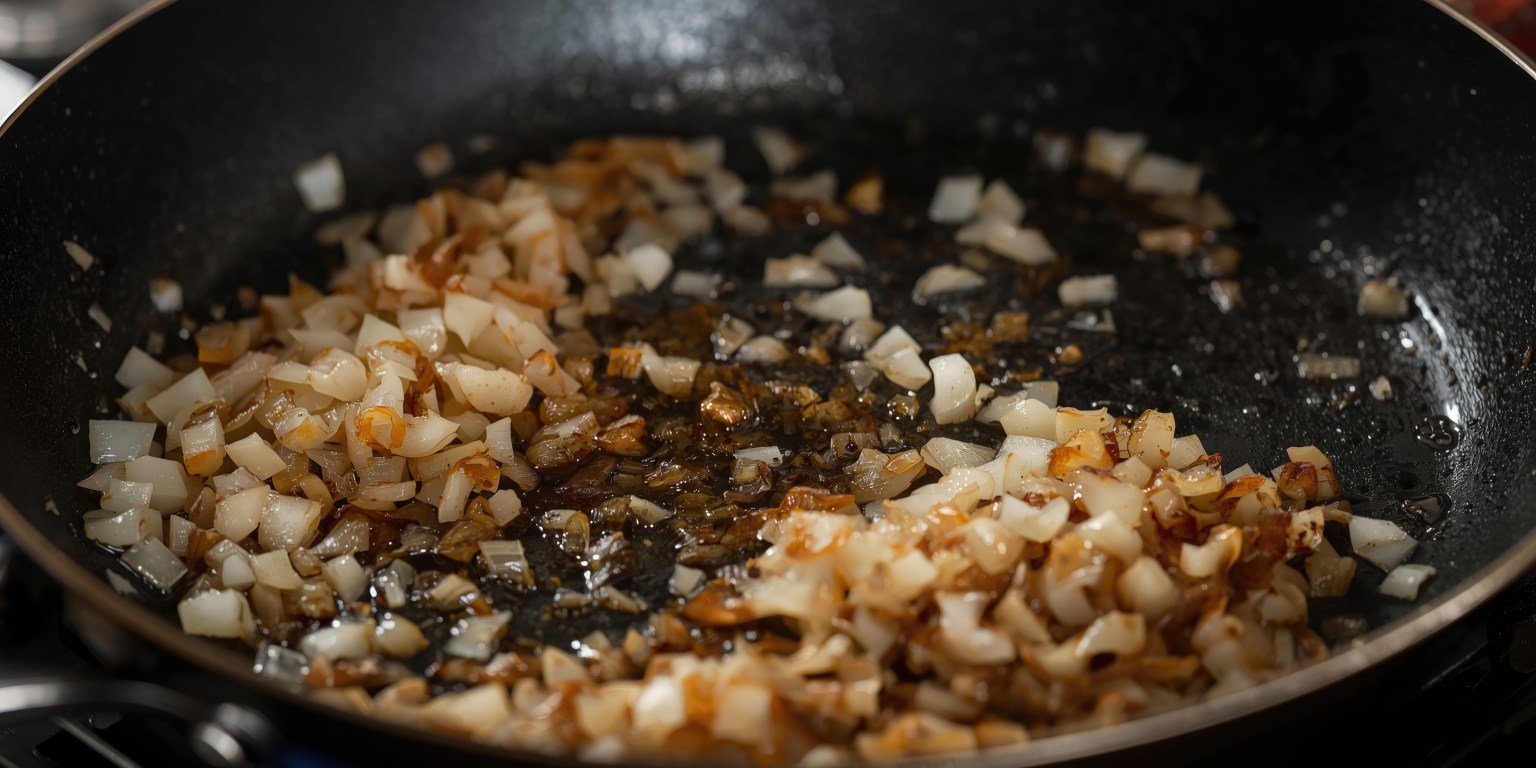
Cook the onions until softened, about five minutes. Caramelize the onions, about ten minutes. Both instructions appear constantly, often in the same magazine, and one of them is describing a different dish while the other is simply false.
An onion passes through at least four distinct states on its way from the board to the pot, and each one is a different ingredient with a different flavor, a different texture and a different job. The recipe that says onion and gives you a time is telling you which one it wants without telling you what it is.
Raw sharpness is created by the knife
An intact onion cell keeps an enzyme and a sulfur-containing precursor in separate compartments. Cutting ruptures the cells, the two meet, and a cascade of reactions produces the volatile compound that makes your eyes water and the aggressive pungency that makes raw onion raw onion.
Which means sharpness is a product of damage, exactly as it is with garlic, and everything about handling it follows.
A sharp knife bursts fewer cells than a dull one. Chilling the onion for fifteen minutes slows the enzyme measurably. And the genuinely effective fix, which almost nobody is taught, is to soak the cut onion in cold water for ten minutes: the pungent compounds are water-soluble and they wash out. Drain, dry, and you have an onion that is still crisp and still tastes of onion without dominating a salad.
That works better than buying a sweet variety, and it works on the onion you already have.
Heat kills the enzyme almost immediately
The reaction needs the enzyme, and the enzyme denatures fast. This is why even a brief cooking removes the harshness entirely, and why an onion that has been in a hot pan for ninety seconds is no longer sharp even though it is not yet anything else.
It is also why the order of operations matters in a dish where raw and cooked onion both appear. The raw one has to go in at the end, or it stops being what you added it for.
Sweating is the stage most recipes actually mean
Ten to fifteen minutes over moderate-to-low heat, with fat, a pinch of salt, and often a lid. No color, or almost none.
What happens is that the cell walls break down, a large amount of water leaves, the harsh sulfur compounds convert into gentler ones, and the onion goes translucent and soft. The salt speeds this by pulling water out, and the lid speeds it by keeping the steam in and the temperature even.
This is the foundation under most soups, braises and sauces, and it is where a five-minute instruction cheats you. Five minutes gets you onion that is hot and still slightly raw at the center, which reads in the finished dish as a faint sharpness nobody can place.
It is the hardest fault to diagnose afterwards, because nothing tastes wrong exactly. The soup is fine. Somebody says it needs something, everybody reaches for the salt, and the something was ten more minutes on the onions an hour ago.
Mahogany takes an hour, and calling it caramelizing is a misnomer
The deep brown, jammy, almost sweet onion — the one on a French onion soup or a good burger — takes forty-five minutes at an absolute minimum and realistically closer to an hour.
And the name is wrong in an instructive way. An onion is only a few percent sugar, which is nowhere near enough for true caramelization to account for the color. Most of the browning is the other reaction, the one between sugars and amino acids, which is why the result tastes savory and complex rather than simply sweet.
The sweetness that does arrive comes mostly from water leaving and concentrating what was already there, plus some breakdown of the onion’s longer-chain sugars into simpler ones. It is a slow business and it cannot be hurried by turning up the flame, which only browns the outside of the pieces and scorches the pan.
What actually works is deglazing repeatedly. When the pan starts to catch, a splash of water, a scrape, and back to dry. Each cycle returns the browned material to the onions and resets the pan, and doing it eight or ten times over an hour is the honest method. This is what separates taking the onion all the way to mahogany from producing a pan of pale onions with burnt bits.
Which is why so few home kitchens ever have mahogany onions in them. Nobody starts an hour-long side dish at half past six with people already in the house. The answer is not a faster method. It is a different afternoon.
The shortcuts and what they cost
A pinch of baking soda raises the pH and dramatically accelerates browning — the difference is visible within minutes. The cost is texture: the onions collapse into something closer to a puree, and too much leaves a soapy, metallic edge. An eighth of a teaspoon for a large batch is a reasonable trade. A half teaspoon is not.
Added sugar does less than people expect, because the missing ingredient was never sugar. It browns before the onion does and pushes the whole thing toward burnt.
Higher heat with constant stirring gets you partway there faster and produces a less even result, which is fine if the onions are going into a stew and obvious if they are going on top of something.
The only free shortcut is volume. Cook four times as many as you need, once, and refrigerate or freeze the rest. Mahogany onions keep well and they are the most tedious hour in savory cooking to repeat.
Past mahogany is burnt, and burnt is permanent
There is a point where the browning goes past deep and into acrid, and the sugars that were producing sweetness start producing carbon.
A little of that at the edges is useful bitterness and part of why deeply cooked onions taste like more than sweet. Past that point it is a flavor that runs through everything built on top of it and cannot be removed. Smell the pan before you commit a pot of stock to it.
The cut decides whether the onions stay or go
Cut root to tip, along the lines, and the pieces hold their shape through long cooking. Cut across, against the lines, and every piece is a stack of severed rings that release more liquid and collapse into the sauce.
For a stew where you want to find onion, cut with the grain. For a base that should disappear, cut against it. For mahogany onions, against — you want the collapse.
This is the cheapest decision on the page. It takes four seconds at the board, it costs nothing, and there is no point later in the cooking at which you can change your mind about it.
The onions are not interchangeable either
Yellow is the all-purpose one and the best for long cooking, because it has the most sulfur compounds to convert and enough structure to survive the hour.
Sweet varieties are low in sulfur and high in water, which makes them good raw and mediocre for browning — they give up too much liquid and go to mush before they go to mahogany.
Red is for raw and for pickling. Acid both tames it and turns it bright pink, because its pigment is a pH indicator, which is the same chemistry that makes red cabbage change color.
Shallots are finer-grained and less aggressive, which makes them the right choice raw in a vinaigrette and an expensive choice in a stew.
Leeks are mild and silky and do not brown usefully. They are a sweating vegetable, and they need washing after cutting rather than before, because the grit is between the layers.
Two storage notes that cost nothing
Onions belong in a cool dark cupboard, not the refrigerator, where cold and humidity make them soft.
And not next to the potatoes. Each releases moisture and gases that shorten the other’s life, which is why the two vegetables most often stored together are the two that should not be.
The question before the pan
Ask what the onion is for. If it is there to be tasted as itself, keep it raw or barely cooked and cut it with the grain. If it is the floor the dish stands on, sweat it properly and give it the fifteen minutes. If it is the flavor of the dish — the soup, the jam, the thing on top — give it the hour and stop believing the ten-minute version exists.
That is three ingredients, one vegetable, and a difference of about fifty-five minutes.
Part of Recipes & Technique.


