A Burner That Cannot Be Shared
The working menu for The Limonaia in February: the prep clock from a week out to the door, real quantities for fifty guests, what holds and what collapses, the shopping order, and the two dishes that are the actual workload.
A note before you cook: this working menu was written for the retired Limonaia in February, for fifty guests and eleven items. The World as it stands now is Limonaia in February. The recipes stand on their own.
The recipes for The Limonaia in February exist now, all eleven of them, and this is the working version, sized to the fifty guests Tangled Thistle designed the evening for. I have not shrunk it to something more domestic, because at fifty the arithmetic is the whole story and halving it would hide the part worth reading. A limonaia exists to keep a whole citrus house alive through the coldest months, and the same logic runs the kitchen: everything here is built to be made ahead, held warm or held cold, and finished at the table, because a heated glasshouse with limited cooking equipment cannot afford a dish that demands last-minute attention it doesn’t have hands for.
The whole sequence
Doors open with the room already warm and the shutters closed against the cold outside. Welcome service runs about forty minutes, standing among the trees, before the table sits for a three-hour seated service of four savory courses, dessert once the shutters open and the room starts to warm further, and a departure drink at the first door as guests actually leave.
A week out
- Start the cedro infusion for Cedro Aperitivo, and the lemon-leaf tincture alongside it — both need the full seven days and there’s no honest shortcut.
Three days out
- Start soaking the salt cod for Whipped Salt Cod on Grilled Polenta Fingers, changing the water at least twice a day. This cannot be compressed, and it’s the one ingredient on the whole menu that punishes being left to the last minute.
Two days out
- Brown and braise the beef for Braised Beef Under Lemon Leaf — it genuinely improves overnight, so this is the correct day to cook it, not the day before service.
- Make the lemon-leaf and bay infusion for Foglia Verde.
The day before
- Cool and refrigerate the beef braise, ready to reheat the next day.
- Poach and whip the salt cod for the arrival course and refrigerate.
- Cook and set the polenta base for the salt cod fingers, ready to cut and grill fresh.
- Blanch the cardoons for Braised Cardoons with Anchovy; the full braise can also be finished today and reheated, since it holds and improves the same way the beef does.
- Make the lemon-leaf broth base for Hot Broth with Lemon Leaf, without the final lemon-leaf steep, and refrigerate.
Morning of
- Slice the cedro and prepare the radicchio for Late Radicchio and Cedro, keeping both covered until close to service since cut cedro dulls at the edges within a couple of hours.
- Mix and rest the dough for Chestnut Flatbread.
- Measure the Lemon and Olive Oil Cake batter’s dry and wet components separately, ready to combine and bake close to when it’s needed warm.
- Start the Wet Polenta on a dedicated burner well ahead of the second course — this alone takes the better part of ninety minutes of real attention, and it should not be sharing a burner or a cook’s attention with anything else that morning. That window, like everything else on this page, was written and reasoned from how the ingredients behave, in line with this site’s standing note on method; the stirring is the mechanism, the ninety minutes is an estimate.
Through service
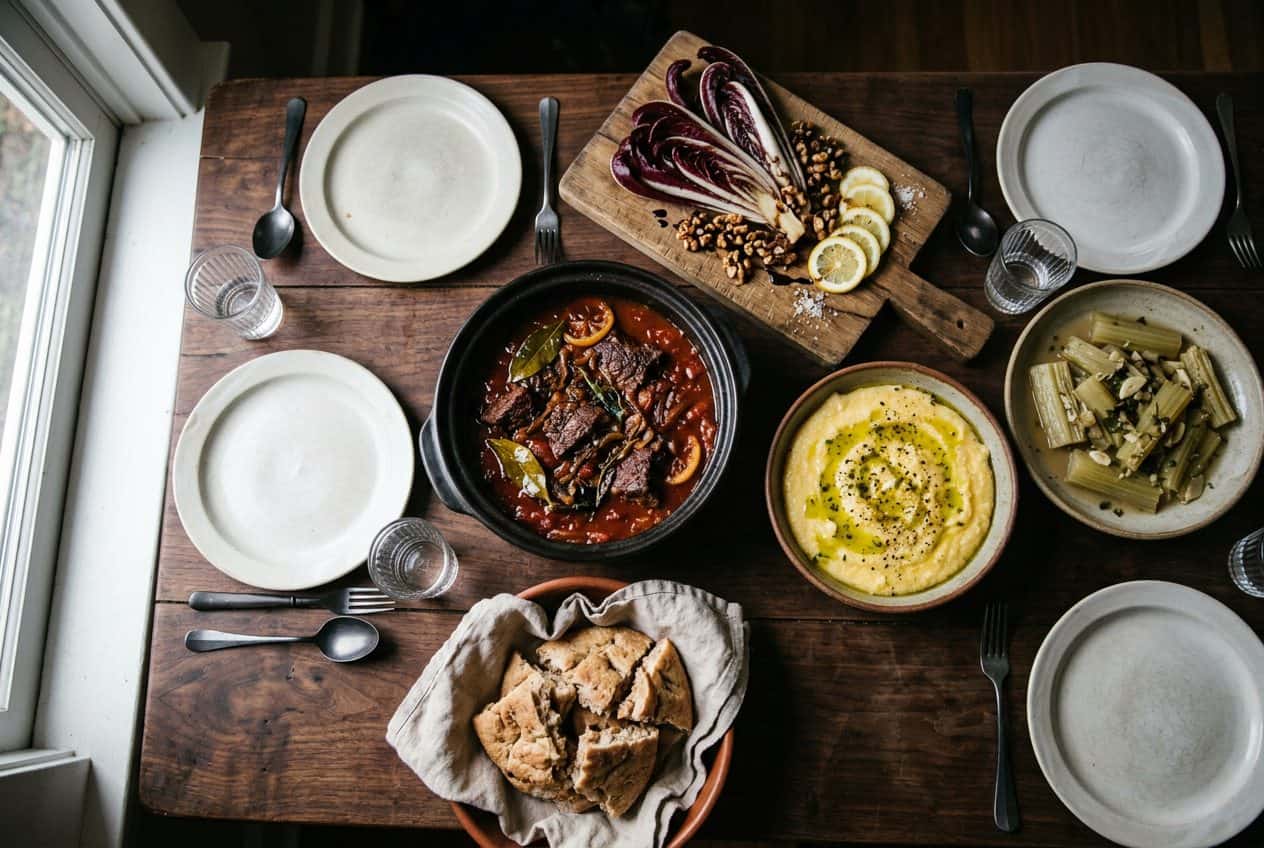
Welcome, standing, with Serra Calda poured from the urn at the door, Cedro Aperitivo and Foglia Verde at the bar, and the salt cod fingers grilled and passed among the trees. The table sits to Late Radicchio and Cedro, already plated cold on boards. The wet polenta follows as the second course, straight from its dedicated burner. Then the braised beef, reheated from the day before, with the cardoons alongside and chestnut flatbread torn and passed in cloth. The lemon and olive oil cake comes out warm once the shutters open and the room starts to recover its heat. Hot broth with lemon leaf is passed around at the first door as the room empties back into February.
Quantities for fifty
- Welcome drink: about 7–8 bottles of white wine for Serra Calda (roughly 2.5 times the base recipe), warmed in two pots and held in two urns rather than one, per the recipe’s own scaling note.
- Arrival food: salt cod and polenta fingers scaled up from the forty-guest base by about a quarter — roughly 1 lb 5 oz dried salt cod and a correspondingly larger polenta tray, cut into about fifty fingers.
- Bar: a 4–5 bottle batch of Cedro Aperitivo (roughly four times the 12-glass formula) alongside an equal-looking batch of Foglia Verde, both bottled cold ahead of time.
- First course: roughly nine heads of tardivo radicchio and three whole cedro for Late Radicchio and Cedro, assembled on boards close to the table sitting.
- Second course: about 5½ lb dry polenta for Wet Polenta, cooked in three pots rather than one very large one, on its own dedicated burner.
- Main: about 27½ lb of beef shin or cheek for Braised Beef Under Lemon Leaf, cooked across two or three pots two days ahead.
- Side: about 16½ lb of cardoons for Braised Cardoons with Anchovy, blanched together in one large pot, braised in batches.
- Bread: roughly sixty sheets of Chestnut Flatbread (six times the base recipe), baked in relays through the morning, well before the table sits.
- Dessert: two and a half trays of Lemon and Olive Oil Cake for fifty servings, with 2¾ lb cold sour cream alongside.
- Departure: about 6 quarts of Hot Broth with Lemon Leaf, roughly one small cup each with margin for guests who linger at the door.
The source menu is explicit about the edges of this range: under twenty guests, run one pot of the braise and drop the cardoons entirely rather than cooking a token half-batch of a dish that needs real volume to be worth the labor. Over a hundred, move to three pots, three service passes and three separate teams, offsetting each pass by ten minutes rather than trying to serve the whole room from one enormous braise and one dedicated polenta burner — both genuinely run out of capacity well before a hundred guests.
What holds, and what collapses
- Holds well: the braised beef, better on day two and holding hot for a genuine 3 hours; the wet polenta, the best-holding dish on the whole menu at 2 hours at 167°F; the cardoons, 4 hours warm.
- Collapses fast: hot food generally in this room, which the operational read is explicit about — anything hot loses meaningful heat within about 90 seconds standing in a room that sits at 50–54°F, so timing the pass from kitchen to hand matters more here than in a warmer venue; the radicchio and cedro, dressed and served within 15–20 minutes; the lemon and olive oil cake, warm for about an hour before the specific warm-cake-cold-cream contrast is lost.
- Needs a dedicated resource, not just a clock: the polenta, which needs its own burner for the better part of ninety minutes and cannot share attention with anything else cooking that morning; the departure broth, which must be genuinely scalding at the door, not merely warm from an urn.
The shopping order
- The bar’s shelf-stable goods, up to two weeks out: grappa or gin, dry white vermouth, dried polenta, anchovy fillets, chestnut flour, dried spices.
- The salt cod, a full week out, so the three-day soak has real margin before it’s needed.
- The beef, four to five days out, ordered by weight from a butcher rather than hoped for on a shopping trip.
- Dairy and eggs for the cake, two to three days out.
- Cedro, lemons and lemon leaves — ideally from the limonaia’s own trees if the venue is genuinely a working citrus house, otherwise ordered specially, since cedro in particular is not a casual supermarket find in most places. Order these early even though they’re used close to service, simply because sourcing them can take longer than the ingredient itself needs to stay fresh.
- Cardoons, radicchio and walnuts, two to three days out.
- Wine for the table and for Serra Calda, whenever convenient, since none of it needs to be fresh in the way the produce does.
Dietary substitutions, named
For a vegetarian or vegan main, cook a braise of borlotti beans and winter squash in its own pot, with the same lemon leaf, the same wine and the same lid as Braised Beef Under Lemon Leaf — the point is that the vegetable braise follows the identical method and timeline as the meat, not a separately improvised dish cooked to a different schedule. For gluten-free guests, a chestnut-and-rice flour flatbread, rolled and baked the same way as the wheat version, keeps the same texture and service. For a fish-free table, the anchovy comes out of the cardoons and the salt cod comes off the menu entirely — substitute a white bean purée with oil, served on the same grilled polenta fingers used for the arrival course, which keeps the format even where the specific ingredient can’t carry over. For a nut allergy, simply omit the walnuts from Late Radicchio and Cedro and add a little more cedro in their place rather than substituting a different nut or seed — the dish loses nothing structural without them.
The two dishes that are the workload
The menu concept already names them for exactly this reason: the polenta and the flatbread, and both fail for the same underlying reason as each other — neither can be rushed, and both compete for scarce kitchen resources with everything else that morning. The polenta needs a dedicated burner and roughly ninety minutes of someone’s real, continuous attention; put that person on nothing else for that stretch, because a polenta stirred intermittently between other jobs comes out lumpy and undercooked in a way no amount of oil at the end can fix. This is the one place on the menu I would spend an entire person, and I would spend them cheerfully.
The flatbread is the smaller job in raw time but the tighter one on oven space: sixty sheets, each needing its own six to eight minutes on a hot tray or stone, in a glasshouse kitchen that likely has one working oven rather than a bank of them. The only real fix is time, not more hands — start baking well before the welcome service begins, hold the finished sheets wrapped in cloth, and treat the flatbread as a morning job finished hours before doors, not a last-hour scramble competing with the cake and the polenta for the same oven. Bread and cake are not my lane — my husband is the baker in this house — so take the flatbread method from its own recipe; what I can tell you is that sixty sheets and one oven is a scheduling problem, and scheduling I can do.
The recipes
Every dish and drink below has its full recipe on Salty & Clever, with quantities, method, make-ahead windows and holding times. The reasoning behind the whole evening — why a citrus house kept warm through winter shapes a menu this way — is in the menu concept on Tangled Thistle and the underlying Occasion Study.
- Serra Calda (welcome drink)
- Whipped Salt Cod on Grilled Polenta Fingers
- Cedro Aperitivo (signature cocktail)
- Foglia Verde (zero-proof)
- Late Radicchio and Cedro
- Wet Polenta with Garda Oil
- Braised Beef Under Lemon Leaf
- Braised Cardoons with Anchovy
- Chestnut Flatbread
- Lemon and Olive Oil Cake
- Hot Broth with Lemon Leaf
None of this makes a February dinner in a heated glasshouse a simple thing to run. What it does is make the two genuinely hard jobs — a burner that can’t be shared and an oven that can’t go faster — the only two things left to actually worry about, in a kitchen where the beef was braised two days ago, the cod has been soaking since last week, and everything else on the table is exactly as ready as it looks.
Part of Kitchen Systems.
Where this goes next

