Halving a Recipe Changes Four Things and Only One of Them Is the Amount
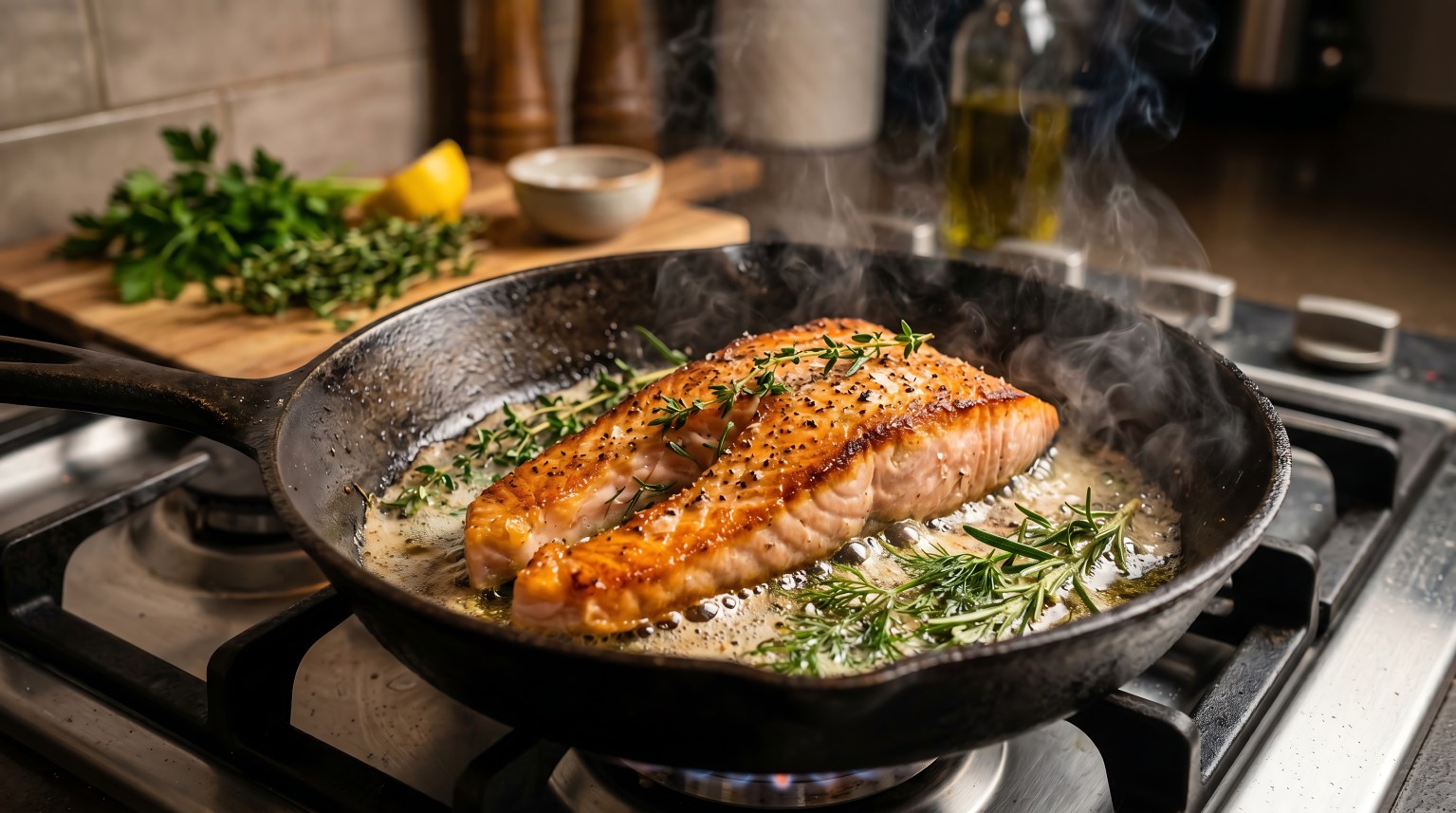
Halve every number on the list, use the same pan, follow the same method, and the dish arrives wrong in a way that is hard to name. Tighter, or drier, or oddly flat, and finished several minutes before it should have been.
That is the complaint underneath almost everything said about cooking for two: recipes are written for four and the arithmetic does not carry. The arithmetic carries perfectly, for exactly one of the things in the recipe. The quantities halve. Nothing else in the pan does.
The pan did not get smaller
This is the largest of the four, and it explains most of the others.
Liquid loses water from its surface, and the surface is set by the pan rather than by the volume. Put half as much braising liquid in the same casserole and the exposed area barely changes, so the pot evaporates at close to the same rate from a pool half as deep. What was a gentle reduction over ninety minutes is a dry pan at fifty, with the meat above the waterline and the sauce turned to paste.
The same applies to a soup, a pot of grains, a sauce left to tighten, anything simmering uncovered.
There are three fixes and the first is the real one. Use a smaller vessel, so the surface shrinks with the volume. Failing that, put a lid on, or leave it ajar, and accept less concentration. Failing that, start with less liquid than the halved figure and add more if it needs it, which is the only direction that is recoverable.
Half a load in the same pot also comes up to temperature noticeably faster, because the burner has not changed and there is less mass to heat. So the moment of inattention that was harmless at full scale now arrives before you are back in the room.
Browning gets better and scorching arrives early
Half the food in the same pan is a less crowded pan, and that part is a gift. The water has an easier time leaving, the surface temperature stays higher, and a half batch frequently browns better than the full one ever did.
What comes with it is that the fat is now spread thin over the same metal, and there is less food releasing moisture to keep the fond from going past brown. A halved saute reaches the point of deglazing sooner and passes it sooner, and black fond does not dissolve into anything you want to eat.
So watch the pan rather than the clock, and deglaze at mahogany rather than at the step number where the recipe says to.
Black fond is not a stage on the way to anything. Deglaze it and the sauce is bitter, and no amount of butter stirred in at the end takes that back out. The half batch that browned beautifully is the same half batch that burns four minutes later. Same pan, same cause, and only the timing between them.
Time is a function of thickness, not of mass
Half a braise is not half the braise. Collagen turns to gelatin as a function of temperature held over duration, so two pounds of shin in a pot need the same three hours that four pounds needed, cut into the same size pieces. The clock is set by the conversion, not by the quantity.
Same for a roast, a chop, a fillet, a potato. Cooking time scales with thickness, and halving a recipe usually does not make anything thinner. It makes there be fewer of them.
What genuinely does shorten is the come-up: the time for the pot to reach a simmer, the time for the oven to recover after the door opens, the time for a half tray of vegetables to get hot. Which is why a halved recipe often feels early and then is not done, and why the temptation is to call it at the point where it looks right.
Seasoning halves only if you were weighing it
Salt is measured as a percentage of what it is seasoning, which means it is the one ingredient that scales cleanly in both directions and the one people most often get wrong when they scale down.
Half a teaspoon is fine if the original teaspoon was correct. The problem is the instruction to salt to taste, applied to a smaller volume, where every pinch is a larger fraction of the whole and the pot is far less forgiving of the one that goes in without thinking. Working from a percentage removes that entirely, and it is the same discipline that makes a pot of pasta water land correctly.
Acid and sugar behave the same way. Everything assertive is easier to overshoot in a small pot, so it goes in later and in smaller increments than the recipe implies.
A small pot cannot be talked round. Four portions of soup will absorb a heavy hand with the vinegar and quietly forgive it; two portions will not, and there is nothing left to dilute it with that does not also dilute the dish. Under-season and it gets fixed at the table. Overshoot and the only repair is cooking more of the thing you were trying not to cook.
Some ingredients do not have halves
One egg, one onion, one can of tomatoes, one packet of yeast, one chicken. These are the things that make a halved recipe feel like a negotiation.
The egg is the one that actually matters, because it is usually doing structural work and the amount is not decorative. Beat it and weigh out half, which takes ten seconds and is exact. If the egg is there for richness rather than structure, a yolk alone is closer than half a whole egg. If it is there for lift, do not halve the recipe at all.
The negotiation itself is the signal. Once a recipe has you deciding what half an onion, half a can and half an egg are worth, it is telling you that the scale was part of the design rather than a detail on top of it. Two-thirds is not a compromise in that situation. It is usually the number the dish was after.
A can of tomatoes is easier: use the whole can and scale everything else to it, which is scaling to two-thirds or three-quarters rather than a half, and which is very often the better answer anyway. A batch for two and a lunch is more useful than a batch for exactly two.
Baking does not halve. It re-pans.
Batter depth governs bake time, the ratio of crust to crumb, and whether the center sets before the edges dry out. Pour half a cake batter into the same tin and you get a thin, dry disc that is done long before the timer and tastes of nothing but edge.
The scaling that works is by pan area rather than by volume. A nine-inch round is about sixty-four square inches, an eight-inch is about fifty, and a six-inch is about twenty-eight. So half of a nine-inch recipe goes into a six-inch tin, a little snugly, at close to the original time. Two-thirds of it goes into an eight-inch tin comfortably.
Loaf tins and square tins scale the same way, on area. And the leavening, the liquid and the flour all have to move together, which is why a cake that sinks is so often a cake that somebody scaled by eye.
The aromatic base does not want to be halved
Half an onion, half a spoon of oil and one clove of garlic spread across a wide pan is a layer too thin to sweat. It dries and browns instead of softening, and the sweetness that a base is supposed to contribute never arrives.
The practical answer is to keep the aromatics at close to full strength and halve everything else. An onion cooked properly is not a quantity of onion, it is a flavor, and a small pot with a full base tastes like the dish rather than like a diminished version of it.
Herbs, spices and anything aromatic follow the same logic in reverse: they are volatile, a small pot loses them at the same rate, so they go in nearer the end.
Which of the three ways out to take
Cook the full recipe and split it before it becomes a dish, which is the component approach and the only one that costs nothing. A braise divided at the pot and finished twice is two dinners. Cooking for two without eating the same thing four nights is mostly this, done deliberately.
Or scale to two-thirds rather than a half, in a pan one size down. Two-thirds keeps the aromatic base workable, uses the whole can, tolerates one egg, and produces a lunch.
Or choose dishes whose geometry survives the reduction: anything cooked in a single pan to order, anything where the sauce is built around the food rather than reduced from a pool, grains and beans cooked in quantity and dressed by the portion. A small pan, a small tray and a small pot solve more of this than any adjustment to the numbers.
Scaling up breaks in its own way, and it breaks along different seams — heat transfer, tray space, the time a large mass takes to come up. Down is the harder direction, because the pan is a floor you cannot go below. A recipe for four, halved, is not a recipe for two. A recipe for two is a different recipe, and most of the difference is smaller equipment.
Part of Recipes & Technique.


